
 Search Articles


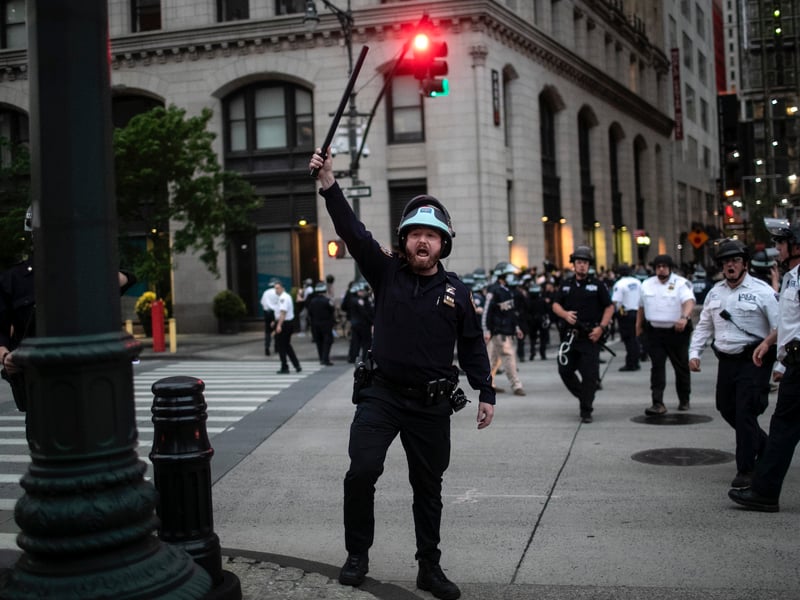
ALBANY (CN) — New York’s top court on Thursday ruled that transparency reforms arising from the George Floyd protests, requiring police departments to disclose open and unsubstantiated disciplinary records, can be retroactively applied to officers’ misconduct records prior to the June 2020 repeal of a provision that kept such records secret.
The unanimous ruling from the seven-judge New York Court of Appeals affirmed two lower court rulings that an amendment to the state’s Freedom of Information Law applies retroactively to police disciplinary records that existed prior to repeal of their exemption under FOIL in a case brought by the New York Post.
“The amendments impose various redaction requirements and personal privacy protections for law enforcement disciplinary records specifically, yet they do not, for example, single out records created before a certain date for special treatment, or direct that disclosure of any record is tethered to the date it was created,” Associate Judge Caitlin J. Halligan wrote, echoing her line of inquiry during oral arguments in January on whether or not the retroactive confidentiality of officers’ records was a vested right.
“Had the Legislature intended to deviate from FOIL’s presumption that information kept or held by an agency is disclosable by exempting records created prior to the repeal, or to mandate that an agency responding to a FOIL request ascertain and apply the law that governed when each responsive record was created, then surely it would have said as much,” she wrote for the court.
Such officer disciplinary records were previously shielded from public disclosure by the state civil rights law section 50-a, until the state repealed it in June 2020, as part of set of major accountability reforms responding to widespread local and national civil rights protests sparked by the killing of George Floyd by a Minneapolis police officer.
Shortly after 50-a — which previously required the concealment of disciplinary records of police officers, firefighters and prison officers from the public — was officially struck down, then-Mayor Bill de Blasio ordered a massive database of disciplinary records on NYPD police officers to be published online through the NYPD’s independent oversight agency, the Civilian Complaint Review Board (CCRB).
Upon the repeal of the secrecy provision, New York Post reporter Craig McCarthy quickly filed 144 separate Freedom of Information Law requests with the New York City Police Department, requesting disciplinary records of high-ranking or otherwise notable officers.
After the NYPD ignored McCarthy’s disclosure requests for a year, the New York Post’s parent company hired the law firm Davis Wright Tremaine to litigate production of the NYPD records. The Police Benevolent Association — the state’s largest police union — then joined as an intervenor, arguing that records from 1976 to June 2020 should remain sealed because the repeal of Section 50-a lacked retroactive application.
The Post prevailed in New York State Supreme Court, where a judge granted the petition to compel disclosure under Article 78 of New York’s Civil Practice Law and Rules. The court found “the NYPD failed to sufficiently justify its claim that the requested documents are so burdensome as to constitute a basis to deny petitioners’ FOIL requests.”
A mid-level state appeals court, the Appellate Division, First Department, subsequently affirmed the lower court’s ruling in favor of the newspaper’s request for production of old records that predate the June 2020 repeal date.
The union then brought an appeal to the state’s highest court, the Court of Appeals, arguing in an appeals brief that appellate ruling had departed from precedent “by writing retroactivity into the repeal of 50-a where the Legislature was silent.”
PBA President Patrick Hendry denounced the ruling for not imposing “even modest limits on the weaponization of police personnel records that were legally protected for decades.”
“It is appalling that the court has put their activist ideology ahead of the facts, the law and the safety of police officers and our families," he wrote in a statement Thursday afternoon. “The precedent set by this decision should be concerning to every New Yorker who could see their confidential information suddenly dumped into public view if the political tide turns against them.”
In a separate ruling Thursday, the Court of Appeals similarly affirmed that the Rochester Police Department must publicly disclose all records related to police discipline and misconduct allegations, regardless of whether the department “substantiated” the complaint or imposed discipline, following the 2020 repeal of 50-a.
“It is evident from the text and history of the 2020 amendments that their purpose was to bring greater transparency to the law enforcement disciplinary process, including how complaints of officer misconduct are handled,” Associate Judge Anthony Cannataro wrote in the unanimous opinion.
“To effectuate that objective, the Legislature added to FOIL a definition of ‘[l]aw enforcement disciplinary records’ that expressly encompasses ‘complaints’ levied against officers ‘in furtherance of a law enforcement disciplinary proceeding’. The definition imposes no limitation based on the outcome or disposition of such proceeding.”
The New York Civil Liberties Union heralded the Rochester ruling as a “landmark decision” and “a huge win for transparency.”
“It puts all police departments across our state on notice that they cannot ignore or rewrite the law — which is crystal clear in requiring them to show the public their misconduct records,” NYCLU assistant legal director Bobby Hodgson said in a statement. “Rochester argued the police must be trusted to police themselves in secrecy, but that’s not how accountability works, and this decision confirms that it’s not how the law works either.”
 Follow @jruss_jruss
Subscribe to our free newsletters
Our weekly newsletter Closing Arguments offers the latest about ongoing trials, major litigation and rulings in courthouses around the U.S. and the world, while the monthly Under the Lights dishes the legal dirt from Hollywood, sports, Big Tech and the arts.