
 Search Articles


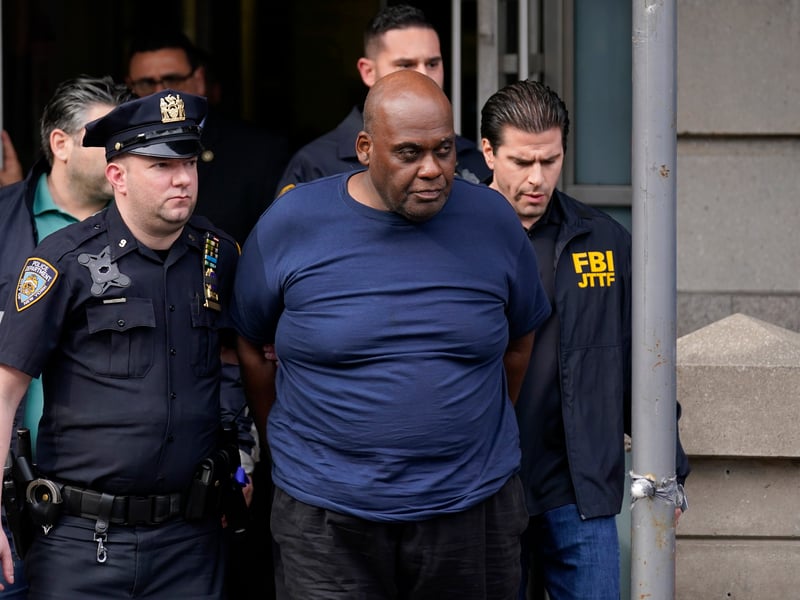
MANHATTAN (CN) — A year after he was sentenced to life in prison for shooting up a New York subway, Frank Robert James told a Second Circuit panel Tuesday that his sentence was unreasonably harsh.
James, who is a diagnosed paranoid schizophrenic, fired more than 30 shots on a Manhattan-bound N train in April 2022 as it pulled into the Sunset Park station in Brooklyn. About two dozen people were hospitalized as a result, including 10 who suffered gunshot wounds and others who were injured because of smoke inhalation and panic. No one died in the attack.
After pleading guilty to all 10 counts of terrorism — one for each gunshot victim — and a single count of discharging a firearm during a violent crime, James was sentenced to life in prison for all 10 counts and an additional 10 years consecutively after a federal judge found he falsely stated that he did not intend to kill anyone on the train. James had acknowledged in his plea that he was “fully aware of the fact that a death or deaths could occur as a result of discharging a firearm in such an enclosed space in the subway care.”
On the day of the shooting, James wore a yellow hard hat and orange reflective jacket that made him look like a construction or Metropolitan Authority worker. Prior to opening fire, prosecutors say he corralled the train passengers to the opposite side of the train car and set off a smoke grenade so he could have a clearer line of fire.
According to prosecutors, James fired a semiautomatic Glock 17 pistol with an extended magazine at his victims. Because of the magazine, the gun was able to fire bullets in rapid succession without taking time to reload.
After reviewing the government’s evidence that detailed James’ “choice of weaponry, the time, the place and the manner in which he executed the attack,” U.S. District Judge William Kuntz concluded the evidence displayed James’ intent to kill the subway passengers.
But James told a Second Circuit panel Tuesday that his sentence was unreasonably harsh, and argued that Judge Kuntz failed to consider his mental illness when finding that he committed perjury during his plea hearing.
“The guilty plea was months after the crime and Mr. James has a lifelong history of serious mental illness,” Darrell Fields, an assistant federal public defender representing James, told the panel.
But the Second Circuit panel didn’t seem convinced, pointing out that James had the mental capacity to intend to injure people but is now arguing that he lacked the mental capacity to state his intent.
“You’re saying his mental illness did not stop him from having the mental capacity to want to put all these people in the hospital under a hail of bullets,” U.S. Circuit Judge William J. Nardini, a Donald Trump appointee, said. “But he did lack the mental capacity to remember what his mental state was.”
Despite the panel’s urging Fields to answer directly, he repeatedly dodged their questions.
“The question is, ‘What did he believe?’ It’s subjective,” Fields said.
But the government says James purposely lied to try and get a lighter sentence.
“The record showed that James had a carefully calculated strategy to get a lower sentence,” Sara K. Winik, an assistant U.S. attorney for the Eastern District of New York, said Tuesday. “The defendant’s carefully worded allocution pled to the baseline, bare essential elements of the statute and then he affirmatively lied.”
Winik added that James could have just admitted to the “bare elements” of the accusations leveled against him, but he intentionally chose to say he never intended to kill anyone.
“He chose to affirmatively lie to the court about something he believed would make his sentence lower,” Winik said.
U.S. Circuit Judge Richard J. Sullivan, also a Trump appointee, and U.S. Circuit Judge Alison J. Nathan, a Joe Biden appointee, rounded out the panel. They did not indicate when they would rule.
 Follow @NikaSchoonover
Subscribe to our free newsletters
Our weekly newsletter Closing Arguments offers the latest about ongoing trials, major litigation and rulings in courthouses around the U.S. and the world, while the monthly Under the Lights dishes the legal dirt from Hollywood, sports, Big Tech and the arts.