
 Search Articles


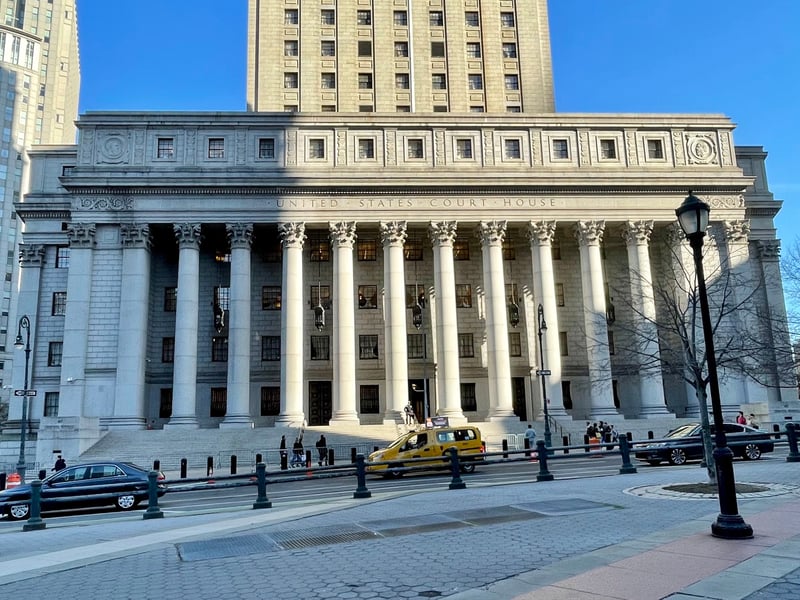
MANHATTAN (CN) — Prison officials failed to give a man who’d spent 14 years in solitary confinement a “meaningful review” of his detention conditions as they kept him in administrative segregation for another five years, the Second Circuit said in a split ruling Friday.
From 2000 to 2014, Tyrone Walker was in solitary confinement as punishment for an attack on corrections officers. When the term ended in 2014, he was immediately placed in a nearly identical form of imprisonment, having been deemed a threat to safety at the prison — despite his lack of involvement in any violent incident since the 2000 attack.
When that switch happened, according to the federal appeals court, due process requirements afforded Walker a more thorough analysis of his disposition.
The court took no view as to whether Walker, now 56 and serving a life prison sentence following his 1994 conviction on two murders and an armed robbery, should have been moved into the general population during the five-year period of administrative segregation.
“But Walker was entitled to meaningful process assessing that question,” U.S. Circuit Judge Susan Carney wrote in the majority opinion, and “a reasonable jury assessing the record could find that the reviews that his continued solitary confinement received were not constitutionally meaningful.”
Carney, a Barack Obama appointee, acknowledged the brutality of solitary confinement in the opinion. Research shows that isolation has deep, long-lasting effects on the brain’s chemistry and function, and can even cause permanent neurological damage. People incarcerated in isolation have high rates of suicide and self-mutilation, and the lack of the ability to move freely deteriorates the body.
“The physical and psychological hardship faced by individuals in solitary confinement has regularly been recognized by the courts and by international bodies,” Carney writes. “In view of these documented extreme effects, courts have regularly held that the due process clause protects incarcerated individuals against the unjustified use of solitary confinement — particularly when its stated purpose is prevention, not punishment.”
In keeping with due process, prison officials must conduct a periodic review to determine whether someone in administrative solitary confinement remains a security risk.
“Those reviews must be ‘meaningful’ — that is, their results must not be pre-ordained; in each, prison officials must actually attempt to assess and then consider the individual’s current threat level and any changes in their behavior,” Carney writes.
Beginning in 2014, New York State Department of Corrections and Community Supervision officials completed 46 such reviews, sometimes repeating the violent assaults Walker committed in 1993 and 2000 and various nonviolent rule infractions — his only misbehavior report in five years of administrative segregation was for swearing at a guard who’d directed Walker to end a phone call with his daughter — before concluding that Walker still posed a safety and security risk.
“Those may have been reasonable determinations; we owe them considerable deference,” Carney writes. But the relevant question is not whether the conclusions were reasonable but rather whether the process to get there was constitutionally meaningful.
Carney and U.S. Circuit Judge Beth Robinson, a Joe Biden appointee, found that they were not.
U.S. Circuit Judge Steven Menashi, a Donald Trump appointee, disagreed.
“Far from suggesting a lack of meaningful consideration, it is difficult to imagine a more reasonable assessment,” Menashi wrote in his dissent. “Given Walker’s history of violence, most observers would find those conclusions unsurprising.”
Menashi, too, went back to Walker’s attack 25 years ago at Green Haven Correctional Facility to explain his reasoning, detailing that Walker had stabbed a prison guard six times and then attacked another guard who intervened.
The dissenting judge took issue with the majority’s sympathy for Walker’s complaints that he wasn’t given any direction as to how he could earn trust and work to demonstrate that he wasn’t a threat.
“[T]oday’s opinion effectively establishes a new rule of constitutional law that prison officials must not only meaningfully review an inmate’s continued administrative segregation but also provide the inmate an opportunity to demonstrate a degree of changed behavior that would overcome the officials’ concern about past conduct,” Menashi writes. “But the due process clause does not require prison officials to provide relaxed conditions of incarceration that would allow an inmate — at the risk of other inmates and staff — to ‘demonstrate his improved behavior [in order] to be released from administrative segregation.’”
The case is remanded to the Northern District of New York for further proceedings in line with the circuit’s ruling.
An attorney for Walker did not return a request for comment Friday.
 Follow @NinaPullano
Subscribe to our free newsletters
Our weekly newsletter Closing Arguments offers the latest about ongoing trials, major litigation and rulings in courthouses around the U.S. and the world, while the monthly Under the Lights dishes the legal dirt from Hollywood, sports, Big Tech and the arts.