
 Search Articles


MANHATTAN (CN) — The Trump administration gave New York officials until mid-March to put a stop to Manhattan’s congestion pricing program, according to a leaked letter from the U.S. Department of Transportation.
“In order to provide NYSDOT and its project sponsors time to terminate operations of this pilot project in an orderly manner, this rescission of approval and termination of the Nov. 21, 2024 agreement will be effective on March 21, 2025,” Federal Highway Administration Executive Director Gloria Shepherd wrote in a Feb. 20 letter made public on Wednesday.
Last week, U.S. Transportation Secretary Sean Duffy ordered New York to close the toll, which he called a “slap in the face to working class Americans and small business owners.” But Shepherd’s letter is the first indication of a hard deadline from the federal government to ice the first-in-the-nation program.
New York officials are adamant, however, that the toll will remain in effect unless a court orders them to shut it down.
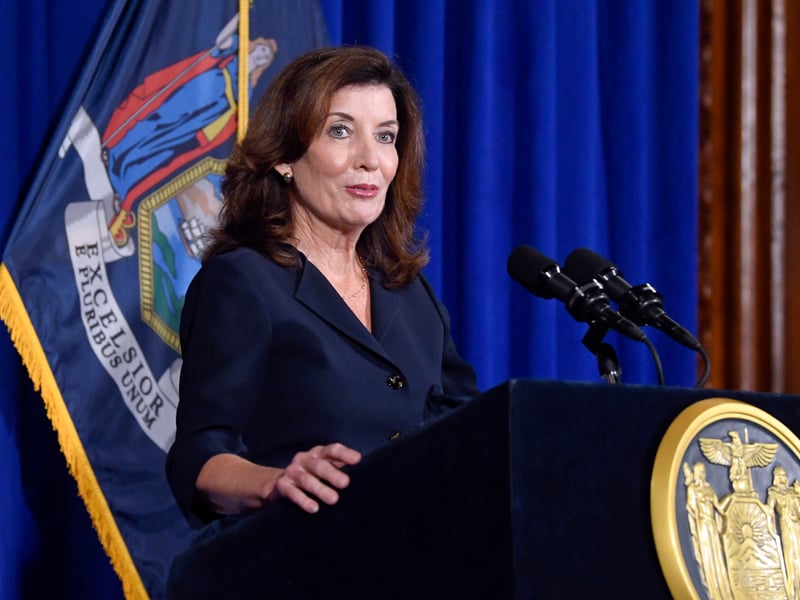
“Secretary Duffy can send as many letters as he’d like, but the cameras are staying on. The MTA has already filed a lawsuit and we expect to be victorious,” Avi Small, a spokesperson for New York Governor Kathy Hochul, said in a statement to Courthouse News on Wednesday.
“Our position is clear: This is not a lawful order. We have already filed a lawsuit and now it’s up to the courts to decide,” John J. McCarthy, the MTA’s Chief of Policy and External Relations, told Courthouse News.
The MTA indeed sued Duffy, Shepherd and the U.S. Department of Transportation promptly after Duffy’s announcement last week that he wants the toll axed. In its complaint, the MTA accused Duffy and the Trump administration of running “contrary to its purported respect for federalism,” since the program was approved at a state level.
President Donald Trump has been a vehement opponent of the toll, which is slated to raise $1 billion per year to fund the MTA’s aging infrastructure by charging passenger vehicles $9 daily to enter Manhattan’s central business district. The program also sets out to reduce traffic and pollution in the busiest part of the city. Early data shows that, thus far, it has succeeded in doing so.
Still, Trump celebrated last week’s announcement by posting on social media: “CONGESTION PRICING IS DEAD. Manhattan, and all of New York, is SAVED. LONG LIVE THE KING.”
For her part, Hochul has tried to get Trump to change his tune on the polarizing pilot program. She even made a visit to the White House, where she presented the president with data that showed the toll to be working.
While those efforts were unsuccessful, she foresees congestion pricing sticking around thanks to the MTA’s lawsuit.
“I feel very confident that we will be victorious in the courts because you all did your work,” the governor told MTA board members during a meeting Wednesday. “We’re ready to take on any challenge that comes our way.”
Leading the MTA’s federal court battle is a high-profile legal team that includes attorney Roberta Kaplan, who represented writer E. Jean Carroll to win a pair of defamation suits against Trump worth more than $88 million in total.
U.S. District Judge Lewis Liman is overseeing the case. The Trump appointee has been assigned to several big-name cases as of late, including a collection action against former New York City Mayor Rudy Giuliani and a defamation dispute between Hollywood A-listers Blake Lively and Justin Baldoni.
Should Liman side with the Trump administration, it would blow a multibillion-dollar hole in the MTA’s capital plan. Such a setback could hamper the rollout of new safety features, accessibility updates and other projects the MTA hopes to tackle with the revenue.
Congestion pricing has been a controversial subject in the U.S. ever since then-Governor Andrew Cuomo signed it into law for New York City in 2019. But comparable programs have existed in cities like London for over a decade.
The program remains contentious statewide, but a February poll from Partnership for New York City shows that those who pay the toll most often are actually in favor of keeping it. About 75% of respondents who regularly commute into the central business district said they’ve experienced less traffic and faster commutes in and out of the city since the toll started in January.
 Follow @Uebey
 Follow @uebey.bsky.social
Subscribe to our free newsletters
Our weekly newsletter Closing Arguments offers the latest about ongoing trials, major litigation and rulings in courthouses around the U.S. and the world, while the monthly Under the Lights dishes the legal dirt from Hollywood, sports, Big Tech and the arts.