
 Search Articles


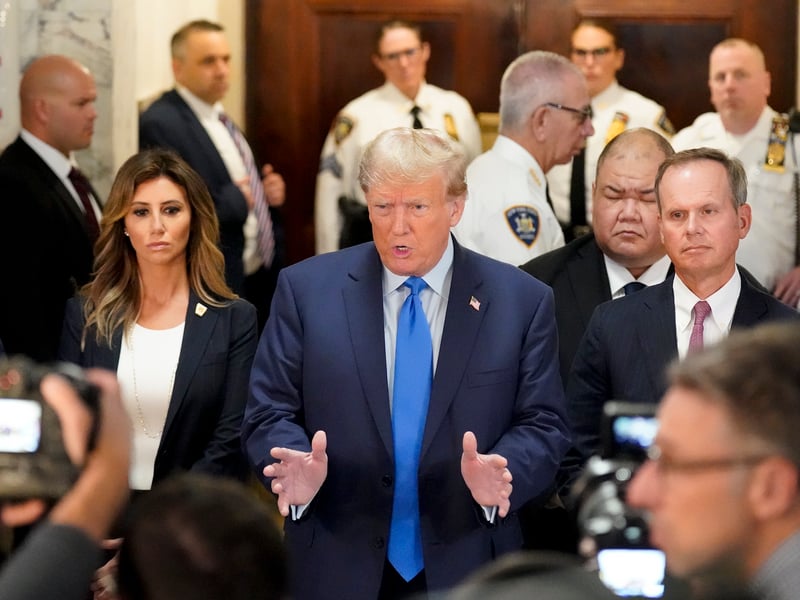
MANHATTAN (CN) — A New York appellate court on Thursday heard arguments from Donald Trump’s attorneys in his bid to toss the hefty civil fraud judgment that could cost the former president roughly half a billion dollars.
The judgment came down in February from New York Supreme Court Justice Arthur Engoron, who ruled that Trump fraudulently inflated his assets and net worth on annual financial documents for over a decade. Trump then used those documents to secure loans, the judge ruled, shorting lenders out of millions of dollars in lost interest.
Engoron ordered Trump to pay about $355 million in penalties, a sum that has since ballooned up to nearly $500 million with interest. The judge also found Eric Trump, Donald Trump Jr. and Trump Organization executives Allen Weisselberg and Jeff McConney liable for assisting in the scheme.
On Thursday, Trump’s attorney John Sauer argued to the appellate panel that Engoron’s ruling greenlights New York Attorney General Letitia James to pursue virtually anyone she wishes under New York Executive Law § 63(12) — the fraud statute that was the foundation of the case.
He doubled down on arguments Trump’s team made during the trial, including that James’ accusations are barred under the law’s statute of limitations, that Trump didn’t intentionally defraud anyone with his statements of financial condition and that the documents included “clear disclaimers” for the lenders to do their own due diligence.
“You’re allowed to do this,” Sauer said. “You’re allowed to make optimistic projections. You’re allowed to reject appraisals.”
Sauer added that trial testimony showed that lenders indeed performed their own due diligence when conducting business with Trump. He claimed there was no proof that the banks wouldn’t have offered Trump the same loan terms if his net worth had been marginally lower, citing testimony from Trump’s expert witnesses.
Thursday’s panel featured five appellate justices: Presiding Justice Dianne Renwick and Associate Justices John Higgitt, Peter Moulton, David Friedman and Llinét Rosado. Trump’s team and the state got 15 minutes each to make their case.
Arguing on behalf of the attorney general was Deputy Solicitor General Judith Vale, who was met with some friction by the five-judge panel Thursday. Friedman seemed particularly skeptical to uphold Engoron’s ruling, interrupting just seconds into Vale’s argument to question the public’s interest in the case.
“There is absolutely a public impact,” Vale said. “When risks are injected into the market … it also harms other participants in the market as a whole.”
Some pushback from Friedman wasn’t unexpected, however — he’s the same judge who gave Trump a break when he temporarily lifted Trump’s gag order during the civil fraud trial, finding that it violated the former president’s First Amendment rights. The order was later reinstated.
Still, Trump likely faces an uphill battle to overturn the massive judgment, which Vale argued Thursday was a result of Trump’s widespread fraud and deception.
“Although this is a large number, it is a large number for a lot of reasons,” Vale said. “Number one is because it was a lot of fraud.”
Vale also looked to debunk the repeated argument from Trump’s team that the state’s claims were barred under the statute of limitations. Just because some of the scrutinized financial statements dated back more than a decade doesn’t mean the practice as a whole couldn’t be called into question, Vale argued.
“Every time someone issues a false financial statement, that is a crime,” she said.
The appellate panel didn’t immediately issue a ruling on Thursday. Trump did not attend the arguments.
Engoron’s bombshell ruling came after a roughly 10-week bench trial that heard testimony from Trump’s adult children, his ex-lawyer Michael Cohen and Trump himself.
Trump immediately signaled his intent to appeal the judgment back in February, and formally filed to do so 10 days after Engoron’s ruling came down. At the time, his team claimed that the state court “abused its discretion, and/or acted in excess of its jurisdiction,” calling the verdict “egregious.”
The civil fraud judgment is one of several legal thorns in Trump’s side as he mounts his 2024 presidential campaign. Earlier this year, a Manhattan jury found Trump guilty on 34 counts of falsifying business records, making him the first president in U.S. history to be convicted of a crime.
 Follow @Uebey
 Follow @uebey.bsky.social
Subscribe to our free newsletters
Our weekly newsletter Closing Arguments offers the latest about ongoing trials, major litigation and rulings in courthouses around the U.S. and the world, while the monthly Under the Lights dishes the legal dirt from Hollywood, sports, Big Tech and the arts.