
 Search Articles


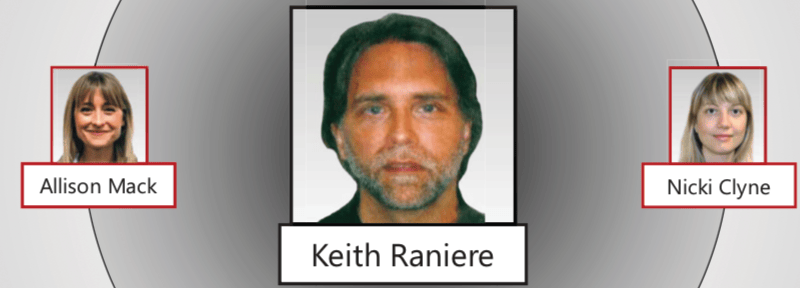
MANHATTAN (CN) — Imprisoned sex cult leader Keith Raniere urged a federal appeals panel on Tuesday to revive his bid for a new trial on the grounds that the claims federal investigators manufactured evidence of child pornography and planted it on a computer hard drive to link him to child pornography and sexual exploitation RICO predicate acts.
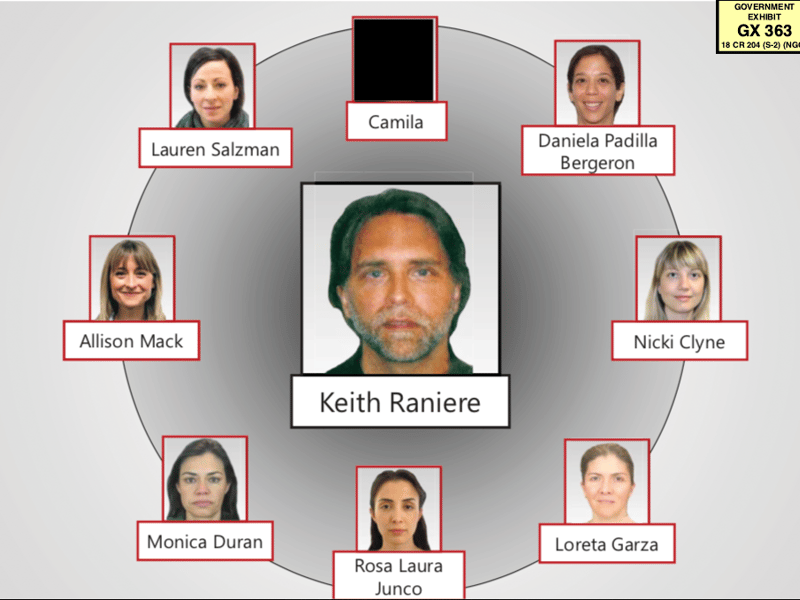
Raniere, 65, founded NXIVM as a purported self-help group in the 1990s and was accused at trial of later creating a secretive inner circle subgroup within the organization known as DOS or “The Vow.”
Its female members said they served as “slaves” for Raniere and “masters” who recruited additional new slaves to serve Raniere, who was known as “the Vanguard.”
They said each new DOS recruit, or “slave,” was forced to provide collateral, like sexually explicit photographs or other personal information, which turned into a monthly pattern of extortion, and at Raniere’s direction, the women would sear his initials on one another with a branding iron, without anesthesia.
During a six-week trial in Brooklyn federal court, witnesses detailed sexual abuse, control and manipulation at the hands of Raniere. He was sentenced to 120 years of prison after being convicted on all seven counts, which included sex trafficking, forced labor and wire fraud.
The fraud charge alone included 11 racketeering acts, among them creation and possession of child pornography, conspiracy to commit identity theft and extortion.
Following his conviction, Raniere’s lawyers filed a motion for a new trial, accusing the FBI of malfeasance in its handling of digital evidence related to a camera memory card that contained primarily nude photographs of Raniere and his sexual partners, which was rejected in April 2024 by U.S. District Judge Nicholas Garaufis of the Eastern District of New York. They then brought an appeal before the U.S. Court of Appeals for the Second Circuit Court of Appeals.
Represented by attorney Deborah J. Blum at oral arguments on Tuesday, Raniere’s defense claims prosecutors fabricated pieces of digital evidence — including files, timestamps, folders and metadata — associated with nude pictures from 2005 of a 15-year-old DOS member named Camila.
“To sustain the highly inflammatory predicate acts, the government inextricably relied on digital evidence to prove that the alleged victim, who never testified, was underage when photographed,” Blum told the panel, seeking on appeal a new trial or an evidentiary hearing on the challenged forensic evidence.
U.S. Circuit Judge Pierre Leval, a Bill Clinton appointee, quickly pushed back on Blum’s claim that the prosecutors relied “inextricably” on those pieces of digital evidence at issue to prove Camila’s age.
“They didn’t rely solely on that; they also relied on the testimony of the young woman’s sister,” he said, referring to the trial testimony of Daniela, Camila’s sister who testified under her first name only.
The underage victim, Camila, did not testify at Raniere’s trial and only testified for her first time later at sentencing, where she described meeting Raniere at age 13, around the time she had just taken second place in her eighth-grade spelling bee. Two years later, Raniere had sex with her. He was 45 at the time.
Camila said he photographed her nude and later told her he knew she was “special” when they first met.
Blum also argued the child pornography and sexual exploitation predicate acts tied to the photos of Camila are “incredibly inflammatory” and can render a trial fundamentally prejudicial, citing the Supreme Court in Andrew v. White .
U.S. Circuit Judge Richard Sullivan challenged Raniere’s defense on the claim that the child pornography crimes were so unfairly inflammatory relative to the other felonies he was charged with.
“Well, they’re no more inflammatory than the other; in fact, these are probably less inflammatory than the other conduct that he was convicted of,” he opined. “So sex trafficking conspiracy and forced labor conspiracy: those are bad, but child pornography would make a jury lose its mind and not be able to consider the evidence,” the Donald Trump appointee queried.
Assistant U.S. Attorney Tanya Hajjar told the appeals panel on Tuesday that all of the digital forensic image evidence of the camera’s memory card that Raniere claims was newly discovered was, in fact, available to him and his lawyers for examination during the time of the trial.
“The district court did not abuse its discretion in finding that Raniere failed to identify anything that would constitute newly discovered evidence, that is evidence that could not, with due diligence, have been discovered before or during trial,” the Eastern District of New York prosecutor said, asking the Second Circuit to affirm the lower court’s denial of Raniere’s motion for a new trial and post-conviction discovery.
Hajjar clarified that the images of “Camila” underlying the racketeering acts related to Raniere’s production and possession of child pornography were recovered only from his Western Digital hard drive, not from Raniere’s Canon EOS 20D digital camera.
The contents of the Canon camera, including its metadata, she said, were introduced primarily to corroborate other evidence that the Canon camera, which was made in Japan, was used to create the images, satisfying the element that the child pornography was produced using materials that had been shipped by interstate commerce and internationally.
U.S. Circuit Judge Maria Araújo Kahn, a Joe Biden appointee, joined Sullivan and Leval on the panel.
The three-judge panel did not immediately rule from the bench on Raniere’s appeal.
The Second Circuit previously rejected Raniere’s prior appeal to overturn his conviction. His lawyers argued in that earlier challenge that the sex trafficking convictions could not stand because the government defined commercial sex act too broadly. The Second Circuit panel disagreed, affirming Raniere’s conviction in a 24-page opinion in December 2022.
 Follow @jruss_jruss
Subscribe to our free newsletters
Our weekly newsletter Closing Arguments offers the latest about ongoing trials, major litigation and rulings in courthouses around the U.S. and the world, while the monthly Under the Lights dishes the legal dirt from Hollywood, sports, Big Tech and the arts.