
 Search Articles


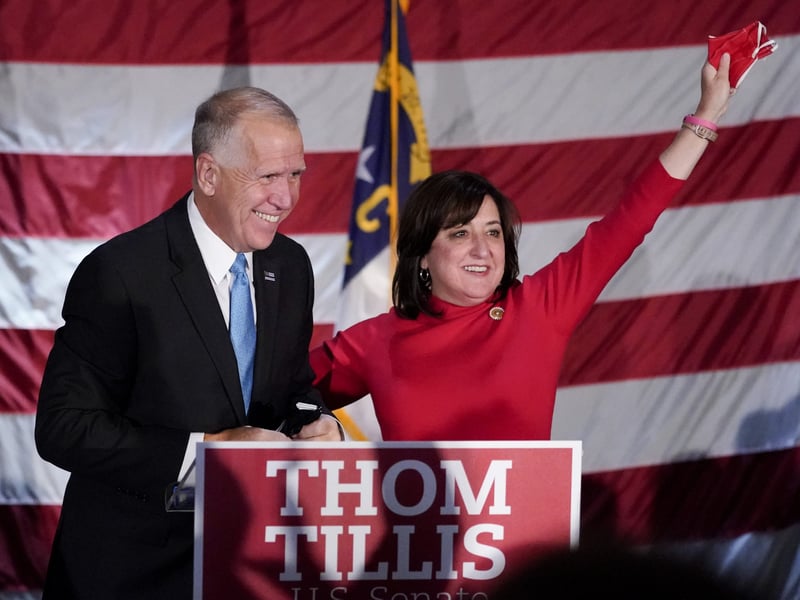
WASHINGTON (CN) — Lingering frustrations among Republicans about the White House’s handling of judicial nominees for appellate courts boiled over Wednesday as North Carolina Senator Thom Tillis promised to grind to a halt all the Biden administration’s efforts to fill court vacancies in the Tar Heel State.
Tillis was on the warpath during a hearing in the Senate Judiciary Committee as lawmakers convened to question Ryan Park, North Carolina’s solicitor general tapped by the White House to serve as a judge on the Fourth Circuit Court of Appeals.
The Republican senator, who has long complained that the Biden administration has not adequately consulted with him nor fellow North Carolina Senator Ted Budd about nominees in their home state, said he informed the White House back in April that he had garnered enough support to block Park’s confirmation.
“What is the White House thinking?” Tillis said. “Instead of spending the last two and a half months trying to find a consensus nominee … the White House chose to move forward on a nomination that I have successfully secured the votes to block on the floor.”
Tillis said he was “ashamed” to be in the position to block an appellate nominee, arguing that he has previously backed bipartisan judicial picks. “Shame on the White House for putting Mr. Park in this position,” he added.
According to the North Carolina Republican, he and Budd set forth four potential candidates for the Fourth Circuit vacancy but were rejected by the White House. He questioned the administration’s sincerity in a bipartisan process.
“For anyone to say this process was ivory perfect doesn’t make sense to me,” contended Tillis.
Though the Senate for years abided by a tradition known as blue slipping, which allows home state senators to object to the White House’s court nominees, the upper chamber’s Republican majority under the Trump administration stopped honoring the process for appellate courts. Under President Joe Biden, Democrats have upheld that precedent — ignoring blue slips for U.S. circuit court nominees but not for U.S. district court appointments.
Illinois Senator Dick Durbin, the Democratic chair of the Judiciary Committee, reminded his colleagues Wednesday that he and other lawmakers warned Republicans that they were establishing “new ground rules” by stepping away from blue slips for appellate nominees.
“There cannot be one set of rules for Republican nominees and another for Democratic nominees,” Durbin argued. “I am following the same standard that Senate Republicans established during the Trump administration.”
Tillis, however, remained unconvinced.
“The White House gave us a take-it-or-leave-it position, and we’re going to leave it,” he told reporters on the sidelines of Park’s hearing.
While he declined to say which Democrats he had convinced to oppose the Fourth Circuit nominee, Tillis told Courthouse News he had reaffirmed their support as recently as last week.
And thanks to the White House’s betrayal on Park, Tillis added, all the administration’s North Carolina nominees — including for several U.S. district court vacancies subject to a blue slip — were off the table.
“I have no interest,” the lawmaker said. “If they can’t negotiate with somebody who has a record of supporting Obama nominees and Biden nominees, and they treat me like this, they needn’t waste their time on talking about the district vacancies. We’ll deal with that next year.”
Carl Tobias, chair of the University of Richmond School of Law, said Tillis’s threat to withhold support for all Tar Heel State nominees was counterproductive and that litigants and judges in the state would be harmed by such a blockade.
“You took an oath,” Tobias said of Tillis, “that says the president nominates judges with the advice and consent of the Senate. If you’re not going to be reasonable with the person in the White House, then you have to explain to your constituents why you don’t have judges.”
Tobias also pushed back on the North Carolina senator’s complaints about the administration moving ahead with Park’s nomination over his objections, concurring with Durbin’s argument that there should not be two separate standards for Republican and Democratic nominees.
“The problem is his own caucus, because they’re the ones who stuffed it down the Democrats’ throat,” he said. “They just have to live with that.”
Meanwhile, Republican members of the Judiciary Committee took aim at Park’s record as North Carolina solicitor general, trying to position him as a political activist rather than an impartial arbiter of the law.
Louisiana Senator John Kennedy accused Park of “substituting” his judgment with the interests of his clients.
“When you think you’re smarter and more virtuous than your client or the law, you substitute your own judgment, and that’s a dangerous thing to do if you’re a federal judge,” he told the nominee.
He pointed to the case Berger v. North Carolina State Conference of the NAACP , a suit challenging a state voter ID law. The North Carolina legislature filed to intervene in the case, arguing that state Attorney General Josh Stein — Park’s boss — was not properly defending the law.
Kennedy accused Stein and Park of intentionally throwing the case for political purposes.
Park rejected that notion and pointed out that he was not involved in the trial proceedings as he was an appellate lawyer.
The nominee further denied any suggestion that he was a political actor, arguing that he has never declined to represent a state client as solicitor general and that he has been “happy and enthusiastic” to defend statutes passed by North Carolina’s Republican legislature or to carry out policies made by Republican state officials.
Tobias forecast that, despite the uncomfortable hearing and threats from Tillis, things could still work out for Park.
“I thought Park did an extraordinary job explaining everything,” he said, “and he showed exquisite temperament given how nasty [Republicans] were to him.”
 Follow @BenjaminSWeiss
Subscribe to our free newsletters
Our weekly newsletter Closing Arguments offers the latest about ongoing trials, major litigation and rulings in courthouses around the U.S. and the world, while the monthly Under the Lights dishes the legal dirt from Hollywood, sports, Big Tech and the arts.