
 Search Articles


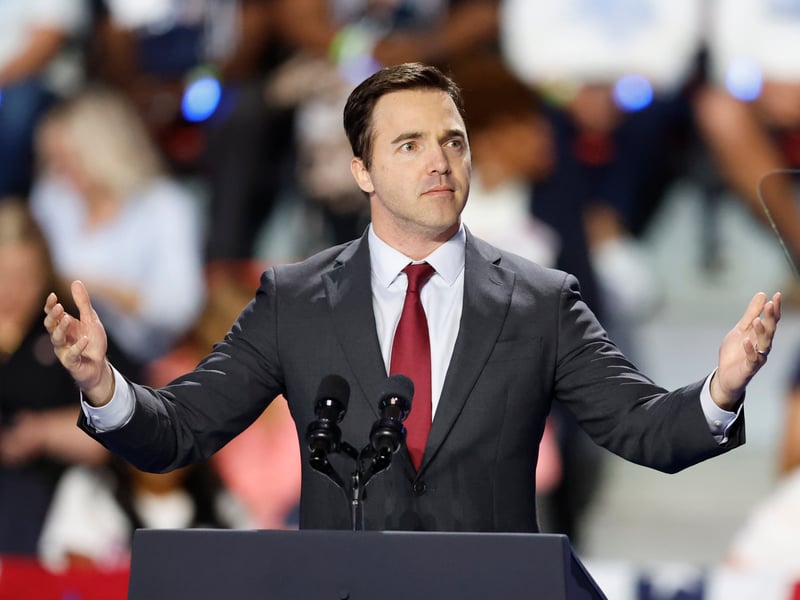
RALEIGH, N.C. (CN) — North Carolina Republican lawmakers are targeting the authority of the state’s Democratic attorney general, rapidly advancing a bill that would strip him of his ability to challenge President Donald Trump’s executive orders in a move to show party support.
The bill, which has an identical measure introduced in the state House, has proceeded through Senate committees and is expected to be read a final time in the Senate this week before moving to the House.
If successfully passed into law, it would prevent Attorney General Jeff Jackson from participating in any multi-state action that challenges an executive order issued by the president, barring him from filing an amicus curiae brief or joining as a party.
Since the start of his term, Jackson has joined other Democratic attorneys general in filing suit over Trump’s executive orders on birthright citizenship, federal funding including for medical research and the so-called Department of Government Efficiency’s access to Treasury Department data.
This isn’t the first attempt at throttling the power of the seat, which has been maintained by Democrats for decades. During the lame duck session in 2024, state lawmakers passed a heavily protested bill that challenged the abilities of incoming Democrats, including Jackson, who was prevented from taking a legal stance contrary to that of the General Assembly after his predecessor, current Governor Josh Stein, declined to defend provisions of abortion law he considered to be unconstitutional.
The effort echoes House Republicans’ move to impeach judges who blocked Trump’s executive actions by pausing the White House’s rollback of citizenship rights for the children of immigrants and taking away Elon Musk’s DOGE’s keys to the Treasury’s payment information database.
In Congress, top Republican leaders have been hesitant to sound their support. In North Carolina, however, Senate President Pro Tempore Phil Berger has been openly critical of Jackson’s participation in executive order challenges, calling it activism on behalf of fellow Democratic attorneys general.
Jackson should focus on handling criminal appeals and representing local agencies, Berger said, “not joining with other Democrats around the country in an attempt to create headlines against the Trump administration.”
“It’s a waste of money,” Berger said, adding that Jackson’s actions are out of step with constituents; the state voted for Trump in the last three presidential elections.
James Tierney, the former attorney general of Maine and a lecturer at Harvard Law School, said the move to limit Jackson’s power is political — and if it’s successful, residents will pay the price.
“If passed, it could hurt the people of North Carolina, because you don’t know what the next president’s executive order is going to be,” Tierney said. “If he decides to abolish FEMA, which he’s talked about doing … I think the people in North Carolina that live in western North Carolina would want to have their attorney general be able to fight back for them. And this law would stop him from doing that.”
More than anything, Republicans are attempting to show constituents they support Trump, Tierney said. Lawmakers aren’t challenging the constitutionality of Jackson’s legal arguments, he pointed out, and the action doesn’t spur from an investigation into his office.
“It’s not a serious attempt to analyze the authority of the attorney general,” he said. “If there was a Republican attorney general, they wouldn’t be doing this.”
Democrats made the same point when the bill was tacked onto the end of the Senate calendar last Wednesday, blindsiding them. It passed along party lines before Democrats begged off the final reading and had it pushed to Tuesday.
“We are giving up the right of our attorney general, whom we elected, to defend our people in court against federal government overreach. I never thought I’d see North Carolina Republicans willingly give up our independence to the federal government. I mean, they didn’t even have to ask for it. We’re just giving it away,” Senator Terence Everitt said on the floor.
“We fought a war to rid ourselves of a king, only now we kneel before a president, exchanging one tyrant for another, which is exactly what our founders warned us about.”
Senator Mujtaba Mohammed also railed against the bill, speaking shortly before it passed its second reading.
“Unchecked power, whether held by a Republican or a Democrat, is a threat to democracy,” he said. “If you pass this bill today, this body risks setting dangerous precedent that limits our state’s ability to push back against federal policies that undermine our industries, our economy, our rights and our values.”
Mohammed said he wanted to work with Republicans to amend the bill, suggesting in part that council of state members could approve any intervention proposed by Jackson. But the primary sponsor in the Senate, Senator Timothy Moffitt, told Courthouse News he doesn’t expect any revisions as the measure advances to the House.
During President Joe Biden’s time in office, Republican attorneys general sued over his revocation of the Keystone XL pipeline permit; his directing federal agencies to work with states to increase voter turnout; and the expansion of the Affordable Care Act to Dreamers.
“The attorney general’s duty is to be a nonpartisan shield for the people of North Carolina,” Jackson’s press secretary Ben Conroy said in a statement. “Any legislation that undermines the independence of the Attorney General’s Office is bad for our state and its people.”
Republicans hold a majority in both chambers, but lost their supermajority in the last election, giving Democrats a hand to keep the bill from passing into law. Republicans have the seats to pass the bill in both chambers, sending it to Stein — who is expected to veto the measure — but are short a person necessary to override a veto without the support of at least one House Democrat. The loss of their supermajority may prevent the body from being able to pass its more partisan proposals.
 Follow @SKHaulenbeek
 Follow @shaulenbeek.bsky.social
Subscribe to our free newsletters
Our weekly newsletter Closing Arguments offers the latest about ongoing trials, major litigation and rulings in courthouses around the U.S. and the world, while the monthly Under the Lights dishes the legal dirt from Hollywood, sports, Big Tech and the arts.