
 Search Articles


RALEIGH, N.C. (CN) — North Carolina Republicans continued to move on a bill stripping powers from newly elected Democrats before the political makeup shifts in January.
There are still several undecided races in North Carolina, as recounts are ongoing. If the results stay the same, state Republicans may lose their veto-proof majority, which has been critical for them to push through more partisan legislation with a Democrat governor in office.
The Senate passed an 131-page bill Monday that included sweeping changes to the responsibilities of governor, attorney general and two judgeships, and also shifted the state board of elections to the Department of the State Auditor. Positions on the state board of elections are filled by the governor, incoming Democrat Josh Stein, but Republicans are instead attempting to grant appointment power to incoming Republican auditor Dave Boliek.
It was first introduced as a blindside to Democrats in the House, who did not receive the bill until it was added to the House calendar for votes, skipping the usual process of working its way through committees first.
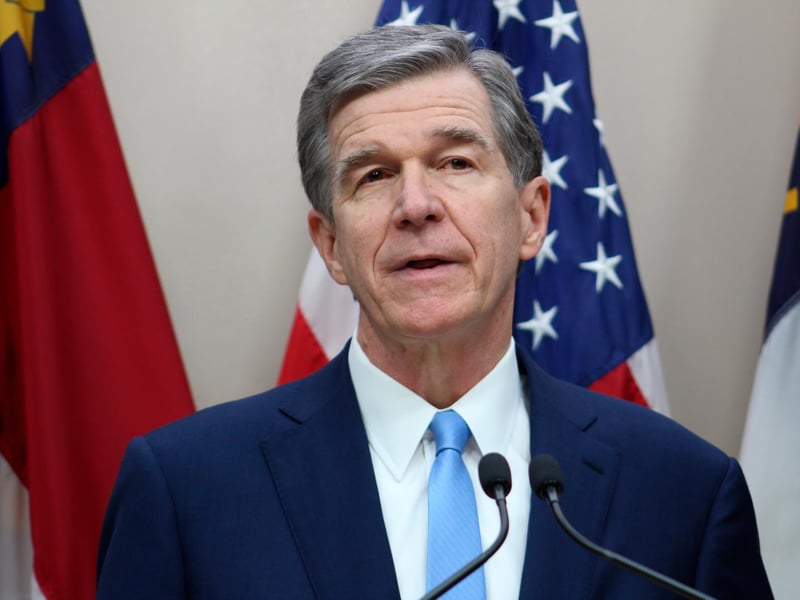
The bill, which passed the House and Senate in November, was vetoed by Governor Roy Cooper, who called it a “sham.” The state Senate overrode the veto Monday along party lines.
Despite a speedy turnaround, the bill has faced public backlash, and members of the public were thrown out of the Senate for hissing when it first passed.
The veto override again faced public opposition Monday, and Lieutenant Governor Mark Robinson ordered the public out of chambers again after they yelled in opposition to the vote, and clapped in response to the reading of Cooper’s veto message. As legislators moved to vote, loud chants of “shame” could be heard from outside the chamber.
“This destroys the will of the voters,” one protester yelled before being removed. “It’s voter suppression!”
“There is a time for protest, but it is not in the halls of this chamber. It is not inside this chamber,” said Robinson. “I don’t mind hearing these folks’ voices, but I won’t tolerate it on this floor, and no one should.”
The North Carolina Poor People’s Campaign, which urged the public to show up, called the legislation an undemocratic power grab.
“The recent Senate Bill 382, introduced and rushed through the legislature with barely an hour’s notice, purports to be a disaster relief bill while devoting most of its 132 pages to an autocratic and antidemocratic legislative coup, bypassing the will of the voters and keeping North Carolinians in the dark,” said the group. “It is urgent that we stand up against this undemocratic, behind-closed-doors power grab from the people of North Carolina.”
The bill had been advertised as a relief bill for western North Carolina following Hurricane Helene, but does not distribute any additional funds. Instead, $227 million is moved to a Helene fund, where it will be held indefinitely until allocated. Lawmakers have approved $917 million in funds already, with damage estimates exceeding $53 billion, amid calls for more immediate financial support for mountain residents as winter approaches.
Cooper, who vetoed the bill at the end of November, condemned it in one of his last moves as governor.
“This legislation is a sham. It does not send money to western North Carolina but merely shuffles money from one fund to another in Raleigh,” he said in his veto message. “This legislation was titled disaster relief but instead violates the constitution by taking appointments away from the next governor for the Board of Elections, Utilities Commission and Commander of the NC Highway Patrol, letting political parties choose appellate judges and interfering with the attorney general’s ability to advocate for lower electric bills for consumers.”
The bill will go to the House next. It needs to pass in both chambers with a three-fifths majority to override Cooper’s veto, and when it passed in the House, lacked the support of three Republicans. With Democrats in indignant opposition to the measure, Republicans need every vote to be able to successfully pass the measure into law.
The Senate also quickly passed measures proposing a constitutional amendment lowering the maximum income tax rate from 7% to 5%, and a proposed amendment requiring all voters to present photo ID, not just those voting in person, to change the constitution to reflect photo ID requirements that first went into effect in municipal elections in 2023.
“Voter ID remains popular in our state,” said Republican Senator Warren Daniel on the floor. “Even when North Carolinans were asked about a stricter version of voter ID that wouldn’t include any exceptions, they supported the proposal 70 to 29%.
The change to photo ID continues to allow for exemptions, but would require those voting provisionally and by mail to also present photo ID before their vote is counted.
Several Republican candidates with pending election results have claimed that not all overseas and military voters provided a copy of their photo ID with their ballot, despite North Carolina’s voter ID requirement, and are protesting their ballots being counted.
The Senate also passed a resolution Monday requesting a constitutional convention to amend the U.S. Constitution to require term limits on members of Congress, a measure which passed in the state House in 2023.
The resolution, which has only passed in eight states, needs support from 34 states requesting a convention on the issue for an amendment to the Constitution to be made. No measure has ever reached the necessary support using this method.
Neither resolutions nor constitutional amendments go to the governor, and instead become law upon being passed in both chambers. The disaster relief bill and proposed constitutional amendments have been sent to the House for votes next Wednesday.
President Pro Tempore Phil Berger said that the Senate has had conversations with the House, and is confident it will have the votes to override the governor’s veto and pass the so-called relief measure into law when it takes it up next week.
 Follow @SKHaulenbeek
 Follow @shaulenbeek.bsky.social
Subscribe to our free newsletters
Our weekly newsletter Closing Arguments offers the latest about ongoing trials, major litigation and rulings in courthouses around the U.S. and the world, while the monthly Under the Lights dishes the legal dirt from Hollywood, sports, Big Tech and the arts.