
 Search Articles


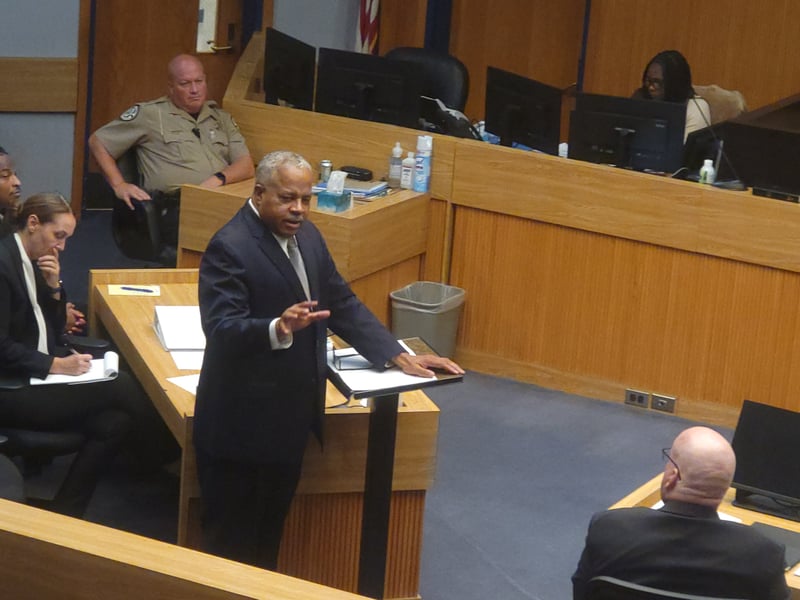
SMITHFIELD, N.C. (CN) — A Black North Carolina man argued Wednesday that his race was factor in the jury selection that led to his 2009 death sentence as part of an case brought under the North Carolina Racial Justice Act that could impact over 100 prisoners on death row.
Hasson Jamaal Bacote is one of 136 prisoners sentenced to death in North Carolina — most of whom have pending cases under the act, attempting to convert their death sentences to life in prison without the possibility of parole.
North Carolina has a history of excluding Black citizens from jury service, Henderson Hill, one of Bacote’s attorneys, said Wednesday in closing arguments.
“You know, if white prospective jurors have a certain relationship with criminal justice the system prior, then white prospective jurors have certain views about the death penalty or not," Hill said. “And those same views, those same experiences, are held by neighbors, Black citizens. White jurors with the same background get seated in the box, black jurors with that same background get shown the door.”
Before North Carolina Superior Court Judge Wayland Sermons Jr. Wednesday, Bacote’s legal team said jury exclusions have resulted in a disproportionate amount of Black men receiving extreme sentences, and denied people of color the opportunity to serve on capital juries.
Bacote was convicted by a jury of 10 white and two Black jurors, who originally returned with a recommended sentence of life without chance of parole, but came back with a death sentence after being informed their decision had to be unanimous.
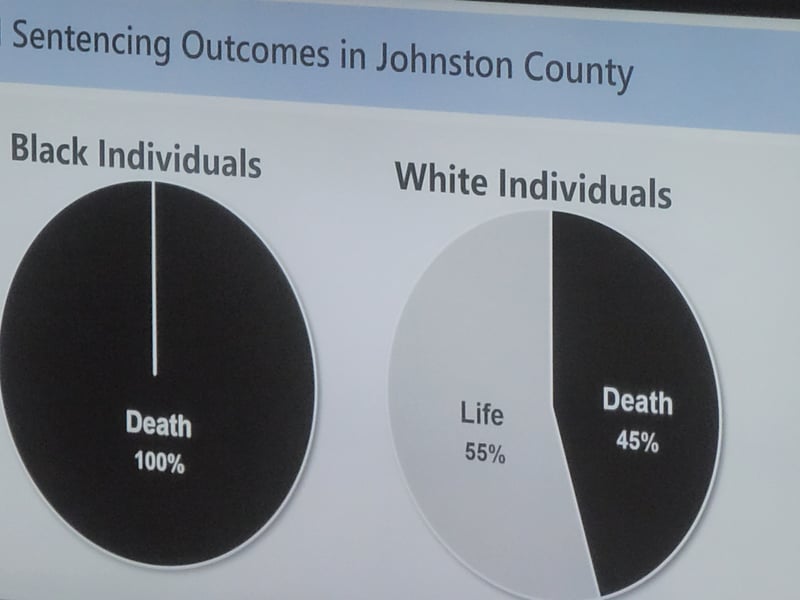
Bacote’s attorneys presented black and white pie charts in court: all Black individuals with capital sentences in Johnston County have all been given the death penalty, while only 45% of white offenders have been sentenced to death.
A trial court sentenced Bacote, who was found guilty of first degree burglary, armed robbery and first degree murder in 2007, in April 2009. He challenged the sentence under the Racial Justice Act in 2010, before it was repealed in 2013.
In court, lawyers for the state argued that if the court vacates Bacote’s sentence because of a history of racial discrimination, it would open the door for other defendants to overturn their sentences without any evidence of discrimination in their case.
Jonathan Babb, special deputy attorney general, warned that the court would set a precedent that just because racism exists in the area, other cases could cite racist history to avoid the death penalty.
“In other words, the state argues again today, as it has consistently, that Bacote must show discrimination in his case for relief under the Racial Justice Act," Babb said. “Must show, by the preponderance of the evidence, that his individual sentence of death was solely obtained on the basis of race.”
Sermons Jr. did not announce a timeline for his ruling.
Eleven people have been sentenced to death in North Carolina under felony murder rule, where a person is charged with murder if someone dies while a violent felony is being committed, even if their death was not intentional. All are men of color. Out of the 11, nine are Black.
“Because we look at the history and culture of Johnston County, we know that race has influenced who is condemned to death and whose life is spared. If unaddressed, racial discrimination does not just disappear with time. It seeps its way into systems and structures,” Ashley Burrell, counsel for the NAACP Legal Defense & Educational Fund said Wednesday.
The North Carolina Racial Justice Act — which passed in 2009 but was later repealed in 2013, by then-Governor Pat McCroy, who said that it effectively halted the death penalty — was intended to allow prisoners who believed race was a significant factor in imposing the death penalty to attempt to vacate their death sentence.
In 2012, Marcus Robinson was the first person to successfully prove racial bias in his death penalty case, and had his sentence commuted to life without parole.
In 2020, the state Supreme Court upheld that the part of the repeal that retroactively voided claims under the act was not constitutional.
The last time North Carolina performed an execution was on August 18, 2006. Samuel Flippen, who was executed by lethal injection, was convicted of the 1994 murder of his two-year-old stepdaughter.
Noel Nickle, the executive director of the North Carolina Coalition for Alternatives to the Death Penalty, said in an interview with Courthouse News that the reason it has been so long since an execution is because of the act, but that executions may now resume.
“What this case really illustrates is salient for the death penalty across the country, and specifically North Carolina: we know it’s rooted in systemic racism. Something that came out this morning really struck me. You know, we talk about a death qualified jury. So jurors are seated because they state that they can’t oppose the death penalty. What we heard today is that what is even more important to prosecutors in North Carolina, is that it be a race qualified jury, that they want to see white jurors. And so that really speaks for itself,” Nickle said. “We cannot deny the racism.”
The coalition is calling on Democrat Governor Roy Cooper to commute all death row sentences to prison terms before his term ends.
 Follow @SKHaulenbeek
 Follow @shaulenbeek.bsky.social
Subscribe to our free newsletters
Our weekly newsletter Closing Arguments offers the latest about ongoing trials, major litigation and rulings in courthouses around the U.S. and the world, while the monthly Under the Lights dishes the legal dirt from Hollywood, sports, Big Tech and the arts.