
 Search Articles


RALEIGH, N.C. (CN) — Environmental groups sued the city of Asheboro, North Carolina, on Tuesday, claiming that it was collaborating with manufacturers to discharge carcinogenic materials into the drinking water of nearly 900,000 residents.
According to Cape Fear River Watch and the Haw River Assembly in their suit, the city of Asheboro’s wastewater treatment plant has been discharging 1,4-dioxane into the Haskett Creek, upstream of drinking water supplies.
“Asheboro has, for at least a decade, allowed StarPet and other industrial users to send highly contaminated wastewater into the city’s wastewater plant,” the groups said. “The city welcomed this pollution despite knowing it would flow straight through its wastewater plant and into downstream drinking water supplies.”
They accuse the city of working with plastics manufacturer StarPet to filter its waste into the city’s municipal wastewater system. The groups also say the city also accepts waste containing 1,4-dioxane from a landfill.
The environmentalists, represented by the Southern Environmental Law Center, say communities downstream of the plant are detecting the chemical in their drinking waters, “far exceeding” the cancer risk advisory levels set by the U.S. Environmental Protection Agency. Conventional water treatments cannot remove the chemical, so polluted water makes it through municipal water utilities and into homes, businesses, churches and schools, the plaintiffs said.
“Asheboro has allowed StarPet to increase its 1,4-dioxane pollution over the last several months,” the groups said. “Consequently, the levels of 1,4-dioxane in Asheboro’s discharges have skyrocketed to the highest levels ever documented from a municipal wastewater plant over the course of North Carolina’s decade-long fight against this water quality crisis.”
The defendants are obligated under the Clean Water Act to pretreat water to ensure pollution is controlled before it reaches the municipal wastewater system, the environmental groups claim.
They also say the parties are violating the terms of their National Pollutant Discharge Elimination System permit. The city’s wastewater plant is designed to treat wastewater used in homes and businesses, but also receives industrial wastewater from metal finishing and textile facilities.
Since March 2020, Ashboro has discharged the chemical above the level protective of human health at least 159 times, the plaintiffs claim, saying it is probable that the city has released 1,4-dioxane above that level on more occasions.
StarPet has a pretreatment system intended to filter out the chemical, but it malfunctions often, they claim.
The pollution also impacts the city of Stanford, which is undergoing a process to expand its drinking water utility services in the future to at least 80,000 residents.
The environmental groups said they have members who rely on and drink water that is sourced from the Cape Fear River, downstream of the wastewater plant, and who have had to treat the water coming into their homes to avoid potential health risks associated with 1,4-dioxane.
Researchers discovered notable levels of 1,4-dioxane in the Cape Fear River Basin in 2014, identifying “hot spots” of contamination that included Asheboro.
In 2023, the state’s Department of Environment Quality tried to limit the amount that the city could discharge, introducing limits on 1,4-dioxane pollution within the city’s new permit.
Asheboro challenged the changes, and the state’s administrative court found in its favor, decidingthat the department first needed to establish an associated water quality standard. An appealof that decision is ongoing, and in the meantime, Asheboro is not required to limit 1,4-dioxane levels.
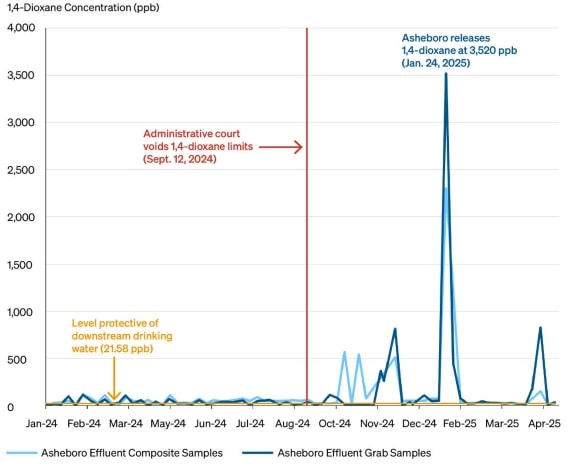
During that time, Cape Fear River Watch and the Haw River Assembly say, the city has increased its pollution, discharging 1,4 -dioxane at concentrations 163 times the level deemed safe to protect downstream drinking water.
The plaintiffs claim Asheboro has given StarPet permission to turn off its pretreatment system to discharge untreated water several times since the court decided to not enforce pollution limits, causing “drastically high levels of toxic chemical pollution” to enter drinking water supplies.
The U.S. Environmental Protection Agency asked the administrative court to reconsider its decision, saying that the state was within regulatory requirements in imposing limits on 1,4-dioxane expulsions. It had previously conducted a risk evaluation and found that 1,4-dioxane consumed through water can cause health issues, including liver toxicity and cancer.
StarPet is owned by Indorama Ventures, which is also a named defendant. A representative for Indorama Ventures did not reply to a request for comment in time for publication, nor did a representative for the city of Asheboro’s water department.
 Follow @SKHaulenbeek
 Follow @shaulenbeek.bsky.social
Subscribe to our free newsletters
Our weekly newsletter Closing Arguments offers the latest about ongoing trials, major litigation and rulings in courthouses around the U.S. and the world, while the monthly Under the Lights dishes the legal dirt from Hollywood, sports, Big Tech and the arts.