
 Search Articles


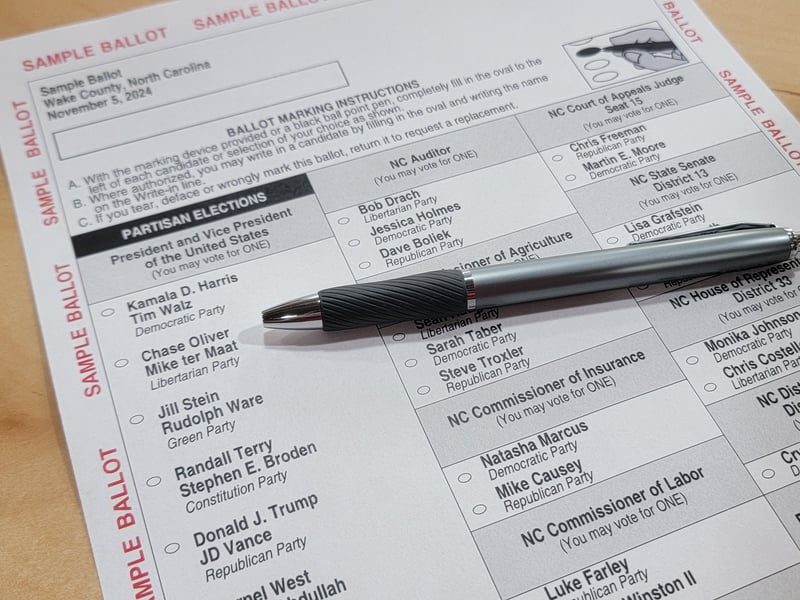
NEW BERN, N.C. (CN) — A North Carolina woman’s petition to eliminate restrictions on ballot photography landed in a federal courtroom Monday, where she seeks an injunction to keep the state from prosecuting her — and others — for taking selfies with their completed ballots.
Susan Hogarth took a selfie with her filled-out ballot when she voted in March. She posted it to X, endorsing Libertarian candidates for governor and president.
But North Carolina is one of 14 states that bans voters from taking pictures of their ballot, and she got a letter in the mail from the state elections board informing her that she committed a misdemeanor and instructing her to take the post down. Hogarth did not.
She sued, claiming that the state and local board of elections and attorney general had violated her First Amendment rights because the restrictions under state law aren’t narrowly tailored to further a compelling government interest.
U.S. District Judge Louise Flanagan declined to issue an injunction Monday, instead directing attorneys to draft an agreement to keep Hogarth from being prosecuted while the case proceeds. Hogarth’s local district attorney had already submitted an affidavit saying she would not prosecute until the constitutionality of the state statutes is decided.
Flanagan did not extend the requirements of that agreement to protect other voters who plan to take ballot selfies in the general election.
State law prohibits anyone from taking a photo of a “voted” ballot, restrictions which extend to absentee ballots. Voters cannot take a picture of their filled-out ballot, even if voting from the privacy of their own home.
Representatives for the state elections board and attorney general have said that there is no rush to expedite Hogarth’s case, and that the challenged laws have existed for decades. North Carolina’s ballot photo restrictionsexist to prevent vote buying, voter intimidation, delays and distractions at polling places and to maintain the privacy of other voters.
Voters may take and share photographs in polling places said Terence Steed, representing the state elections board and attorney general, as long as they have permission.
In court Monday, Flanagan didn’t seem wholly convinced that Hogarth had been harmed or that voters should have the right to take ballot selfies, asking questions about what privacy expectations other voters should have, and if loosening photo restrictions wouldn’t be disruptive to the polling process.
How different is Hogarth’s ballot selfie from taking a photo of an empty ballot with a pen pointed to your candidate of choice, Flanagan asked.
Steed said that to the state board, the difference is the ballot wasn’t voted, and could be photographed.
To Hogarth, they are vastly different.
“What people want is they want to know what really happened at a time and place,” she said. “And to be able to share that is really powerful.”
But North Carolina’s restriction that allows candidates to take photos of themselves and willing voters? That seems more disruptive, Hogarth said, than allowing voters to take pictures of themselves or their ballots.
“Talk about disruption in the polling place, to have (Attorney General and gubernatorial candidate) Josh Stein show up with the camera crew and stuff. That’s disruptive. Me whipping out with my phone and being like, here I am voting for myself: not disruptive," Hogarth continued.
Hogarth is a Libertarian candidate for state Senate in district 13, which would allow her to take a photo of herself without permission from a polling official when she votes in the Nov. 5 election — but not photograph her ballot. And for elections in the future where she isn’t running, she would not be able to photograph herself without permission.
Hogarth wants to make it possible for voters to be able to take pictures of their ballots, and take pictures of themselves in the voting booth without the permission of an election official, said Jeff Zeman, a Foundation for Individual Rights and Expression attorney representing Hogarth.
“We are here to protect everyone’s speech,” he said after the hearing.
In North Carolina, voters have to get permission from the chief judge of the precinct to take a photo of themselves. If they want to take a picture of another voter, they need that voter’s permission as well as the chief judge’s OK.
Being forced to ask permission could mean the voter being told no and not being allowed to take and share the photo, which Zeman said would be suppressing voters’ constitutional rights.
The state has not provided recent evidence that vote buying is a problem, Zeman said, or that changing the statute would be an undue burden for it.
The North Carolina State Board of Elections has no referred reports of vote buying in the last five years, according to its public data.
It only had one reported case of ballot photography in 2023. In 2020, the last major election year, it also only had one. There were no reported cases in 2019, 2021 or 2022.
Hogarth said she’s taken several ballot selfies in the past, and plans to continue taking them in the future. This is the first time she’s ever received a letter from the state board threatening prosecution.
“Susan Hogarth’s speech is core political speech,” Zeman said. “With her ballot selfies she can do something that no other speech can. Like she’s told you, an “I voted” sticker just doesn’t cut it. The ballot selfie shows who she voted for, how she voted, her enthusiasm for voting, her enthusiasm for third parties. It does it all with one photograph. It’s unique, and the state can’t say ‘do it some other way.’”
Attorneys for the state board defendants and a representative for Stein declined to comment.
 Follow @SKHaulenbeek
 Follow @shaulenbeek.bsky.social
Subscribe to our free newsletters
Our weekly newsletter Closing Arguments offers the latest about ongoing trials, major litigation and rulings in courthouses around the U.S. and the world, while the monthly Under the Lights dishes the legal dirt from Hollywood, sports, Big Tech and the arts.