
 Search Articles


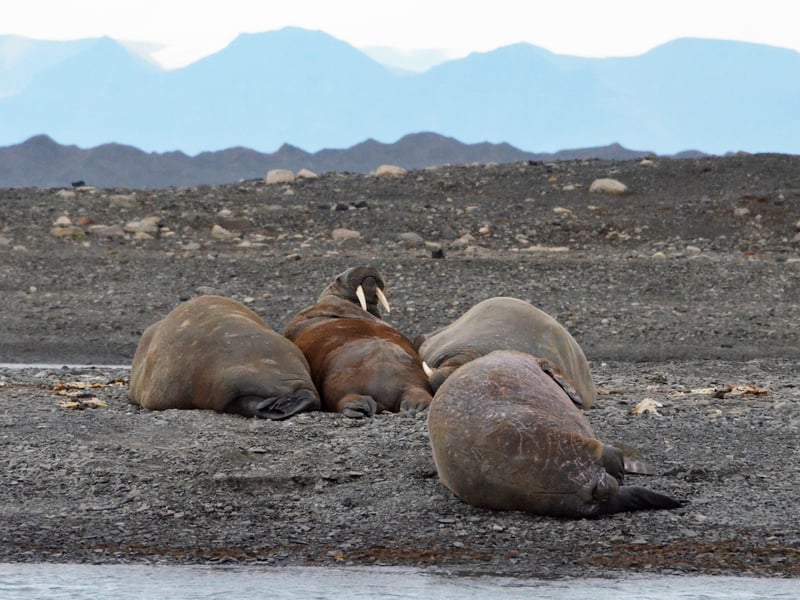
(CN) — Medieval Norse hunters who ventured deep into the Arctic to hunt walruses weren’t just seeking survival — they were also part of extensive trade networks that could represent the earliest steps toward circumpolar globalization, according to research published Friday.
The findings, published in Science Advances, shed light on early connections between distant cultures.
Genetic analysis shows that Norse hunters likely sailed into the Pikialasorsuaq, or North Water Polynya, during the Medieval Warm Period (950-1250 CE) in search of ivory. As local walrus populations declined, Norse hunters traveled farther into the Arctic.
Before 1120 CE, most ivory came from areas far from the Tuniit and Thule Inuit, the primary Indigenous groups in the region. However, after 1120 CE, the Norse began hunting in the North Water Polynya, which lies between northwest Greenland and Arctic Canada, bringing them closer to Indigenous peoples.
“Traditionally, the Norse expansion into the Northwest Atlantic has been viewed in terms of farmers looking for land and opportunity,” Emily Ruiz-Puerta, a postdoctoral researcher at the Arctic Centre in Groningen, said in an email. “In recent years, it has become clear that elite demand for commodities in European trade and consumption centers — especially for Arctic walrus ivory — was also driving Norse expansion into the North Atlantic.”
These findings challenge earlier beliefs that Norse ivory mostly came from local hunting grounds near Greenland. It now appears that the Norse traveled deep into the High Arctic for their walrus hunts, indicating they were part of a broader trade network rather than just isolated farmers.
“What really surprised us was that much of the walrus ivory exported back to Europe was originating in very remote hunting grounds located deep into the High Arctic,” Peter Jordan, a professor of archaeology at Lund University and senior author of the study, said in an email. “Most of the exported Norse ivory appears to be coming from the North Water Polynya, which is a marine ecological ‘hot spot’ located between northwest Greenland and Arctic Canada.”
The researchers also raised questions about the interactions between the Norse and Indigenous groups, as they were likely using the same Arctic resources at the same time. While direct evidence of trade between them is still scarce, the researchers believe Norse expansion into the Pikialasorsuaq region may have led to some early contact.
To trace the origin of the ivory, the research team used genetic techniques, taking advantage of the fact that different walrus populations in the Arctic have unique genetic signatures due to their isolation. This allowed them to match ivory artifacts found in Europe to specific Arctic walrus stocks.
“Unlike many other marine mammals, Atlantic walrus tend to aggregate in smaller groups close to shallow-water feeding grounds, which are only located in a few specific areas,” Morten Tange Olsen, an associate professor at the Globe Institute in Copenhagen, said in an email. “Over time, these groups become quite isolated from each other and develop their own unique genetic identities.”
According to researchers, the Norse economy relied heavily on walrus ivory, which commanded high prices in medieval Europe. As the demand for ivory grew, Norse hunters ventured farther into the Arctic, eventually coming into contact with Indigenous Arctic peoples.
Whether these encounters were peaceful or tense is still a topic of debate. As Jordan noted, such meetings likely involved mixed emotions.
The Norse, with European facial features, were bearded, wore wool clothing and sailed plank-built vessels. They hunted walruses with iron-tipped lances. In contrast, the Thule Inuit, who were adapted to Arctic conditions, used sophisticated toggling harpoons to hunt the walruses in open waters, wore fur clothing and exhibited more Asian facial features.
“This would have been a meeting of two quite different cultural worlds,” Jordan said. “On a more human level, these meetings in the vast and empty landscapes of the High Arctic would probably have involved fear, excitement, and also curiosity, creating opportunities for social interaction, sharing and exchange.”
Subscribe to our free newsletters
Our weekly newsletter Closing Arguments offers the latest about ongoing trials, major litigation and rulings in courthouses around the U.S. and the world, while the monthly Under the Lights dishes the legal dirt from Hollywood, sports, Big Tech and the arts.