
 Search Articles


CHICAGO (CN) — A Wisconsin man imprisoned for unlawful gun possession looked to a trepidatious Seventh Circuit panel Thursday to overturn his conviction.
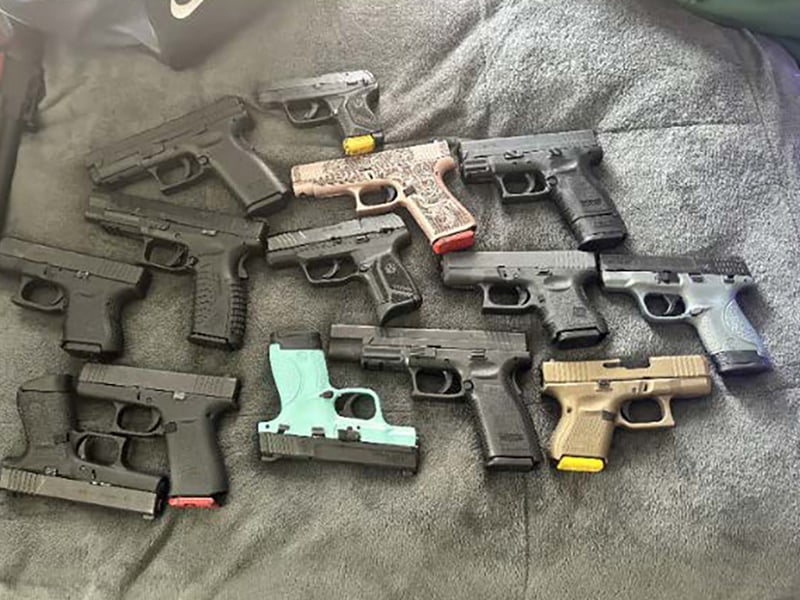
Police arrested Edlando Watson in June 2022 on outstanding cocaine possession and felony bail jumping charges in Madison, Wisconsin. Months later, police searched a storage unit and found five guns that matched Watson’s DNA from his arrest. Federal prosecutors filed unlawful gun possession charges against Watson in 2023, and said he could not own a gun as a convicted felon.
Watson’s attorney Ellen Matheson, however, argued before the three-judge panel that the gun charge violates Watson’s Second Amendment rights because he is a nonviolent felon. The Seventh Circuit typically hears arguments at Dirksen’s Federal Courthouse, but the panel heard Thursday’s arguments at Marquette Law School in Milwaukee.
“Here, the court asks us to conflate Mr. Watson’s predicate convictions as an assumption of inherent dangerousness,” said Matheson of the Wisconsin firm Foley Lardner.
Watson appealed his conviction based on New York State Rifle & Pistol v. Bruen , a 2022 Supreme Court case that changed the constitutional muster required to determine whether a gun restriction is permitted. Bruen found that courts must rely on the historical tradition of gun regulations to determine if a particular gun restriction runs afoul of the Second Amendment.
“One thing the government tries to do to connect the dots between Watson and dangerousness is to go around the felony predicates entirely,” Matheson said. “It points to the fact that he was on bail and subject to a restraining order at the time of the [gun] charge and it also highlights [an] incident that occured over five months before the weapons were found.”
Matheson maintained that because Watson’s convictions were nonviolent, his Second Amendment rights are presumptively protected by the Constitution. She referenced Supreme Court case United States v. Rahimi , which found that if a person is deemed to be a credible danger to society they may be disarmed consistent with Second Amendment tradition.
U.S. Circuit Judge Diane Sykes said she wasn’t sure that was an appropriate way to characterize the Rahimi decision.
“It’s not entirely clear how we’re supposed to analyze that, and whether it’s limited to the statute of conviction,” the George W. Bush appointee said.
U.S. Circuit Judge Frank Easterbrook also pushed back on Matheson’s characterization that drug offenses equate to nonviolent convictions.
“There are a whole bunch of federal statutes treating people with drug convictions as people who have serious violent felonies on their record,” the Ronald Reagan appointee said.
Department of Justice attorney Joshua Handell emphasized that regardless of whether the crime was violent or nonviolent, restricting felons from gun possession is long established in historical tradition.
Matheson also argued that Watson’s Fourth Amendment rights were violated when Wisconsin police made him take a DNA sample during his June 2022 arrest because the warrant they relied on to collect the sample was broad and not specific to DNA collection.
Handell chided back that because the DNA was obtained in good faith, and Watson’s objection is based on a misreading of the underlying warrant.
Alongside Sykes and Easterbook on the panel was U.S. Circuit Judge Michael Brennan, a Donald Trump appointee. The panel did not indicate when it might rule on the matter.
 Follow @RosenCaitlyn
Subscribe to our free newsletters
Our weekly newsletter Closing Arguments offers the latest about ongoing trials, major litigation and rulings in courthouses around the U.S. and the world, while the monthly Under the Lights dishes the legal dirt from Hollywood, sports, Big Tech and the arts.