
 Search Articles


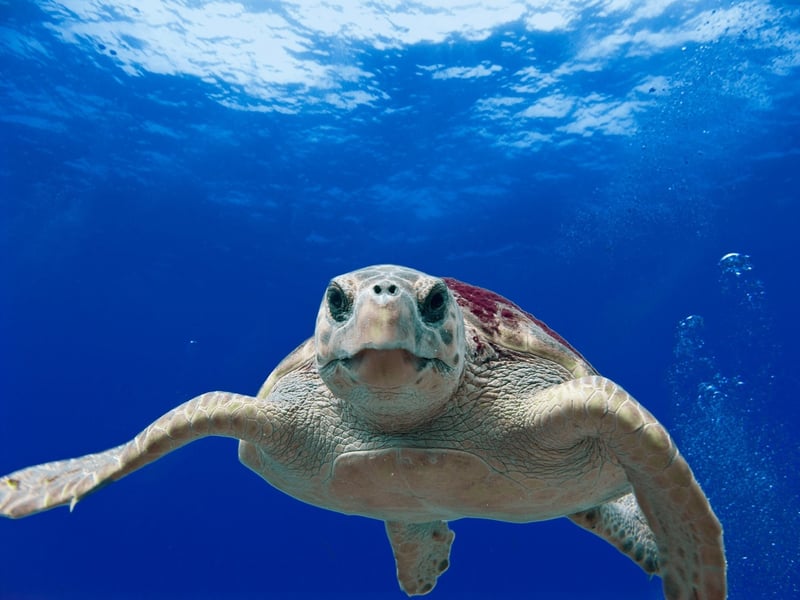
(CN) — Watching hatchling sea turtles take in their new world mere moments before they intently make their way to the sea is an insider’s look at incredible natural perception. Through an awareness of the Earth’s magnetic field, they somehow know just which direction and where to go.
In a study published on Thursday in the Journal of Experimental Biology, new evidence suggests young loggerhead sea turtles understand their position and location based on two magnetic senses; however, the use of their magnetic “map” sense can falter if magnetic pulses interfere.
Loggerheads can understand they are swimming north or south based on their directional or “compass” sense, aligning with the Earth’s magnetic field, while they also have a positional or “map” sense to understand their place within a certain area.
Many animals, including birds on their first migratory flight, rely on their “compass” sense to make it to their destination, and it’s an important part of how animals move and recognize their habitats.
In the new study, Alayna Mackiewicz, researcher in the Department of Biology at the University of North Carolina at Chapel Hill and lead author, said the turtles’ ability to know where they are on their long migration routes is based on the “map” sense that relies, at least partially, on magnetite-based receptors. Magnetite is an iron oxide mineral found in many different rocks across the globe.
“One leading hypothesis for how the map sense might work is through tiny magnetic crystals called magnetite, permanently magnetized magnets that twist into alignment with Earth’s magnetic field if allowed to rotate freely,” she said in an email. “These small magnetite particles may allow an animal to ‘feel’ magnetic information.”
Mackiewicz noted scientists don’t know exactly where these tiny magnets are located in a turtle’s body, but they’re likely embedded in specialized sensory cells, she said.
“The simplest possibility is that as magnetite twists into alignment with the geomagnetic field, it produces signals that send through the nervous system and to the brain, where the turtle processes this information to navigate,” she said.
Mackiewicz’s research focuses on understanding how animals detect and use Earth’s magnetic field for orientation and navigation.
“Our new results build upon the previous study by demonstrating that a magnetic pulse disrupted the magnetic map sense, an outcome that should not have occurred if the map sense were based on chemical magnetoreception,” she and the other authors said in the study. “Thus, the new findings provide additional evidence for dual magnetoreception systems in turtles.”
During the experiments, Mackiewicz and her colleagues created a system of magnetic coils intersecting at right angles with an electric current. The magnetic “signatures” the system produced matched areas in the Atlantic Ocean, including one near Turks and Caicos and one near Haiti. For two months, the research team conditioned 16 loggerheads to relate one of the magnetic signatures with food, splitting up the group evenly between both locations.
“Loggerhead sea turtles are iconic migrants that use their compass sense and map sense throughout their life history in three key stages,” Mackiewicz said. “As hatchlings, turtles leave their nests and begin their navigation around the North Atlantic Gyre System. During this migratory period, turtles travel thousands of km, and the entire journey takes about six to ten years to complete. Throughout this time, loggerheads use magnetic information to guide these transoceanic migrations, which helps them remain within favorable ocean currents and advance along the migratory pathway.”
After completing this migration, Mackiewicz explained, loggerheads take up residence in feeding areas along the southeastern parts of the U.S.
“Turtles often display high fidelity to particular feeding grounds and may use magnetic information to remember these locations,” she said.
And once they reach sexual maturity, between 25 to 30 years, they navigate back to the same beach they were born at or a similar geographic region to lay their eggs.
For the study, once conditioned to their magnetic signatures, the loggerheads, which were acquired on Bald Head Island in North Carolina, were exposed to different magnetic pulses to examine if their magnetic “map” sense was changed by them, in what the researchers call an assay, or a lab test used to measure a certain effect.
“Because the assay we used is the first in any animal to decouple the magnetic map from the magnetic compass, the study provides the most direct evidence to date that a magnetic pulse affects the map sense as opposed to a magnetic compass,” the authors said in the study.
And now that the researchers understand the “map” sense a little more deeply, Mackiewicz is excited to continue her quest in finding where receptors may be located.
“What makes magnetoreception so interesting is that the mechanisms underlying magnetic field detection are still unknown and receptors have not been localized yet in any species,” she said. “One difficulty is that we as humans appear to lack a magnetic sense (or if we do have this ability, we are not conscious of it), so we have no intuitive understanding of how this sensory system operates. Additionally, magnetic fields pass freely through biological tissue, so a receptor might hypothetically be located anywhere in the body.
“Right now, magnetoreception seems so complex because nothing has been definitively demonstrated. Everything seems complicated when you don’t understand it, but once we know more, it could turn out to be quite simple.”
Subscribe to our free newsletters
Our weekly newsletter Closing Arguments offers the latest about ongoing trials, major litigation and rulings in courthouses around the U.S. and the world, while the monthly Under the Lights dishes the legal dirt from Hollywood, sports, Big Tech and the arts.