
 Search Articles


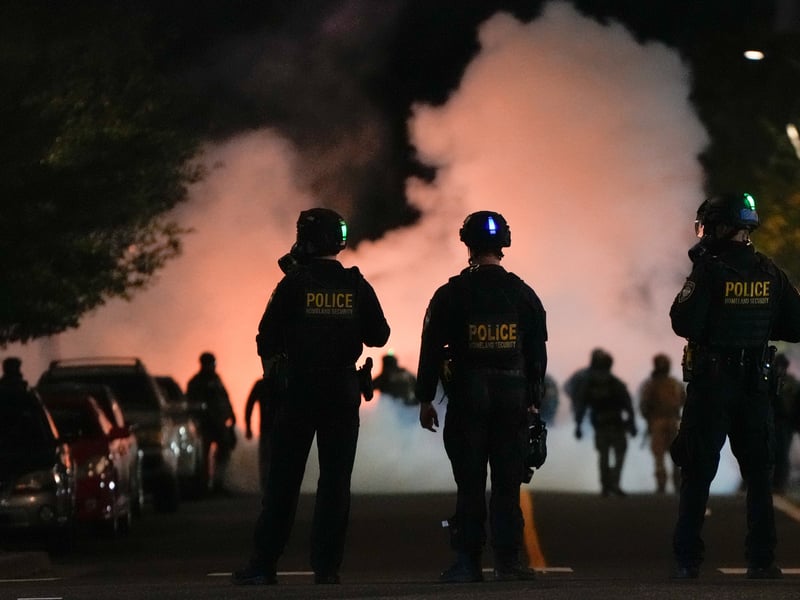
PORTLAND, Ore. (CN) — An en banc Ninth Circuit will rehear an appeal over an order blocking National Guard deployment in Portland, according to a late Tuesday order.
The decision comes just over a week after a split panel overturned a lower court block of the Trump administration from federalizing and deploying 200 members of the Oregon National Guard to respond to ongoing protests at Portland’s Immigration and Customs Enforcement facility.
The order for a rehearing comes on the eve of a three-day trial set to begin in the U.S. District Court of Oregon on Wednesday.
Oregon Attorney General Dan Rayfield celebrated the Ninth Circuit’s decision as one that sends a clear message that Trump cannot send the military into U.S. cities unnecessarily.
“This ruling shows the truth matters and that the courts are working to hold this administration accountable,” Rayfield said in a statement. “The Constitution limits the president’s power, and Oregon’s communities cannot be treated as a training ground for unchecked federal authority.”
Governor Tina Kotek’s office called the ruling “good news for everyone who cares about the rule of law in America.”
The White House felt differently.
“The facts haven’t changed. Amidst ongoing violent riots and lawlessness, that local leaders have refused to step in to quell, President Trump has exercised his lawful authority to protect federal officers and assets,” White House Spokesperson Abigail Jackson said in a statement.
Jackson added that Trump “will not turn a blind eye to the lawlessness plaguing American cities” and that the White House expects the court to uphold the law.
On Oct. 20, the majority of a three-member Ninth Circuit panel — comprised of two Donald Trump appointees and a Bill Clinton appointee — ruled that Trump was “within his statutory authority” to send troops to Portland, which Trump described in a social media post as “war ravaged.”
The Ninth Circuit order affected one of two temporary restraining orders U.S. District Judge Karin Immergut, a Trump appointee, issued at the beginning of the month. Both blocked the Trump administration’s efforts to send military intervention to Oregon, with the second blocking the deployment of any National Guard troops, not just Oregon troops.
While the majority of the Ninth Circuit panel called for Immergut’s first order to be paused, a strong dissent from U.S. Circuit Judge Susan Graber, the Clinton appointee, urged the Ninth Circuit to “act swiftly to vacate the majority’s order before the illegal deployment of troops under false pretenses can occur.”
Within two hours of the Ninth Circuit’s ruling, a circuit judge called for a vote on whether the court should rehear the case en banc.
By the end of last week, as Immergut was pondering how to proceed regarding the unappealed second temporary restraining order, the Ninth Circuit stayed its earlier order until a vote on rehearing could be held.
The Ninth Circuit did not indicate when the rehearing would occur, but the case is set to proceed in federal court with a trial on the merits and on a motion for a preliminary injunction beginning on Wednesday.
Oregon and Portland sued the Trump administration on Sept. 28, a day after Trump took to social media to announce his intent to “provide all necessary troops to protect war-ravaged Portland” and its ICE facility. Following the post, the state received a memo announcing the imminent deployment of the Guard.
The city and state have characterized the protests at the ICE facility, which are often attended by protesters in inflatable costumes, as mild. However, the Trump administration painted a picture of anarchy and rebellion against federal officers.
In the majority opinion from last week, U.S. Circuit Judges Ryan Nelson and Bridget Bade — both appointed by Trump during his first term — agreed with the federal government’s view of the situation and said that the lower court had wrongly “discounted the violent and disruptive events” occurring at the ICE facility over the summer. The two judges pointed to instances where protesters blocked the driveway of the facility or otherwise disrupted operations.
In her dissent, however, Graber, noted that accepting the government’s characterization of Portland as a battle zone and ignoring “Portland protesters’ well-known penchant for wearing chicken suits, inflatable frog costumes, or nothing at all” may seem absurd. She went on to say the decision was “not merely absurd,” but also one that erodes core constitutional principles, including sovereign states’ control over their states’ militias and the people’s First Amendment rights to assemble and to object to the government’s policies and actions.”
Subscribe to our free newsletters
Our weekly newsletter Closing Arguments offers the latest about ongoing trials, major litigation and rulings in courthouses around the U.S. and the world, while the monthly Under the Lights dishes the legal dirt from Hollywood, sports, Big Tech and the arts.