
 Search Articles


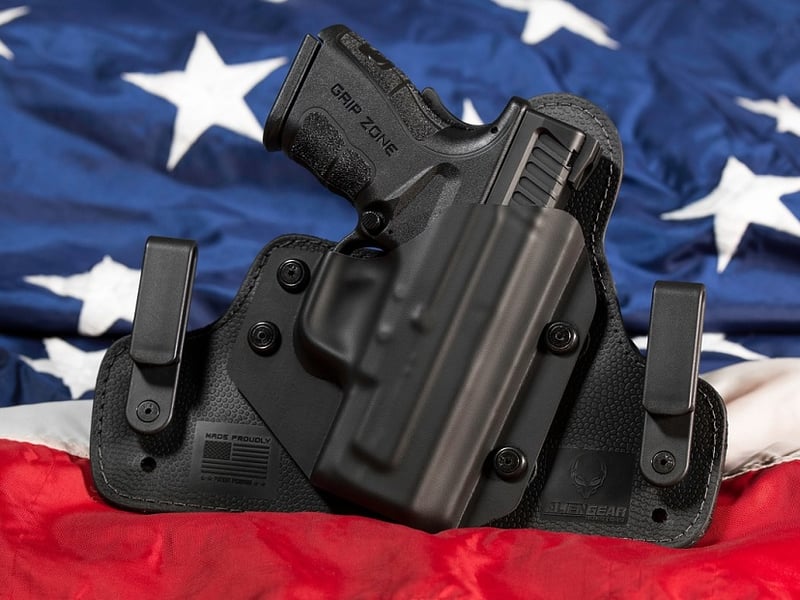
(CN) — The Ninth Circuit on Tuesday took up the question of whether California can prohibit most of the state’s residents from openly carrying firearms for self-defense in the wake of a landmark U.S. Supreme Court decision.
A three-judge panel of the federal appeals court, at a hearing in Seattle, grappled with whether the Second Amendment right to carry arms is satisfied if a California resident can carry a concealed gun even if they aren’t allowed to carry one in open view.
U.S. Circuit Judge Lawrence VanDyke, a Donald Trump appointee, was particularly bemused by the state’s licensing regime under which only residents of counties with a population of less than 200,000 people can, at least in theory, apply for a permit to openly carry a firearm, leaving about 95% Californians who live in urban counties unable to get such a permit.
“If you live in San Francisco, say, you can’t get a license to open carry — not only in San Francisco, but you can’t get a license to open carry in Nevada County,” VanDyke said, referring to the California county of about 100,000 residents in the Sierra Nevada mountains. “So, if you live in San Francisco, you are banned from open carry anywhere in the state.”
Additionally, VanDyke noted, residents of rural counties who can get a license to open carry, can only do so in their own county and not in other rural counties, let alone in Los Angeles or San Francisco.
This, the judge said, appears to be similar to the ban New York had on the public carrying of firearms, concealed or otherwise, if a person didn’t have proper cause to do so. That ban was thrown out by the 2022 U.S. Supreme Court decision in New York Rifle and Pistol Association v. Bruen .
Senior U.S. Circuit Judge N. Randy Smith, a George W. Bush appointee, said that the so-called Bruen test, which the Supreme Court established to determine whether regulations that appear to infringe on Second Amendment rights pass constitutional muster, may be an issue for California’s position that it can restrict open carry in public if it permits concealed carry of a firearm for self-defense.
The Bruen test looks at whether challenged state and local gun laws are consistent with the historical tradition of firearm regulations in the U.S., which Smith noted pertains mostly to the period immediately before the framing of the Constitution through the antebellum.
“During that time period, there were no state statutes, there were no public judicial decisions, there were no legal commentators which addressed whether the states could ban open carry for self-defense while allowing concealed carry,” Smith said. “None of the regulations banned open carry by allowing concealed carry, none of the history did that. How does that merit up with what California’s doing?”
Aaron Pennekamp, a lawyer with the California attorney general’s office, argued in response that the U.S. Supreme Court looked at the same historical evidence and concluded that state governments are free to adopt carry restrictions, including very restrictive ones that entirely prohibit one form of public carry, as long as another form of public carry is available.
Smith, on the other hand, insisted that the antebellum decisions all allowed states to ban concealed carry of firearms without a problem, but not open carry.
“They say the only manner of public carry that effectuates the right of self-defense guaranteed by the Second Amendment, and is therefore the public carry protected by the amendment, is open carry,” the judge said.
The case at hand was brought by Mark Baird, a resident of Siskiyou County, California, who seeks to exercise his purported right to carry a handgun “exposed and holstered on his person” for self-defense throughout California. Baird specifically challenges state laws that criminalize openly carrying a firearm in public.
“There’s zero historical analog for banning open carry,” Amy Bellantoni, Baird’s lawyer, told the panel. “It’s been the preferred method of carrying weapons since the beginning of time and the dawn of ages.”
The third judge on the panel was Kenneth Kiyul Lee, also a Trump appointee.
The same panel also heard a new appeal by Junior Sports Magazines Inc. and Second Amendment advocates in a lawsuit over whether California can ban advertisements by the firearm industry aimed at minors.
The panel in 2023 had found that the statute likely ran afoul of First Amendment free speech protections and overturned a district judge in Los Angeles who had declined to issue a preliminary injunction against enforcement of the law.
However, on remand, Senior U.S. District Judge Christina Snyder, a Bill Clinton appointee, only agreed to preliminarily enjoin part of the California law that specifically referred to advertisements and refused to block a provision pertaining to the use of minors’ private information by members of the firearm industry.
At Tuesday’s hearing, the panel gave short shrift to the state’s argument that this provision can be litigated separately from the rest of the statute.
“I’m trying to figure out why we’re here,” Smith said, noting that he wasn’t aware of any legal precedents supporting the state’s position that the validity of a specific provision that hadn’t been argued at the district court and the appellate court initially can now be argued on its own merits.
“When someone doesn’t argue severability, it’s waived,” Smith said. “Our opinion treated the statute as a whole.”
 Follow @edpettersson
Subscribe to our free newsletters
Our weekly newsletter Closing Arguments offers the latest about ongoing trials, major litigation and rulings in courthouses around the U.S. and the world, while the monthly Under the Lights dishes the legal dirt from Hollywood, sports, Big Tech and the arts.