
 Search Articles


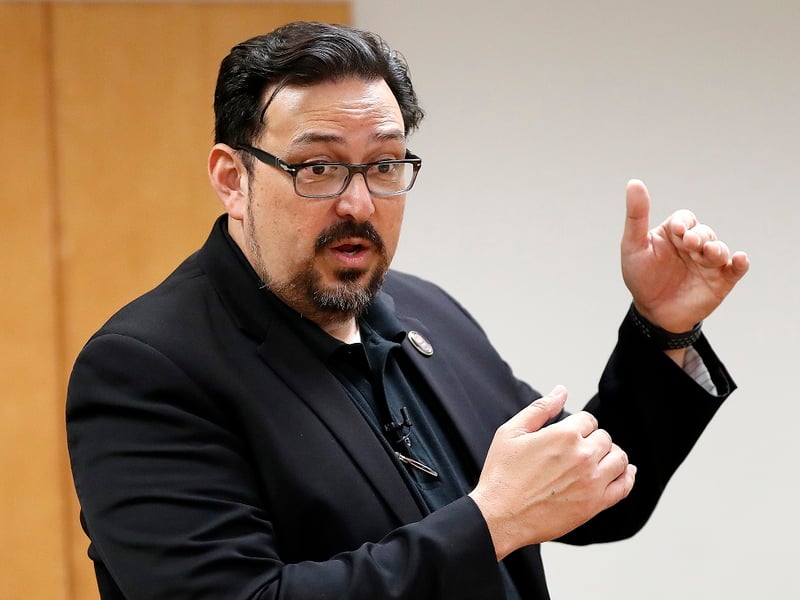
PHOENIX (CN) — A Ninth Circuit panel appears split on two provisions of Arizona’s elections procedures manual enjoined by a federal judge after conservative groups challenged them over potential voter suppression.
In response to heightened political tensions, Democratic Secretary of State Adrian Fontes last year updated the 2023 manual, published at the end of every odd year, to address two growing concerns.
The first section challenged in federal court by American Encore and the America First Policy Institute, known as the “canvass provision,” requires the secretary of state to throw out the votes of a county that refuses to canvass its votes by its deadline if the secretary has exhausted all other remedies.
The provision responds to Cochise County, whose supervisors in 2022 delayed the county canvass until just days before the secretary of state’s deadline.
The second addition, called the speech provision, expands the list of what constitutes voter intimidation in Arizona, including “aggressive behavior, such as raising one’s voice or taunting a voter or poll worker,” and “using threatening, insulting, or offensive language to a voter or poll worker.”
A federal judge enjoined both provisions before the 2024 general election. Defendants Fontes and Attorney General Kris Mayes appealed the order, arguing in Pasadena on Tuesday that the plaintiffs showed no likelihood of harm.
“The theory of injury is extraordinarily speculative,” Joshua Bendor told the panel, representing the attorney general’s office. He argued that the situation in Cochise County, in which two Republican supervisors tried to delay the canvass to instead platform election conspiracy theories, proved that voters have nothing to worry about because the secretary was able to enforce the canvass before reaching the point of voter disenfranchisement.
“The secretary’s very clear. He doesn’t want to do this,” Bendor added.
Jonathan Riches, attorney for the America First Policy Institute, countered that the mandatory language of the provision deems the threat of disenfranchisement very real and asserted that the secretary of state had plenty of other remedies available “that are much less nuclear than discarding the votes of entire counties.”
U.S. Circuit Judge Salvador Mendoza Jr. used the same logic against him, suggesting there’s no reason to assume the other available remedies wouldn’t work.
“There’s a series of assumptions we have to make to get to a violation here,” the Joe Biden appointee told Riches.
U.S. Circuit Judge Anthony Johnstone concurred, adding that the state statute already requires the secretary of state to certify the statewide votes in whatever way they can.
“What are the material differences in the guidance not present in the state statute?” asked Johnstone, a fellow Biden appointee. “It seems like they’re both trying to do the same thing.”
The statute doesn’t suggest voter disenfranchisement, Riches replied.
Riches argued that the threat of injury posed by the speech provision is just as real, as it could result in unfair removals of voters from polling places based on overbroad language defining intimidation. Johnstone seemed to agree.
“This is kind of an unusual effect-based restriction of speech,” he said.
Bendor told the panel that the plaintiffs have no standing to challenge the provision because they’ve outlined no conduct they intend to engage in that would be barred by the language in the manual.
“It’s simply a summary of what Arizona intimidation statutes say,” he said.
Bendor added that the injunction, as written, is overbroad because it enjoins enforcement of the entire section, including blocking the entrance, threatening a voter or following a voter to their car, rather than just the challenged language.
The plaintiffs say poll workers will use the provision to suppress voters, but Attorney General Mayes has already disavowed criminal enforcements based on violations of the manual. In fact, since the language was introduced in 2019 and updated in 2023, no implementation of the plaintiffs’ interpretation of the provision has occurred, Bendor said.
Still, the judges asked why keep the language written as it is if the administration doesn’t intend to follow it.
“Read it the reasonable way,” Bendor answered. “Don’t reach to read it the unconstitutional way.”
The judges didn’t indicate when they will rule.
 Follow @JournalistJoeAZ
Subscribe to our free newsletters
Our weekly newsletter Closing Arguments offers the latest about ongoing trials, major litigation and rulings in courthouses around the U.S. and the world, while the monthly Under the Lights dishes the legal dirt from Hollywood, sports, Big Tech and the arts.