
 Search Articles


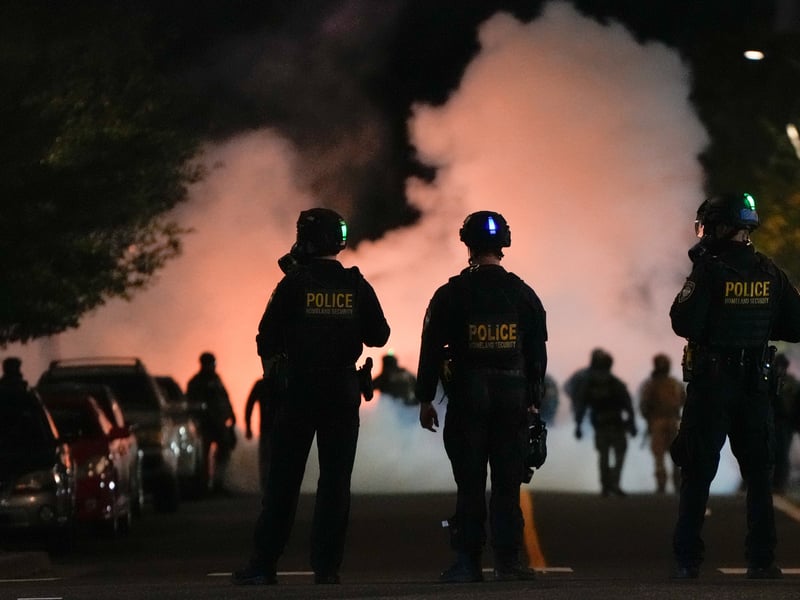
PORTLAND, Ore. (CN) — The Ninth Circuit Court of Appeals convened virtually this morning to hear arguments in the federal government’s appeal of a recent ruling that blocked the deployment of National Guard troops to protect an Immigration and Customs Enforcement facility in Portland, Oregon.
A three-judge panel featuring U.S. Circuit Judges Ryan Nelson and Bridget Bade — both appointed by Donald Trump during his first term — as well as Bill Clinton-appointed U.S. Circuit Judge Susan Graber aggressively pressed both sides on the legal and factual basis for the contested deployment.
On Wednesday, a separate Ninth Circuit panel lifted one of two temporary restraining orders issued last week by fellow Trump appointee U.S. District Judge Karin Immergut, maintaining federalization of the Oregon National Guard while continuing to block any deployment in Portland.
Throughout the hearing, the judges scrutinized the factual foundation of Immergut’s decision, a move somewhat unusual for the appellate court, which typically defers to the lower court’s factual findings. The panel seemed particularly focused on Immergut’s statement that “the president’s determination was simply untethered to the facts.”
Attorney Stacy Chaffin, representing the state of Oregon, the city of Portland and the state of California, was questioned about the size and nature of the protests at the Portland ICE facility. While she declined to dispute reported levels of protest-related violence, she argued that the incidents were mischaracterized.
Chaffin supported the lower court’s findings that protests were “small, less than 30 people, largely sedate and generally peaceful,” which was quickly met by opposition by Nelson.
“There’s clearly been protests that were above 30, unless you’re trying to limit it to certain time periods,” said Nelson, prompting a brief examination of daily protest sizes and events from early September, such as the arrest of an individual operating a drone near the ICE facility.
Chaffin emphasized that isolated aggressive acts by individuals or small groups did not amount to “explicit violence or rebellion,” but instead constituted ordinary criminal activity.
Deputy Attorney General Eric D. McArthur, representing the federal government, also declined to contest the existing factual record but disagreed with its interpretation, arguing that the lower court minimized the extent of protest-related violence. McArthur maintained that the protests disrupted ICE operations and federal protective services.
He noted that 115 Federal Protective Service officers — nearly a quarter of the nation’s 497 total — had been assigned to the Portland facility, which he argued demonstrated a disproportionate strain on federal resources.
“The president has concluded that the regular forces are unable to enforce,” McArthur said, referring to immigration enforcement obligations and other law enforcement activities, noting that FPS leadership is “not equipped to deal with this kind of ongoing, sustained unrest while the officers are expected to be able to respond to emergencies.”
When asked about evidence supporting the president’s decision, McArthur cited a June 7 memorandum, recent Truth Social posts and a subsequent memorandum relating to the Illinois National Guard. He argued that these collectively established “violence directed at ICE officers that seeks to impede their execution of immigration laws.”
Chaffin maintained that reliance on the June 7 memo was invalid, “not relating to Portland, and it was exceptionally stale by the time the National Guard was actually federalized in September.”
Nelson wondered whether the president might have had greater authority to act earlier in the summer, noting that the Portland ICE facility was closed for nearly a month in June due to protest activity. When Chaffin agreed that June might have been a closer call but still not warranted, Nelson responded: “So the president loses his right to do that because he waits to see how things turn out on the ground?”
The hearing also examined definitions of “rebellion,” a term central to the statutory authority under review. Chaffin cited dictionary and legal definitions requiring an attempt to overthrow the federal government. McArthur argued for a broader interpretation, noting that under Chaffin’s standard, even if a governor shut down all ICE centers in a state, it might still not qualify as rebellion.
Nelson pressed Chaffin further: “The president gets to direct his resources as he deems fit, and it just seems a little counterintuitive to me that the city of Portland can come in and say, ‘No, you need to do it differently.’"
In close, McArthur challenged the plaintiffs’ portrayal of the Portland protests and invoked language frequently echoed by the Trump administration about the Democratic-run city.
“This is hardly the peaceful and sedate crowd that plaintiffs try to make it out to be,” said McArthur. “These are violent people … the president is entitled to say enough is enough.”
Officials including Department of Homeland Security Secretary Kristi Noem, who recently visited the Portland ICE facility, have publicly referred to the city as being “under siege.” Similar characterizations have been made about other cities such as Memphis and Chicago, where, as of Thursday morning, Texas National Guard troops had been deployed to assist federal agencies.
Nineteen Republican state attorney generals recently filed a brief in support of the federal government’s position, while 20 Democratic attorneys general and the governors of Kansas, Kentucky and Pennsylvania submitted a brief in support of Oregon. The state of California was also recently added as a plaintiff to the case after its own National Guard was deployed in connection with the federal order. In response, Immergut issued a second emergency restraining order on Sunday night.
The panel did not issue an immediate decision, but it expects to rule quickly on the urgent matter. In the meantime, federal deployment of National Guard troops in Portland remains blocked for now as they train less than two hours away in the small coastal city of Warrenton.
Subscribe to our free newsletters
Our weekly newsletter Closing Arguments offers the latest about ongoing trials, major litigation and rulings in courthouses around the U.S. and the world, while the monthly Under the Lights dishes the legal dirt from Hollywood, sports, Big Tech and the arts.