
 Search Articles


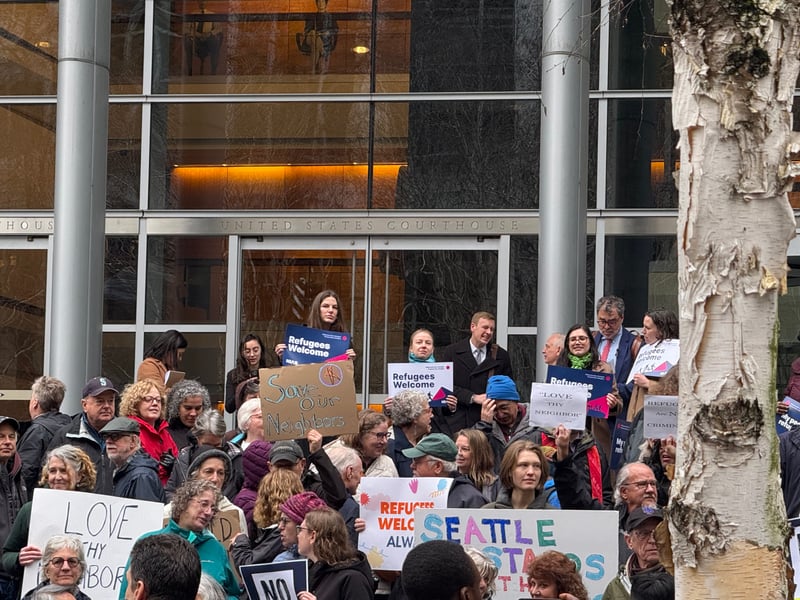
(CN) — The Trump administration notched another win in its effort to restrict refugee travel to the United States after a Ninth Circuit panel on Friday blocked a series of injunctions intended to protect the U.S. Refugee Admissions Program.
“The government is likely to prevail on plaintiffs’ challenge to the validity of Executive Order No. 14163’s suspension of refugee admissions, and we cannot engage in ‘a searching inquiry into the persuasiveness of the president’s justifications,’” wrote the ruling’s majority, which included U.S. Circuit Judges Richard Clifton and Jay S. Bybee, both George W. Bush appointees.
As such, the appeals court vacated its earlier stay orders and issued a new stay, pausing both preliminary injunctions issued by a federal judge in Washington state earlier this year, except as they pertain to refugee resettlement agencies.
After taking office, President Donald Trump signed Executive Order No. 14163, titled “Realigning the United States Refugee Admissions Program,” which suspended all “entry into the United States of refugees” under the program starting Jan. 27.
U.S. District Judge Jamal Whitehead, a Joe Biden appointee, issued two preliminary injunctions blocking Trump’s order, but the Ninth Circuit stayed the bulk of both in orders that have now been vacated and replaced by the appeals court’s latest order.
Citing federal immigration law, which states the government must provide certain reception and placement services to refugees after they are admitted into the United States, the Ninth Circuit panel found that the plaintiffs — nine refugees and three refugee resettlement nonprofits — were likely to succeed on only one challenge brought under the Administrative Procedure Act.
The government had long contracted agencies such as the three involved in the lawsuit to assist with reception and placement services to newly-arrived refugees. The State Department terminated all cooperative agreements with resettlement agencies in February, leaving resources scarce for those already admitted.
“In light of the government’s uncertainty regarding its ability to provide the reception and placement services statutorily mandated under 8 U.S.C. § 1522, the government is hereby directed to reinstate such cooperative agreements necessary to provide the reception and placement services described in § 1522 to refugees who have been admitted to the United States,” the majority wrote.
Mevlüde Akay Alp, a senior staff attorney with the International Refugee Assistance Project representing the plaintiffs, recognized the small win for the plaintiffs but noted the broader decision was unfavorable.
“ Today’s stay order from the Ninth Circuit makes clear that it was illegal for the government to deny vital benefits to refugees who had recently arrived in the United States,” Alp said. “At the same time, there are tens of thousands of refugees who have been waiting years to be resettled in the U.S. and were preparing to start new lives here, and they remain stranded in limbo, and many of them remain separated indefinitely from their family members.”
The panel’s previous stay orders created a narrow carveout, allowing a slim fraction of refugees who met certain conditions to be admitted to the United States
“Unfortunately, as a result of this order, no refugees are able to travel to the United States anymore,” Alp said. “That carveout no longer exists.”
Alp estimated that only around 70 refugees were able to resettle as a result of the preliminary injunctions. Under the Refugee Act, the president can determine the number of refugees the country can admit in a fiscal year. In late 2024, former President Joe Biden set that number at 125,000 for fiscal year 2025.
U.S. Circuit Judge Kenneth K. Lee, a Trump appointee, largely agreed with the majority but wrote in a partial dissent that he would pause the lower court’s injunctions in their entirety.
“My colleagues and I agree that the president has the authority to impose a moratorium on refugee admissions and would thus stay the district court’s injunction on that issue,” Lee wrote in a partial dissent. “But we depart on whether the federal government has a legal duty to provide services to those who were recently admitted before the suspension went into effect.”
The panel noted that a full opinion on the merits will be released, but it’s brief Friday order pauses the injunctions in the meantime. The court heard oral arguments on Sept. 3.
The Justice Department did not immediately respond to a request for comment.
Subscribe to our free newsletters
Our weekly newsletter Closing Arguments offers the latest about ongoing trials, major litigation and rulings in courthouses around the U.S. and the world, while the monthly Under the Lights dishes the legal dirt from Hollywood, sports, Big Tech and the arts.