
 Search Articles


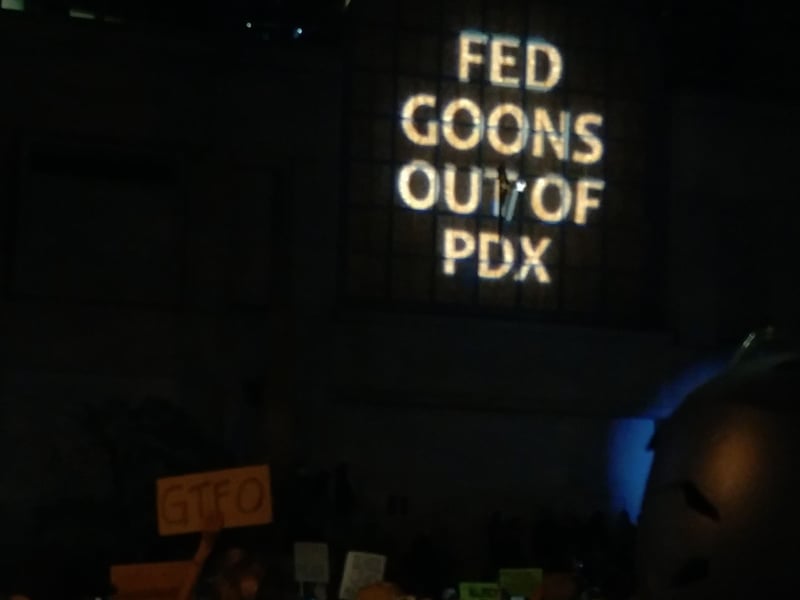
PORTLAND, Ore. (CN) — A Ninth Circuit panel ruled on Wednesday to lift a lower court order barring the Trump administration from sending federalized National Guard troops to Oregon at President Donald Trump’s direction to protect what he called “war-ravaged” Portland and its Immigration and Customs Enforcement facility.
In a four-page order, the three-judge panel blocked the first of two temporary restraining orders issued by U.S. District Judge Karin Immergut over the weekend.
The panel reasoned that blocking Immergut’s first order would most effectively maintain existing conditions during the appeals process.
“Prior to the October 4 temporary restraining order, Oregon National Guard members had been federalized but not deployed,” the panel wrote. “An administrative stay of the October 4 temporary restraining order will maintain the federalization of Oregon National Guard members, because that order prohibits implementation of the memorandum.”
The panel consists of U.S. Circuit Judges Ryan Nelson and Bridget Bade, both Donald Trump appointees, and U.S. Circuit Judge Susan Graber, a Bill Clinton appointee.
Oregon Attorney General Dan Rayfield remarked that the order doesn’t change anything on the ground.
“While it keeps the Oregon National Guard under federal status, most importantly, it prevents the President from deploying the guard in Portland,” Rayfield said in a statement. “That means no unnecessary federal escalation — and that’s a win for Oregonians who want calm, not conflict in our communities.”
On Saturday, Immergut issued the temporary restraining order blocking a memorandum from Department of Defense Secretary Pete Hegseth authorizing the federalization and deployment of 200 Oregon National Guard service members. Portland and Oregon sued the federal government earlier this month after receiving the memo from Hegseth.
The Trump administration quickly appealed that order and attempted to send already federalized members of the California National Guard to Oregon. The California National Guard was federalized earlier this year in response to protests in Los Angeles. Oregon Governor Tina Kotek also stated that she had been informed that members of the Texas National Guard would be sent to the state.
Late Sunday, Immergut issued a second temporary restraining order blocking the Trump administration from deploying any federalized members of the National Guard in Oregon.
The Ninth Circuit’s administrative stay of the first order only allows federalization, as troop deployment is still barred by the second restraining order, which remains in place.
“Thus, the effect of granting an administrative stay preserves the status quo in which National Guard members have been federalized but not deployed,” the panel wrote.
Kotek underscored that the order continues to keep federal troops out of Portland.
“There is no need for military intervention in Oregon. There is no insurrection in Portland. No threat to national security,” Kotek said in a statement. “Oregon is our home, not a military target.”
The ICE facility at the center of the litigation is in southwest Portland. It has been the site of protests over the past several months. The federal government remains in sharp disagreement with local authorities over the situation on the ground.
Documented reports from Portland police leaders consistently described the protest activity outside the ICE facility as “mild,” but Trump has continued to characterize the city as “burning to the ground.”
In Immergut’s first temporary restraining order, she noted that the protest activity fell short of the threshold required for federal intervention.
“Here, the protests in Portland were not ‘a rebellion’ and did not pose a ‘danger of a rebellion,’ especially in the days leading up to the federalization,” she wrote.
Immergut also cited the county’s longstanding tradition of resisting government overreach.
“This historical tradition boils down to a simple proposition: This is a nation of constitutional law, not martial law,” the Trump-appointed judge wrote in the order. “Defendants have made a range of arguments that, if accepted, risk blurring the line between civil and military federal power — to the detriment of this nation.”
Portland Mayor Keith Wilson described the Trump administration’s actions as federal intimidation.
“As I’ve said from the beginning, the number of troops needed in Portland is zero,” Wilson said in a statement. “Our local police are focused on protecting Portlanders’ right to protest peacefully and keeping our community safe.”
The White House celebrated the appeals court’s ruling.
“This is a significant win for the Trump Administration and reaffirms our position that the president exercised his lawful authority to protect federal officers and assets following unmitigated violence against them," White House spokesperson Abigail Jackson said in a statement. “We look forward to full victory on the issue in the near future.”
The Ninth Circuit will hear oral arguments on the matter on Thursday morning.
Subscribe to our free newsletters
Our weekly newsletter Closing Arguments offers the latest about ongoing trials, major litigation and rulings in courthouses around the U.S. and the world, while the monthly Under the Lights dishes the legal dirt from Hollywood, sports, Big Tech and the arts.