
 Search Articles


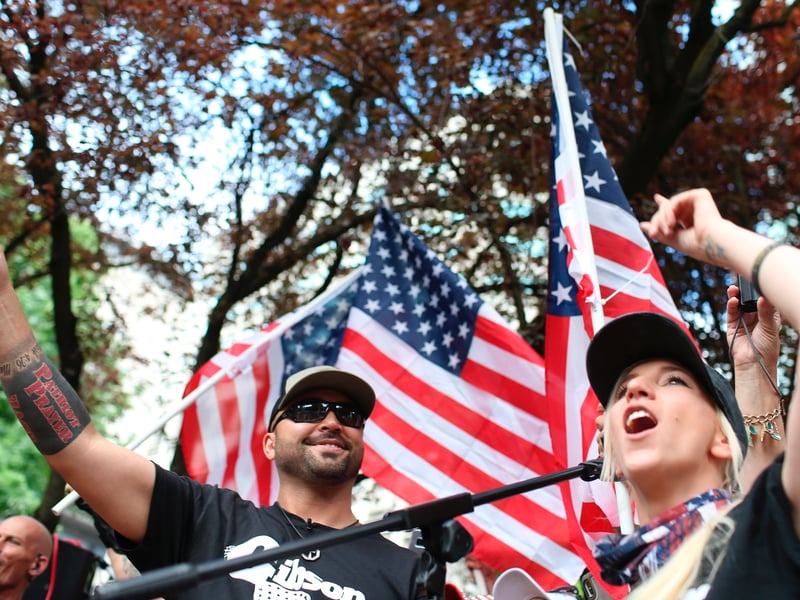
PORTLAND, Ore. (CN) — Two far-right activists have another shot at pleading that a Portland-area deputy district attorney submitted false testimony to secure an arrest warrant, the Ninth Circuit ruled on Thursday.
The second chance is largely due to the right-wing provocateurs submitting a deficient complaint that left the court to speculate about what, exactly, they were accusing various Oregon prosecutors of violating.
“This case presents complex questions of fact and law,” U.S. Circuit Judge Jay Bybee, a George W. Bush appointee, wrote on behalf of the majority of a three-judge panel. “Those questions are made all the more complicated by plaintiffs’ shotgun pleading.”
Joey Gibson, founder of the far-right group Patriot Prayer, and fellow Patriot Prayer member Russell Schultz sued Portland, Multnomah County, the county District Attorney’s Office and several individual staff members in 2023.
Gibson and Schultz were arrested in 2019 over their involvement in a street brawl that left one woman with a fractured spine. In their original complaint, Gibson and Schultz maintain they harmed no one and were merely subject to the aggression of the antifascist protesters they had followed to a bar. Video of the fracas shows Gibson repeatedly shouting “Do something!” to the people in the bar.
Gibson and Schultz accused the police of failing to investigate the antifascist protesters, but rather focusing their efforts on Patriot Prayer’s role in the incident.
According to the far-right activists, Multnomah County Deputy District Attorney Brad Kalbaugh presented knowingly false testimony from the investigating officer to a grand jury, which indicted both Gibson and Schultz for the crime of riot, though the two were ultimately acquitted.
The two accused the defendants of being “extremely hostile to political and religious beliefs associated with patriotism” and of depriving them of various constitutional and statutory rights in a shotgun pleading that the appeals court said was both inadequate and forced the defendants and courts to decipher the details.
In 2024, U.S. District Judge Marco Hernandez dismissed their complaint, finding many of the claims were immunity-barred and that Gibson and Schultz failed to tie the facts to the claims.
The Ninth Circuit agreed.
“Plaintiffs have only listed multiple purportedly unconstitutional actions without stating how the named parties took those unconstitutional actions,” Bybee wrote.
Gibson and Schultz argued that tying the facts to the claims would make the complaint unnecessarily long, but this again did not persuade the Ninth Circuit that the two were incapable of submitting an adequate complaint.
“Factual allegations, however detailed, must be tied to corresponding causes of action,” Bybee wrote.
For example, Bybee noted the right-wing activists consistently failed to identify which defendants they were accusing of certain violations, instead making vague accusations such as “at least one of the conspirators did an overt act.”
“To be sure, the complaint is replete with references to conspiracies. Indeed, in the fact section, plaintiffs have subtitled one section ‘Further Overt Acts in Furtherance of the Conspiracy,’ and another ‘Further Conduct in Furtherance of the Conspiracy,’” Bybee wrote in a footnote.
Since Schultz and Gibson failed to comply with the general rule that complaints state a claim with a short and plain statement of facts, the Ninth Circuit ruled they can replead the claims that haven’t been barred by prosecutorial or sovereign immunity.
That means the two can replead their claims against Kalbaugh, whom they accuse of falsifying an affidavit, and their claims against Multnomah County itself rather than its district attorney’s office or individual prosecutors.
The right-wing activists’ claims against Kalbaugh can be repleaded because they are based on the accusation that Kalbaugh knowingly presented false testimony to obtain an arrest warrant and filing a probable cause affidavit isn’t a prosecutorial function that warrants absolute immunity.
A spokesperson for the Multnomah County District Attorney’s Office described the lawsuit as a “procedural case that is prone to misunderstanding.”
“The Multnomah County District Attorney’s office believes this allegation to be false and has every confidence that former Deputy District Attorney Kalbaugh will prevail on the merits if plaintiffs seek to refile their claim,” the spokesperson said. “Neither the District Court nor the Ninth Circuit has found that Deputy District Attorney Kalbaugh knowingly made false statements.”
Rather, the spokesperson emphasized the decision merely allows Gibson and Schultz to pursue the matter further and attempt to prove their accusations.
“We firmly believe they will not be able to do so, because that is not what happened in this case,” the spokesperson said.
Gibson and Schultz saw the ruling as a win. D. Angus Lee, attorney for Gibson and Schultz, called the court’s decision an “important victory for accountability and basic constitutional truth.”
“Prosecutors cannot personally swear to facts to secure an arrest warrant, and then claim immunity when those sworn facts are false,” Lee said in a statement. “Today the Ninth Circuit confirmed that prosecutors cannot hide behind immunity when they personally act as a complaining witness to obtain an arrest warrant.”
This lawsuit is not the first time Gibson and Schultz have taken legal action against city and county prosecutors. In 2020, the two sued the Multnomah County District Attorney’s Office over claims that a policy to dismiss most charges from that summer’s racial justice protests was unfair because it didn’t apply to them.
U.S. District Judge Karin Immergut, a Donald Trump appointee, dismissed that lawsuit on the grounds that she couldn’t interfere with the state court’s active prosecution.
U.S. Circuit Judge Kenneth Lee and U.S. Circuit Judge Danielle Forrest, both Trump appointees, rounded out the panel.
Subscribe to our free newsletters
Our weekly newsletter Closing Arguments offers the latest about ongoing trials, major litigation and rulings in courthouses around the U.S. and the world, while the monthly Under the Lights dishes the legal dirt from Hollywood, sports, Big Tech and the arts.