
 Search Articles


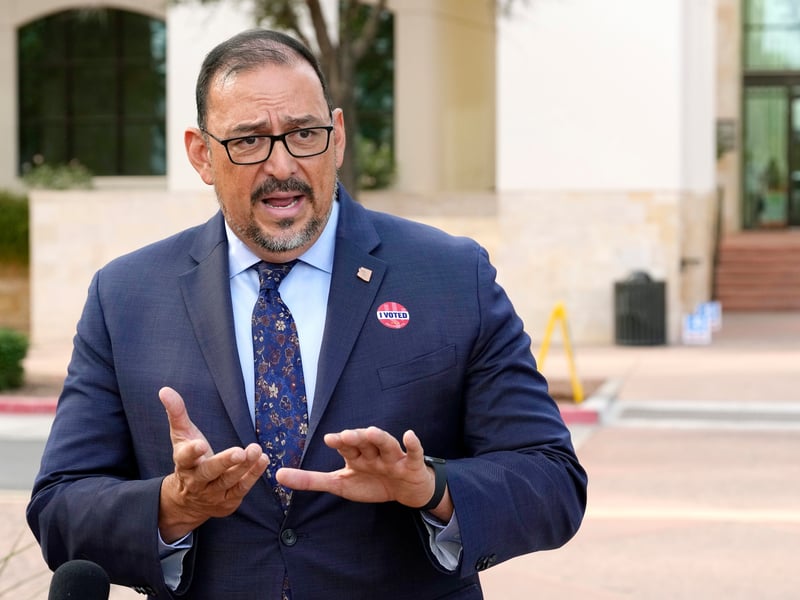
PHOENIX (CN) — The Ninth Circuit rejected claims Tuesday that Arizona violated the National Voter Registration Act, finding arguments about untidy voter rolls enabling voter fraud too speculative to carry weight.
“At the pleading stage, a plaintiff must allege facts demonstrating an invasion of a legally protected interest which is concrete and particularized, and actual or imminent, not conjectural or hypothetical,” U.S. Circuit Judges Richard Clifton and Jay Bybee, both George W. Bush appointees, and U.S. Circuit Judge Eric Miller, a Donald Trump appointee, wrote in an unpublished memorandum filed Tuesday morning.
Two Republican voters brought the lawsuit in June 2024, claiming as many as 1.2 million ineligible voters have been left on Arizona’s voter rolls. They say that their own votes will be diluted if those ineligible voters are allowed to cast ballots.
Concurring with U.S. District Judge Dominic Lanza, a Trump appointee who dismissed the complaint in December 2024, the Ninth Circuit panel found too many variables would have to line up for the plaintiffs’ vote dilution claims to come to fruition.
“As the district court observed, however, plaintiffs’ feared injury would occur only after (1) ‘an ineligible voter requests an early ballot or presents at a polling place,’ (2) that person ‘casts a ballot,’ and (3) ‘that ineligible ballot is tabulated,” the panel wrote. “If voting in person, the voter would also have to present proof of identity that ‘reasonably appears to be the same as the name and address in the precinct register.’”
At oral arguments before the Ninth Circuit on March 2, the plaintiffs claimed they had evidence of “known cases of voter fraud” in Arizona, but did not provide examples and did not claim those instances to be the result of inadequate list maintenance or that they directly diluted the plaintiffs’ votes. Instead, they argued a “substantial risk of future harm” if Arizona Secretary of State Adrian Fontes is not ordered to clean up the rolls.
“But plaintiffs cannot establish a substantial risk based on an attenuated chain of inferences,” the panel ruled. “Their injury is entirely hypothetical: Plaintiffs claim that including ineligible voters on the rolls “heightens the risk” of ineligible ballots being cast and counted by offering ineligible voters “an opportunity” to vote, “risking the dilution” of plaintiffs’ ballots. Such conjectural allegations of potential injuries and chains of hypothetical contingencies are insufficient to plead an actual or imminent injury.”
The plaintiffs also argued that confidence in the integrity of Arizona’s elections erodes as a result of improper voter roll maintenance. Like their first claim, the panel found their fears are based on nothing more than “hypothetical future harm that is not certainly impending.”
Lastly, the plaintiffs claimed they were injured by being forced to divert resources to canvassing and voter education to combat the supposed fraud.
“A plaintiff who has not suffered a concrete injury caused by a defendant’s action cannot spend his way into standing simply by expending money to gather information and advocate against the defendant’s action," the panel wrote.
Further, the judges said the plaintiffs haven’t adequately explained what the canvassing and education projects might be or how their resources might be diverted.
The National Voter Registration Act requires states to make reasonable efforts to remove ineligible voters from active voter rolls, most commonly when voters move out of state, change counties without responding to address notices, or die. State law bars the immediate removal of voters who change addresses. Instead, those voters are placed on an inactive list for two election cycles and removed only if they fail to confirm their address by the second election.
In a motion to dismiss, Fontes said Arizona removed more ineligible voters in 2022 than any state except Washington and did so at a rate 4.5% higher than the national average. He added that the plaintiffs’ broad estimates of ineligible voters — between 500,000 and 1.2 million — show they are merely guessing.
In the March 2 hearing, state attorney Kara Karlson explained one way the data the plaintiffs are using may be unreliable. If a registered voter changes addresses within Arizona and a new voter moves into the first voter’s old house, the rolls may, for some time, show that both voters are registered to that address.
Despite widespread, unproven claims of voter fraud in the 2020 and 2022 elections, there have been no similar claims made about the 2024 election.
Neither side has responded to a request for comment.
 Follow @JournalistJoeAZ
Subscribe to our free newsletters
Our weekly newsletter Closing Arguments offers the latest about ongoing trials, major litigation and rulings in courthouses around the U.S. and the world, while the monthly Under the Lights dishes the legal dirt from Hollywood, sports, Big Tech and the arts.