
 Search Articles


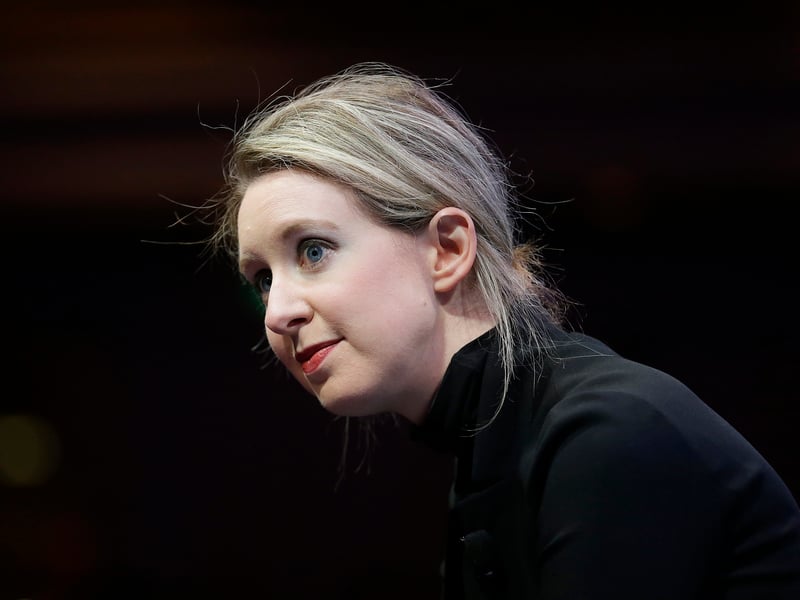
SAN FRANCISCO (CN) — This could be the end of the line for Elizabeth Holmes.
A panel of Ninth Circuit judges on Thursday unanimously denied a request by the former Theranos CEO for a full en banc panel rehearing of her high-profile 2022 fraud conviction.
“The full court has been advised of the petition for rehearing en banc, and no judge of the court has requested a vote on whether to rehear the matter en banc,” the panel said in its short, four-sentence order.
The panel’s decision marks the likely end of the former Silicon Valley superstar’s options for overturning her conviction. Although Holmes was found guilty in 2022, her last few years have been a mixture of calls for a new trial, appeals to the Ninth Circuit and ultimately beginning her 11-year sentence at a federal prison in Texas.
After the Ninth Circuit upheld her conviction in February, Holmes requested that the court rehear her case in April, saying the minor errors the panel addressed in its opinion ultimately weren’t as “harmless” as it ruled.
“The panel’s flawed opinion calls out for en banc review,” Holmes said in her petition.
Holmes also said that the panel’s findings were “illogical” and contradicted Ninth Circuit precedent, arguing that if not an en banc rehearing, she should at least receive a panel rehearing.
“In addition, the panel’s opinion suffers from significant factual mistakes relevant to the issues raised above,” Holmes argued.
Although the “Bad Blood” CEO could conceivably petition the Supreme Court for a writ of certiorari, it is unknown if the nation’s highest court would accept her appeal without some larger issue of law to decide.
The saga of Holmes’s rise and fall has been well-documented.
Holmes founded the biotechnology company Theranos in the early 2000s, which sought to revolutionize the medical lab testing field. By the early 2010s, the company claimed it could run fast, affordable and accurate blood tests using just a drop of blood in stark contrast to traditional methods.
The company’s mission and lofty vision captivated Silicon Valley and attracted investors from the highest echelons of business and the U.S. military. Investors included media magnate Rupert Murdoch, former Defense Secretary James Mattis and a lucrative partnership with Walgreens to set up Theranos blood testing centers in Arizona and California.
However, in late 2015, The Wall Street Journal broke a story exposing the limitations of Theranos’ technology, as well as internal power struggles at the company. It also revealed that pharmaceutical companies never validated their technology, as Holmes and her partner Ramesh “Sunny” Balwani claimed to investors, and the companies suggested that Theranos cheated on proficiency tests to receive laboratory certification.
The company’s futuristic blood-testing tech, it seemed, failed to deliver on its promise.
Theranos was first sued by Walgreens for breach of contract in 2016, just over a year after the article was published. A subsequent class action accused Theranos of using technology other than its own to conduct the majority of its blood tests.
After more than two and a half years of investigation, a grand jury returned an indictment against Holmes and Balwani. Both were tried separately in lengthy trials in 2022.
After a 15-week trial, a federal jury convicted Holmes and Balwani of defrauding investors and publicly misrepresenting the benefits of their now-defunct company’s blood-testing device following a monthslong trial. The court held Holmes and Balwani jointly and severally liable for $452 million in restitution, including $397 million for the 12 victims identified at sentencing and $54.5 million for two other victims, Safeway and Walgreens.
U.S. District Judge Edward J. Davila sentenced Holmes to just over 11 years in federal prison in November 2022. Just a month later, Balwani was sentenced to almost 13 years in federal prison for fraud that risked patient health by misrepresenting the accuracy of Theranos’s blood analysis technology.
Holmes and Balwani appealed soon after in 2023, challenging their convictions, sentences and the restitution order. A panel of Ninth Circuit judges heard oral arguments on the matter at a hearing in June 2024.
Holmes began her sentence on May 30, 2023, when she surrendered herself at Federal Prison Camp, Bryan, a minimum-security women’s prison in Texas.
Attorneys for Holmes did not immediately respond to a request for comment.
The panel that decided the matter included U.S. Circuit Judges Jacqueline H. Nguyen, an Obama appointee; Mary M. Schroeder, a Jimmy Carter appointee; and Ryan D. Nelson, a Donald Trump appointee.
Subscribe to our free newsletters
Our weekly newsletter Closing Arguments offers the latest about ongoing trials, major litigation and rulings in courthouses around the U.S. and the world, while the monthly Under the Lights dishes the legal dirt from Hollywood, sports, Big Tech and the arts.