
 Search Articles


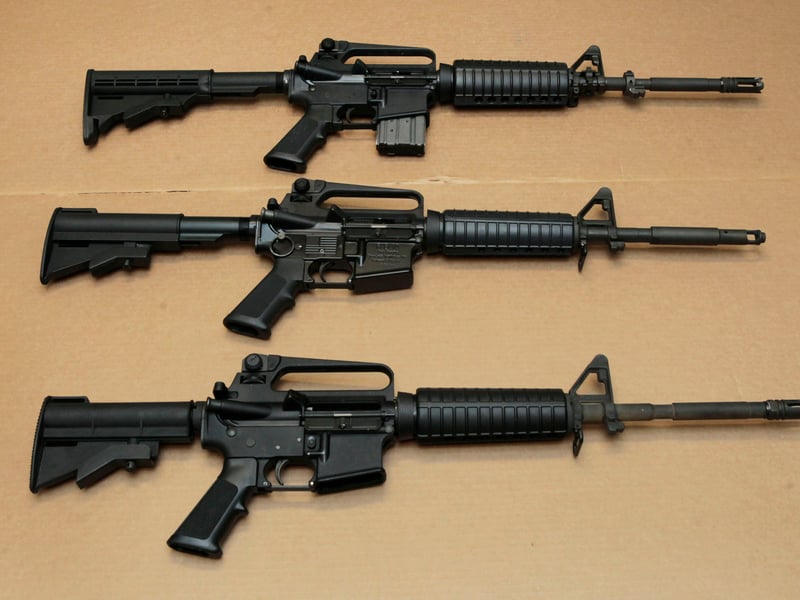
SAN DIEGO (CN) — A Ninth Circuit panel in Pasadena on Wednesday heard arguments in a long running case challenging the legality of California’s decades-old ban on semi-automatic weapons, and whether or not it violates residents’ Second Amendment rights.
Deputy Attorney General John Echeverria told the three circuit judges presiding on the panel that the Supreme Court has repeatedly determined that some weapons — like the M-16 rifle, for example — aren’t entitled to protection under the Second Amendment.
“In this case, plaintiffs are challenging eight defined categories of assault weapons that are banned because of the dangers they pose to the public, particularly in mass shootings. Those weapons configurations are defined by certain tactical features and accessories that make those weapons offensive military weapons, and not weapons of ordinary self defense. These restrictions are constitutional under Bruen ,” said Echeverria, referencing the Supreme Court’s 2022 landmark ruling New York State Rifle & Pistol Association, Inc. v. Bruen .
In that case, the Supreme Court ordered all state gun regulations must be justified by evidence of consistency with regulations from the 18th and 19th century when the Second Amendment was first enacted.
Echeverria added that the state has developed a robust record of historical analogues and gun regulations from the time period, and that assault weapons are akin to military weapons outside of the scope of the Second Amendment’s right for people to possess “ordinary” self defense weapons.
The suit was brought by San Diego County gun owner James Miller, along with a number of gun activist groups, who are challenging California’s Roberti–Roos Assault Weapons Control Act of 1989, which banned Californians from owning a number of assault weapons.
Republican Governor George Deukmejian signed the law after a gunman killed five children at Cleveland Elementary School in Stockton, California, with an AK-47 in 1989. It was the most deadly shooting at a K-12 school in the U.S. until the shooting at Columbine High School ten years later.
In 2021 U.S. District Judge Roger Benitez, a George W. Bush appointee, struck down the law, but the state appealed. The case was sent back down to Benitez in the wake of Bruen . Benitez ruled again in October 2023 that the law was unconstitutional, and the state appealed again.
The state is asking the Ninth Circuit panel to either reverse Benitez’s order, or put the case on hold until a similar case — Duncan v. Bonta — challenging the state’s ban on large capacity magazines for guns is decided.
“Under Heller and Bruen , this is a straightforward case. Those cases establish that there is an absolute right to own firearms that are in common use for lawful purposes.” said Peter Patterson, an attorney for the plaintiffs.
“Isn’t that just irretrievably circular? If there still were a federal assault weapon ban, presumably the numbers of these weapons that would be kept by individuals would be way less,” asked Senior U.S. Circuit Judge Marsha Berzon, a Clinton appointee, cutting off Patterson.
“It is not circular, because with a representative government in this country, presumably — an item that a substantial portion of the population believes is effected for lawful purposes — a ban on that item is not going to be maintained over long periods of time over broad swaths of the country, and that’s what we see here. These firearms have not traditionally been illegal in this country as the Supreme Court itself held,” Patterson said.
Millions of Americans bought assault weapons after the 1994 Federal Assault Weapons Ban sunsetted in 2004. When surveyed, the majority of individuals who have such weapons say they own them for self defense purposes, Patterson said.
“And they are indeed the most popular rifles in the history of this nation. And so the notion that the most popular rifles in the history of this nation should be deemed dangerous and unusual is just implausible,” he added.
While Americans own more than 24 million assault weapons, the plaintiffs presented data that showed those weapons were owned by only by eight million people. The number of Californians who own such weapons is proportionally even smaller, given how many of those weapons are owned by law enforcement in the state, U.S. Circuit Judge Jacqueline Nguyen, a Barack Obama appointee, said.
“And that’s, I think, where your argument on how commonly used for self defense it is, especially if we go to the local level, starts to fall apart,” Nguyen said.
Patterson responded that prior court decisions indicate that the scope of common use has to be seen in context with what guns people own across the country, not just in a particular state. He added that their argument doesn’t just rely on the number of people who own assault rifles, but that it’s the state’s burden to show how these weapons are dangerous and unusual and why they shouldn’t be owned by citizens.
When asked by Nguyen if assault rifles like AR-15s are functionally the same as banned machine guns, like M-16s, except for the fact that M-16’s have the ability to automatically fire, Patterson said “basically, yes,” except that prior court rulings found machine guns to be highly unusual to own, while automatic rifles are ubiquitous.
“We have a published order from the Duncan en banc panel saying that the state is likely to prevail on the merits in that case, so, if we sort of take that as a given, as we have to, if the state is likely to prevail in Duncan , how can you be likely to prevail, or win, here if the state wins Duncan ?” asked U.S. Circuit Judge Eric D. Miller.
“I think it does make it likely,” Patterson said, but he said there could still be some distinctions made in the classification of “arms.”
Attorney General Rob Bonta issued a statement about the case before Wednesday’s hearing.
“Weapons of war have no place on California’s streets,” Bonta said. “This has been state law in California for decades, and we will continue to fight for our authority to keep our citizens safe from firearms that cause mass casualties."
The panel did not indicate when they would issue a ruling in the case.
Subscribe to our free newsletters
Our weekly newsletter Closing Arguments offers the latest about ongoing trials, major litigation and rulings in courthouses around the U.S. and the world, while the monthly Under the Lights dishes the legal dirt from Hollywood, sports, Big Tech and the arts.