
 Search Articles


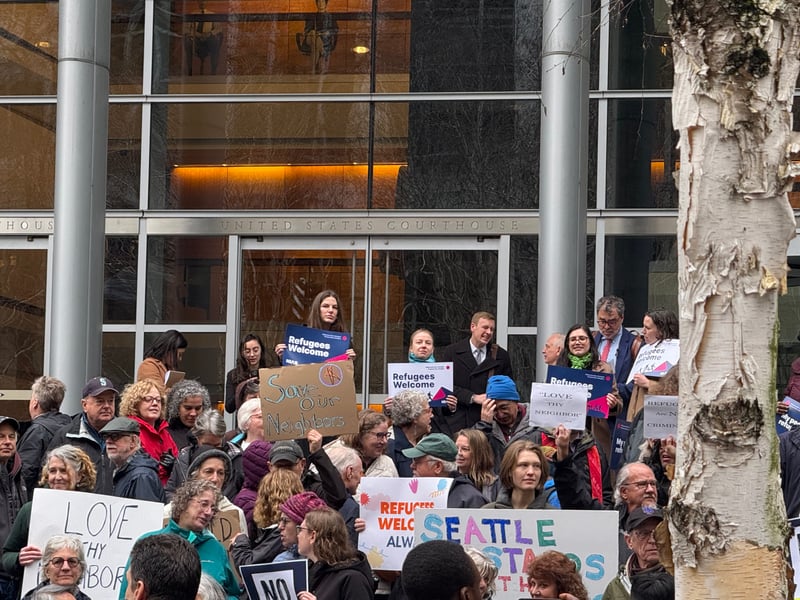
(CN) — The Ninth Circuit Court of Appeals on Monday issued a clarification of its decision last month to partially uphold a lower court’s preliminary injunction against the Trump administration’s bid to suspend refugee admissions into the United States.
The three-judge appellate panel explained that its previous order only pertained to individuals who, prior to Jan. 20, had been conditionally approved to be admitted as refugees, who had been cleared by Citizen and Immigration Services to travel to the U.S., and who had confirmable travel arrangements to come to the country.
Both the administration and the organizations who sued to thwart President Donald Trump’s executive order, titled “Realigning the United States Refugee Admissions Program," had misconstrued the carveout the Ninth Circuit panel had made for refugees who were pretty much on their way to the U.S. when Trump issued the order on his first day in office.
Such was the case with a refugee from the Democratic Republic of the Congo who was approved for resettlement in the U.S. and scheduled to travel with his family on Jan. 22. However, he was forced to shelter with his wife and baby in the parking lot of the U.S. embassy in Nairobi after their travel was abruptly canceled pursuant to Trump’s order.
The carveout was not intended to encompass as many as 130,000 individuals who, according to the administration, were conditionally approved for refugee approval before Jan. 20, the panel said.
And neither was it meant to apply to the the tens of thousands of refugee applicants who, according to the organizations that brought the lawsuit, have completed the application process and have been deemed ready for departure by the government.
“We concluded that there was little chance of irreparable harm to the government from permitting those refugee applicants who were conditionally approved and in transit,” the panel explained. “In contrast, there is a significant chance of irreparable harm to the government from compelling it to process over 100,000 conditionally approved applications that it would otherwise be permitted to discontinue.”
In a brief order last month, the panel granted the administration’s motion to stay the lower court’s Feb. 28 preliminary injunction, except as it applies to people conditionally approved for refugee status before Jan. 20. The order didn’t define “conditional approval,” leading to the conflicting interpretations that went beyond the panel’s intent.
As a result, the administration asked the panel to clarify its decision.
The case centers around the U.S. Refugee Admissions Program, which is an association of federal agencies and nonprofit organizations that work together to identify qualified refugees, admit them to the U.S. and then assist them with resettlement.
Trump’s executive order effectively dismantled the program’s infrastructure, and refugee admissions to the U.S. have come to a halt, leaving some refugees in the middle of the process stranded and organizations that help resettle refugees without funding.
In February, the Joe Biden-appointed judge granted injunctive relief to the plaintiffs — three faith-based refugee assistance agencies and nine individual plaintiffs who argue the suspension of the contracts violates Congress’ authority to make immigration laws.
 Follow @edpettersson
Subscribe to our free newsletters
Our weekly newsletter Closing Arguments offers the latest about ongoing trials, major litigation and rulings in courthouses around the U.S. and the world, while the monthly Under the Lights dishes the legal dirt from Hollywood, sports, Big Tech and the arts.