
 Search Articles


LOS ANGELES (CN) — For the second time, the Ninth Circuit Court of Appeals on Thursday reinstated an indictment against a pair of Southern California white supremacists, overruling a federal judge who said the men were singled out for selective prosecution.
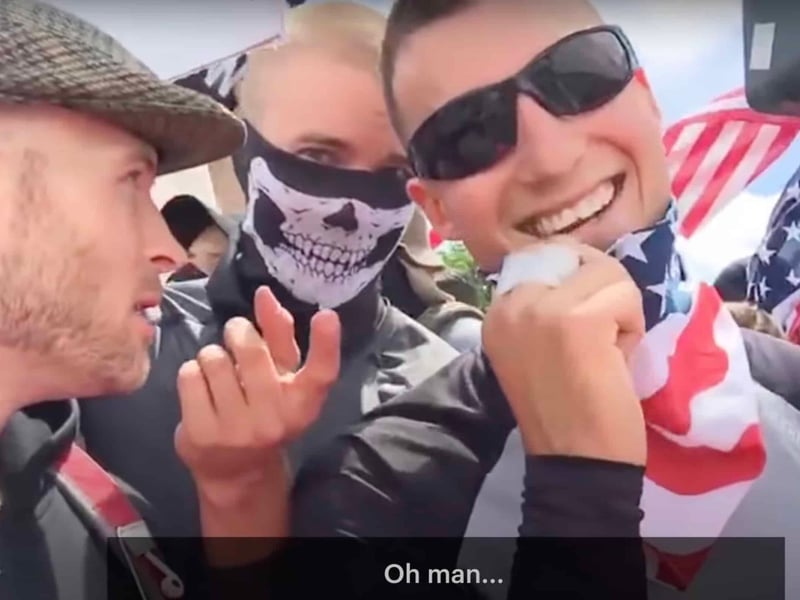
The appellate panel rejected the conclusion of Senior U.S. District Judge Cormac Carney, a George W. Bush appointee, who said federal prosecutors went after the two members of the white-supremacist Rise Above Movement while ignoring similar violence by members of far-left groups. The pair was accused of chasing down and violently attacking counter protesters at Make America Great Again rallies.
By looking broadly at the collective conduct of groups like antifa and weighing it against the individual conduct of the two defendants, Robert Rundo and Robert Boman, Carney was comparing apples to oranges, the Ninth Circuit panel said.
Moreover, the panel said, Carney was wrong to conclude that the conduct of three far-left activists was similar to that of the white supremacists. In that case, three leftist protesters were arrested at a March 25, 2017, MAGA rally in Huntington Beach, California, but weren’t ultimately charged by federal prosecutors under the Anti-Riot Act.
“First, defendants repeated their conduct at other rallies, while these individuals did not,” U.S. Circuit Judge Milan Smith Jr., also a George W. Bush appointee, wrote.
“Second, defendants behaved like leaders of an organized crime group,” she continued. “They coordinated combat training sessions; created materials to recruit others; and planned cross-country travel to commit their acts.”
In addition, the panel said, the Justice Department had a much stronger case to prosecute the two Rise Above Movement members than they had against the counterprotesters that were arrested at the Huntington Beach rally.
Unlike the counterprotesters, this pair had previous convictions for violent crimes, Smith noted. They also bragged about their exploits online, providing the government with a ready source of evidence against them.
Caroline Platt, a federal public defender representing the two men, didn’t immediately respond to a request for comment on the ruling.
Joining Smith in the unanimous decision were Senior U.S. Circuit Judge Richard Paez, a Bill Clinton appointee, and U.S. District Judge Jon Tigar, a Barack Obama appointee sitting by designation from the Northern District of California.
The panel had signaled their misgivings about Carney’s dismissal of the indictment at a hearing in Pasadena, California, last month.
At that hearing, Assistant U.S. Attorney Alexander Robbins had argued the government had no evidence that leftist activists at the Huntington Beach rally had engaged in interstate communications to plan their rioting — an essential element for a criminal case under the Anti-Riot Act.
“The reality is you [have] got to prove beyond a reasonable doubt that each of element of the Anti-Riot Act has been violated, and you don’t even come close to that,” Smith observed at the time, referencing the counterprotesters. “Whereas in the case of the defendants here, they actually put all the evidence up on the internet, bragging about what they did, the preparation and the like.”
Rundo, who was first charged in 2018, was extradited to the U.S. from Romania last year.
According to federal prosecutors, he co-founded the Rise Above Movement, a racially motivated violent extremist organization that portrays itself as a combat-ready militant group representing a new nationalist and white-supremacist movement.
The group trained in mixed martial arts. In 2017, they went to political rallies in Huntington Beach and Berkeley, California, to confront and attack counterprotesters affiliated with antifa, the loose coalition of leftist and anti-fascist groups that have become more prominent since the election of Donald Trump in 2016.
According to a ProPublica report on the Rise Above Movement, some of its members were also at the violent Unite the Right rally in Charlottesville, Virginia in 2017, where an assortment of white supremacist and neo-Nazi groups clashed with counter-demonstrators.
Rundo and other members of his group were first charged with violating the Anti-Riot Act in 2018. Carney threw out the indictment the following year after concluding that the 1968 law, enacted during the height of protests against the Vietnam War, was unconstitutionally overbroad and violated the First Amendment.
“Make no mistake that it is reprehensible to throw punches in the name of teaching Antifa some lesson,” Carney said at the time. “Nor does the court condone RAM’s hateful and toxic ideology. But the government has sufficient means at its disposal to prevent and punish such behavior without sacrificing the First Amendment.”
The Ninth Circuit reversed Carney’s decision. Federal prosecutors filed a superseding indictment against Rundo and two of his associates in January.
 Follow @edpettersson
Subscribe to our free newsletters
Our weekly newsletter Closing Arguments offers the latest about ongoing trials, major litigation and rulings in courthouses around the U.S. and the world, while the monthly Under the Lights dishes the legal dirt from Hollywood, sports, Big Tech and the arts.