
 Search Articles


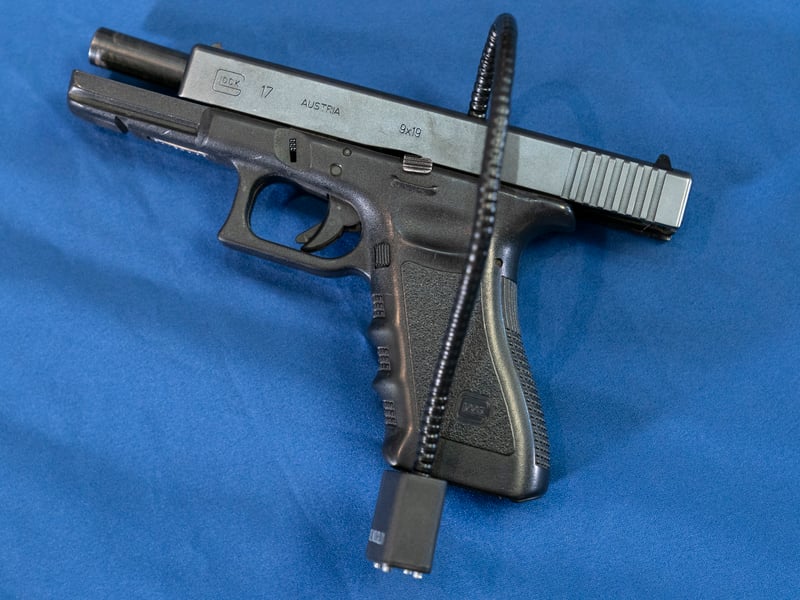
(CN) — A man convicted of possessing a firearm while being a felon, who won back his right to gun ownership last year under a recent U.S. Supreme Court ruling, had that win reversed Friday by an en banc panel of the Ninth Circuit.
The panel affirmed Steven “Shorty” Duarte’s 2021 conviction of being a felon in possession of a firearm. Convicted by a jury in the Central District of California, Duarte appealed, arguing the charge was unconstitutional because he was a non-violent offender.
Duarte based his argument on the 2022 Supreme Court decision New York State Rifle & Pistol Association v. Bruen , which made sweeping changes to the interpretation of the Second Amendment. That decision found that gun restrictions must have root in regulations from the nation’s founding, when the Second Amendment was written.
The panel on Friday ruled that the charge of being a felon in possession of a firearm is not unconstitutional when applied to non-violent felons. People facing forgery and horse theft accusations in the nation’s early days faced the death penalty, the panel wrote. Facing death, it’s easy to conclude they’d also lose their gun rights — meeting Bruen’s historical bar.
“While this is an issue of first impression for our court, we do not write on a blank slate, as courts of appeals across the nation have been wrestling with fresh challenges to the viability of [the felon firearm possession law] in the wake of Bruen ,” wrote U.S. Circuit Judge Kim McLane Wardlaw, a Bill Clinton appointee, for the majority. “Four circuits have upheld the categorical application of [the law] to all felons.”
Authorities accused Duarte of throwing a pistol out of a car after running a stop sign in Inglewood on March 20, 2020. Officers stopped the car and searched it, finding a magazine that fit into the pistol. A jury convicted him in August 2021 and he was sentenced the following year to over four years’ incarceration.
Duarte appealed in March 2022 and the Bruen decision followed months later. Using Bruen in his argument, Duarte said that the crime of possessing a firearm as a felon is unconstitutional for him, as he only had non-violent offenses.
A three-judge panel, ruling 2-1, agreed with Duarte. It found that existing precedent conflicted with Bruen , meaning the crime of being a felon and possessing a firearm couldn’t apply to non-violent felons. It also ruled that government attorneys failed to show how that crime fit into the country’s history of regulating firearms — a legal test under Bruen .
A majority of active Ninth Circuit judges then opted to rehear the appeal en banc.
On Friday, Wardlaw wrote that Bruen and United States v. Rahimi , the latter of which upheld the government’s power to temporarily prohibit people to have firearms when under domestic violence restraining orders, support stopping felons from having guns. Bruen is limited to “law abiding citizens.”
Additionally, Bruen clarified that it didn’t imply that states with “shall-issue” licensing regulations were unconstitutional. Those “shall-issue” laws require background checks to ensure felons don’t receive gun licenses.
“Together, these repeated and consistent ‘assurances’ make clear that felon-in-possession laws, like [the felon possessing a firearm law], are presumptively constitutional, demonstrating that our holding in [United States v. Vongxay] remains consistent with the Supreme Court’s articulation of Second Amendment rights,” Wardlaw wrote. “Further, these ‘assurances’ recognize a historical tradition of firearm regulation that supports the categorical application of [the law] to felons like Duarte.”
U.S. Circuit Judge Lawrence VanDyke, who sat on the three-judge panel that vacated Duarte’s conviction, concurred and dissented in part to Friday’s ruling.
VanDyke wrote that the en banc panel should have used a different legal standard to affirm Duarte’s conviction.
The Donald Trump appointee also wrote the panel erred by ruling that legislatures have wide discretion to disarm people by labeling them “felon” to any conduct they choose. He also disagreed with the conclusion that legislatures can disarm large classes of people without showing someone is individually dangerous or tends toward violence.
Representatives for the U.S. Attorney’s Office and federal public defender couldn’t be reached for comment by publication time.
Subscribe to our free newsletters
Our weekly newsletter Closing Arguments offers the latest about ongoing trials, major litigation and rulings in courthouses around the U.S. and the world, while the monthly Under the Lights dishes the legal dirt from Hollywood, sports, Big Tech and the arts.