
 Search Articles


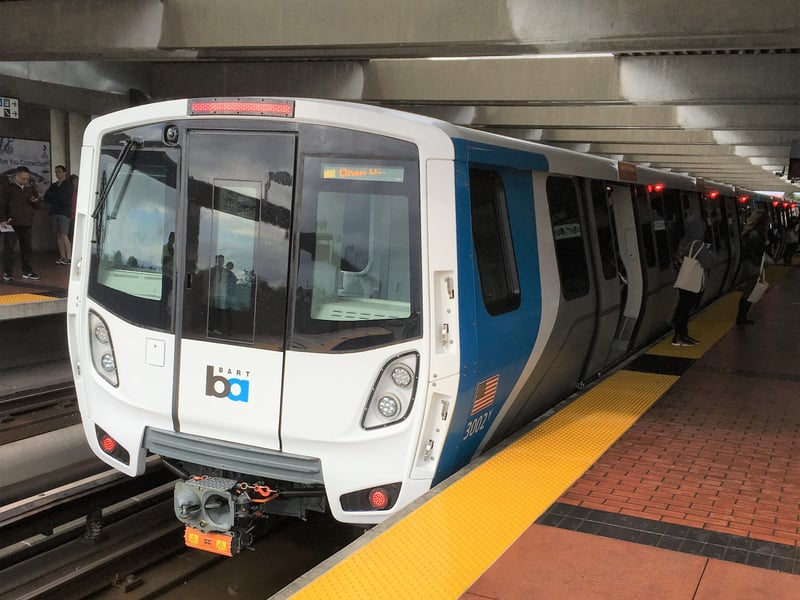
SACRAMENTO, Calif. (CN) — Friday marked a major win for pro-housing campaigners in California, as Governor Gavin Newsom signed into law new rules aimed at increasing density near transit hubs.
Authored by state Senator Scott Wiener, a San Francisco Democrat, Senate Bill 79 or the Abundant and Affordable Homes Near Transit Act creates new zoning standards within a half mile of major train stations and bus stops allowing for the construction of midrise apartments.
“For too long, California has poured billions into transit without building the housing density needed for those systems to reach their potential," the governor wrote in a statement on Friday. “SB 79 helps change that by focusing more homes near rail stations — boosting ridership, cutting traffic and pollution, lowering household costs, and expanding access to jobs, schools and services.”
“This approach not only strengthens neighborhoods anchored by transit," Newsom added: “It also protects taxpayer investments and begins to break the cycle of asking Californians to subsidize underutilized systems.”
California consistently ranks among the states with the highest costs of living.
The state’s restrictive zoning laws have been a major factor. According to the California Department of Housing and Development, housing production in the state averages less than 80,000 new homes each year, far below the 180,000 needed to keep up with annual demand. That’s also put a squeeze on renters, most of whom spend more than 30 percent of their income on rent.
SB 79 creates a two-tired system for housing height and density near transit hubs. Tier-one zoning covers areas near train stations, while tier two covers light-rail and rapid-transit bus stations.
Higher density tier-one zoning allows for nine stories adjacent to a train station, seven stories within a quarter mile and six stories within a half mile. Tier-two zoning allows for eight stories adjacent to a light-rail or rapid-transit bus station, six stories within a quarter mile and five stories up to a half mile away.
“SB 79 is a historic step toward tackling the root cause of California’s affordability crisis — our profound shortage of homes and too few people having access to transit,” Wiener said in a news release Friday. “SB 79 unwinds decades of overly restrictive land use policies that have driven housing costs to astronomical levels, forcing millions of people to move far away from jobs and transit, to face massive commutes or to leave California entirely.”
The law marks the latest effort to increase housing stock in California, after Newsom signed Assembly Bill 130 and Senate Bill 131 earlier this year.
It’s also a major achievement for California’s YIMBY or “Yes In My Backyard” movement. A riff on NIMBYs, a pejorative term meaning “Not In My Backyard,” the YIMBY movement seeks to support development that can have a positive effect on communities and society. Following the lead of cities like Tokyo, Singapore and Hong Kong, SB 79 allows homes to be built on land owned by transit agencies, thereby increasing both density and revenue.
“The world looks to California for leadership," Newsom stated. “It’s time to build modern, connected communities that fulfill California’s promise, meeting the needs of today and the next generation.”
The law was not without opponents, including some neighborhood groups and local-level officials.
That includes Los Angeles Mayor Karen Bass, who publicly expressed her opposition to the bill in a letter to Newsom in September.
“We must streamline the production of housing for all Angelenos,” Bass wrote. “However, we must do so in a way that does not erode local control, diminish community input on planning and zoning, and disproportionately impact low-resource neighborhoods.”
The governor also signed two bills related to looting and impersonation of first responders in the aftermath of the Palisades fire in Los Angeles earlier this year after police made dozens of arrests.
Assembly Bill 468 strengthens penalties “for looting during emergencies, closes loopholes that hinder prosecution, and provides additional protections to communities as they rebuild following wildfires and other disasters.” Similarly, Senate Bill 571, strengthens penalties for people who impersonate first responders.
Additionally, Newsom signed into law legislation that would prohibit the sale of certain types of semi-automatic handguns that can be converted into “automatic machine guns.” The law targets “machinegun-convertible” handguns that can be modified by a device known as a “switch.”
Newsom also signed landmark legislation that established the Bureau for Descendants of American Slavery, that will be responsible for “reparative justice initiatives.”
Newsom has until midnight on Monday to sign or veto any remaining legislation on his desk.
Subscribe to our free newsletters
Our weekly newsletter Closing Arguments offers the latest about ongoing trials, major litigation and rulings in courthouses around the U.S. and the world, while the monthly Under the Lights dishes the legal dirt from Hollywood, sports, Big Tech and the arts.