
 Search Articles


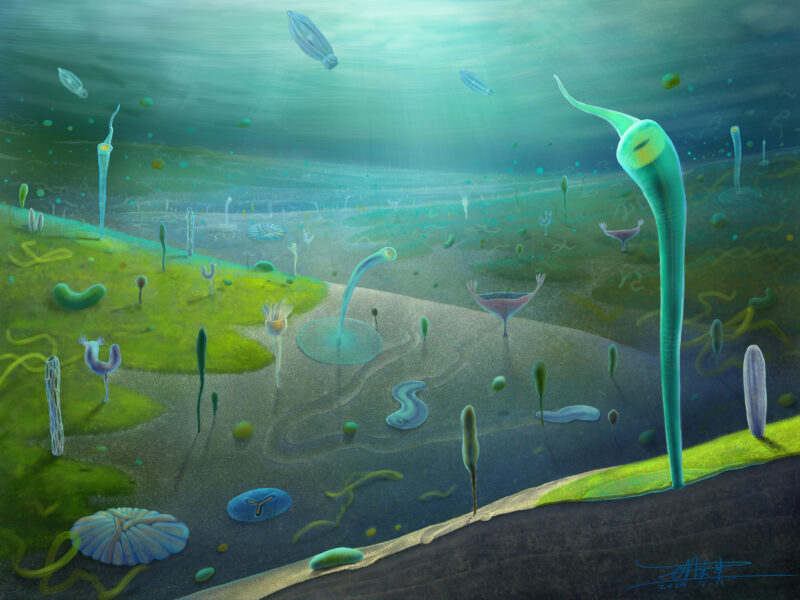
(CN) — Complex animal life may have emerged on Earth further back in the past than previously thought, according to scientists who recently found intricate fossils that push the record into a more ancient period.
A study published Thursday in the journal Science details the discoveries of delicate life found at a fossil site in southwest China. Researchers from Oxford University’s Museum of Natural History and Department of Earth Sciences and Yunnan University in China unearthed creatures identified as some of the oldest known relatives of deuterostomes, a broad group of animals that include vertebrates like fish and humans.
What is astounding about the find is the fossils appear to predate the Cambrian period, a specific time in the Earth’s ecological history that started after what is known as the Cambrian explosion — or what scientists say was the rapid diversification of animal life from simple to more complex life forms approximately 535 million years ago.
The recent discoveries, however, push the timeline of animal evolution on the planet back four million years and into another era known as the Ediacaran period. The scientists recovered over 700 specimens between the ages of 554 and 539 million years old in the Jiangchuan biota in the Yunnan Province of China.
Both known and unknown life forms were discovered at the fossil site, including predecessors of modern starfish and acorn worms grouped under the term ambulacraria. The ambulacraria fall under the taxonomic superphylum of deuterostomes — the group that includes modern day vertebrates — and were attached to the seafloor with a stalk, had a U-shaped body and a tentacled head to grab food. Other animals the researchers found appear similar to early comb jellies and a bilateral worm, meaning the organism has symmetry on both sides of the body.
“This discovery is extremely exciting because it reveals a transitional community: the weird world of the Ediacaran giving way to the Cambrian, the following time period where the animals are much easier to place in groups that are alive today,” Luke Parry, a co-author of the study and an associate professor in the Department of Earth Science at Oxford University, said in a statement. “When we first saw these specimens, it was clear that this was something totally unique and unexpected.”
The fossils were extremely well preserved too, the researchers said, and allowed them to identify “feeding structures, locomotory organs and guts” due to the specimens’ outlines in carbonaceous film. Carbonaceous film is a two-dimensional layer of carbon left by the soft tissues of an organism on rock due to high pressure compression during fossilization. It creates a dark and detailed imprint.
And how the fossils were preserved may be a key to a greater understanding of where the discovered animals fall on the evolutionary chain.
“Our results indicate that the apparent absence of these complex animal groups from other Ediacaran sites may reflect differences in preservation rather than true biological absence,” Ross Anderson, study co-author and associate professor at the Museum of Natural History at Oxford University, said in a statement. “Carbonaceous compressions like those at Jiangchuan are rare in rocks of this age, meaning that similar communities may simply not have been preserved elsewhere.”
Subscribe to our free newsletters
Our weekly newsletter Closing Arguments offers the latest about ongoing trials, major litigation and rulings in courthouses around the U.S. and the world, while the monthly Under the Lights dishes the legal dirt from Hollywood, sports, Big Tech and the arts.
Additional Reads

 A strange ‘sneezing’ signal from a newborn star April 2, 2026

 California faces second-worst snowpack in decades April 1, 2026