
 Search Articles


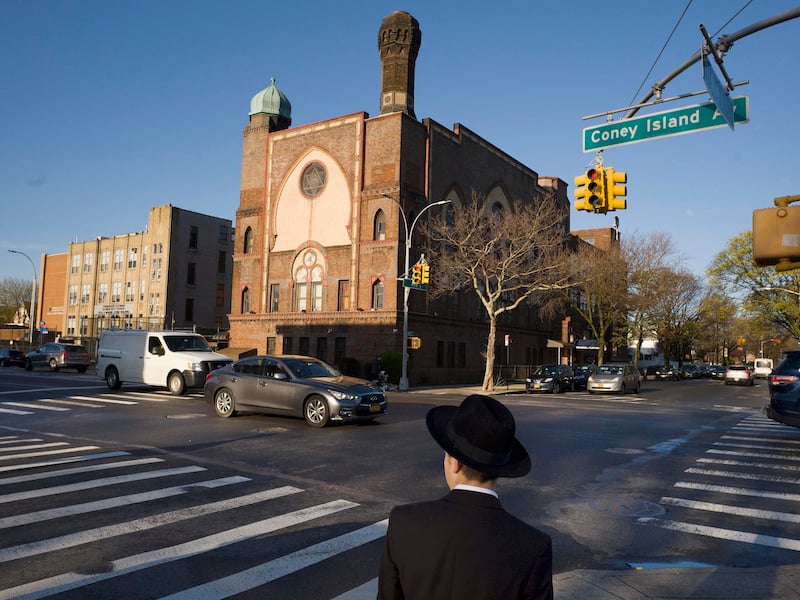
ALBANY (CN) — New York Hasidic leaders on Wednesday lost their challenge to the New York education department’s enforcement regulations of state law requiring nonpublic and religious schools to provide comparable education to public ones.
In a 10-page ruling penned by Associate Judge of the Court of Appeals Jenny Rivera, the New York Court of Appeals found that the state education department “lawfully promulgated the regulatory sections at issue here.”
The plaintiffs, comprising five nonpublic schools and the advocacy group PEARLS (Parents for Educational and Religious Liberty in Schools), are challenging state regulations that require nonpublic schools to offer an education substantially equivalent to that of public schools.
Under the provision adopted by the state education department three years ago, schools that fail to meet this standard “shall no longer be deemed a school which provides compulsory education.”
The plaintiffs argue that the regulation has led to the closure of several yeshivas, forcing Hasidic parents to “unenroll” their children and enroll them in schools that meet state standards.
The affected schools primarily focus on religious studies and offer minimal or no instruction in secular subjects such as English, math, science or history.
In its Wednesday ruling, the Court of Appeals acknowledged that the regulations do not “authorize school closures,” which PEARLS took as a victory.
“The Court of Appeals’ affirmance was based on an interpretation of the regulations that severely limits the State Education Department’s authority over yeshivas and yeshiva parents,” the group said in a statement to Courthouse News.
But the court also found that “nothing in these provisions requires that parents ‘unenroll’ their children from a nonpublic school deemed not to provide substantially equivalent instruction.”
“The provisions merely state that the nonpublic school does not provide substantially equivalent instruction — a determination well within the authority provided to the commissioner by the statute,” Rivera wrote. “The parent or custodian must determine how then to ensure their compliance with the education law.”
The department’s enforcement mechanism, which allows for institutions that don’t meet the mark to “no longer be deemed a school” fulfilling state requirements, is lawful, the court ruled.
“The regulations simply establish a mechanism by which the statutory mandate is enforced,” Rivera wrote. “In this regard, instead of being contrary to the statute’s purpose, the challenged regulations are a natural consequence flowing from the statutory language itself.”
The ruling allows the education department to decide whether nonpublic schools meet the required standards, but bars it from shutting them down or forcing student transfers. The department claims it never sought those powers, while PEARLS sees the decision as a positive outcome.
“Since schools can’t be closed by [the New York Department of Education] and children can’t be forced to unenroll, the practical effect is that parents can supplement any missing instruction through homeschooling or at an after-school program,” the group said. “That is what we have been advocating since the outset of this litigation.”
The state education department didn’t immediately return a request for comment.
Just days before oral arguments on this matter last month, state lawmakers reached a deal to give nonpublic schools more flexibility to meet substantial equivalency requirements.
Several judges on the court’s panel theorized that this might make the issue moot. But PEARLS’ attorney Avi Schick insisted that this case was about purported damage that has already been done to yeshivas as a result of the requirements.
A 2022 investigation from the New York Times found that, despite New York City yeshivas receiving hundreds of millions of dollars in government funding every year, they are “resisting any outside scrutiny of how its students are faring.”
The students enrolled in those schools tanked on standardized test scores, the Times reported, with the paper ultimately coming to the conclusion that “generations of children have been systematically denied a basic education, trapping many of them in a cycle of joblessness and dependency.”
 Follow @Uebey
 Follow @uebey.bsky.social
Subscribe to our free newsletters
Our weekly newsletter Closing Arguments offers the latest about ongoing trials, major litigation and rulings in courthouses around the U.S. and the world, while the monthly Under the Lights dishes the legal dirt from Hollywood, sports, Big Tech and the arts.