
 Search Articles


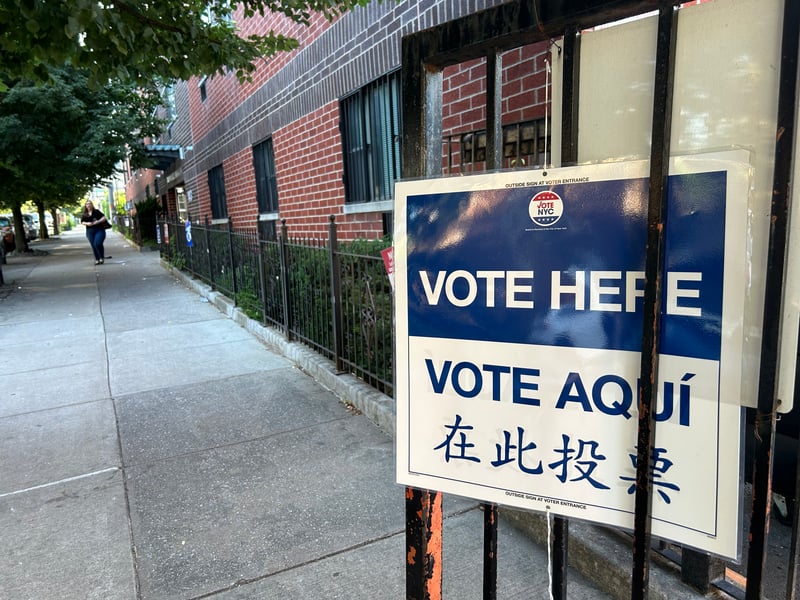
BROOKLYN (CN) — New York Republicans on Thursday slammed state leadership in a lawsuit over the contentious rule change that moves certain local elections to even-numbered years.
In a 28-page complaint filed in Brooklyn’s federal court, the New York Republican State Committee — along with three counties, eight towns and more than a dozen elected officials and candidates — claim that the law “suppresses local speech, increases racial polarization and erodes democracy.”
“Cloaked in the rhetoric of increased ‘voter turnout,’ the law is a calculated attempt to centralize top-of-the-ticket political power at the expense of local democracy,” they argue.
Currently, local elections in New York take place in odd-numbered years, while statewide and national ones are reserved for even-numbered years. But in 2023, Democratic Governor Kathy Hochul signed the scrutinized change into law, consolidating some local races to even-numbered years starting this fall.
Advocates of the change say it will boost turnout, decrease voter confusion and allow the state to consolidate resources into fewer Election Days.
But the GOP plaintiffs claim that the law violates the First Amendment by placing “severe burdens” on local candidates’ core political speech, which they say would be drowned out by national races at the top of the ticket that command more attention.
“By mandating the consolidation of local races onto ballots dominated by federal and state contests without the ability of political subdivisions to opt out, the EYEL deprives local candidates of a meaningful opportunity to convey their messages to voters, effectively pushing their races to the bottom of an exceedingly long ballot,” the groups say.
Those longer ballots will result in low-information voters, the Republicans claim, which in turn will increase their reliance on “heuristics, including partisan, racial and gender stereotypes.” They point to studies that suggest voters are unable to get reliable information about downballot contests until they get to the polls.
The Republicans say this phenomenon will worsen under the new law, as local candidates will have to work even harder to spread their messages amid the simultaneous national races.
“Campaign costs for local candidates will rise prohibitively as they seek to reach voters in an information environment dominated by presidential and congressional races, effectively depriving candidates for local offices from meaningful political communication,” the groups claim. “Put simply: Local candidates will not be able to compete in that landscape.”
It’s a similar case to one that was just heard by New York’s high court, which fielded a challenge from local Republicans who charged the even-year law as one that would unduly burden rural voters who cared more for downballot races than the national ones.
But the court rejected their claims and greenlit the law, ruling that “any alleged injury is minor as compared to the state’s legitimate and substantial interest in increasing voter turnout and reducing confusion.”
In the new federal case, the Republicans are seeking a court order that gives localities the choice to opt out of the new election law. They’re also seeking a declaration that the change violates both the First Amendment and the 14th Amendment of the U.S. Constitution.
They’re represented by the New York City-based Brewer, Attorneys & Counselors, which notably defended the National Rifle Association in its yearslong corruption probe brought by New York Attorney General Letitia James until the firm split with the NRA late last year.
The law moves only certain local elections around the state to even-numbered years, excluding some city elections and certain races for county positions like clerk, sheriff, district attorneys and local judges.
New York City is unaffected by the law. The city is leaving that issue up to voters, who can elect to move city elections to even-numbered years on their ballots Nov. 4.
 Follow @Uebey
 Follow @uebey.bsky.social
Subscribe to our free newsletters
Our weekly newsletter Closing Arguments offers the latest about ongoing trials, major litigation and rulings in courthouses around the U.S. and the world, while the monthly Under the Lights dishes the legal dirt from Hollywood, sports, Big Tech and the arts.