
 Search Articles


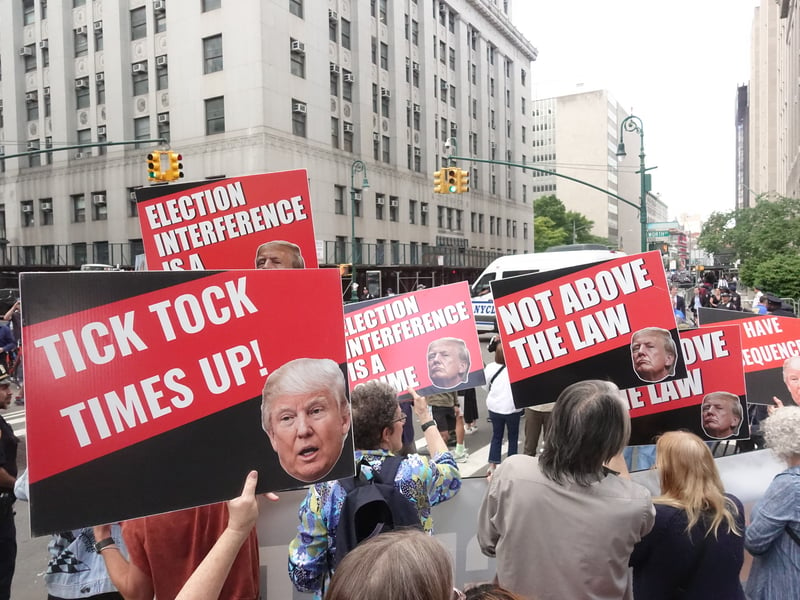
MANHATTAN (CN) — A New York federal judge on Wednesday signaled he was unlikely to grant President Donald Trump a transfer of his so-called “hush money” case from state court to Manhattan federal court, where Trump is hopeful to present presidential immunity arguments that would overturn his 2024 criminal conviction for falsifying business records to cover up payments to bury bad press in the run-up to the 2016 presidential election.
“Here, there’s nothing for me to do, and I’m not sure that saying ‘here’s the judgment, go appeal it’ is sufficient,” U.S. District Judge Alvin Hellerstein said Wednesday in response to Trump’s motion to sign off on the case transfer to the Southern District of New York federal jurisdiction.
“The fact that someone is unhappy with the strategic decision they got does not render it good cause,” Hellerstein, a Bill Clinton appointee, told Trump’s lawyers during oral arguments that ran nearly three hours.
A jury in Manhattan state supreme court convicted Trump in May 2024 on 34 felony counts of falsifying business records, which stemmed from a sweeping and salacious hush money scheme aimed at quashing bad press during his 2016 presidential campaign.
The jury found that Trump orchestrated his former personal attorney and “fixer” Michael Cohen to pay $130,000 to adult film star Stormy Daniels, who Trump was concerned would share details from their 2006 sexual encounter at an inopportune time during the election. When repaying Cohen, Trump disguised the payments as standard legal fees, sometimes signing those illicit checks from the Oval Office during his first presidential term, witnesses testified.
Trump, now in his second term, argues the jury should never have heard some of the trial testimony due to a federal evidentiary immunity specific to the president.
Under the federal officer removal statute, federal courts have jurisdiction over civil actions against any officer of the United States for their official duties.
A panel of three Second Circuit judges sent the case back to Hellerstein in the Southern District of New York, finding in its November ruling that Hellerstein should address whether Trump’s conviction ran afoul of the Supreme Court’s recent ruling for broad presidential immunity.
In court filings to Hellerstein, Trump cites the July 1, 2024, Supreme Court finding in Trump v. United States, that the president is entitled to broad and absolute immunity from criminal prosecution with respect to the exercise of his “core constitutional powers” and that he is further entitled to “at least a presumptive immunity” from prosecution for acts within the “outer perimeter of his official responsibility.”
“The fact that the Supreme Court issued its landmark presidential immunity decision — including a broad evidentiary immunity prohibiting prosecutors from inviting a jury to probe a president’s official acts — after his state criminal trial supplies good cause for post-trial removal,” Trump’s defense argued in the latest motion to transfer the case.
During oral arguments Wednesday, attorney Jeffrey Wall argued that Trump has not voluntarily relinquished the right to a federal forum and asked Hellerstein to grant leave for removal to “let us fight it out at the Second Circuit.”
“Should the scope and applicability of federal constitutional immunity for the president of the United States be decided in a federal court or a state court?” he asked.
Trump’s lawyers also argued the hush money conviction rests on an intent to violate a state law that is preempted by the Federal Election Campaign Act.
Trump also argues that New York Supreme Court Justice Juan Merchan allowed the jury to see evidence that should have been off-limits pursuant to the Supreme Court’s ruling for broad presidential immunity.
He pointed to testimony from Hope Hicks, one of his top White House aides during his first term, who told jurors how she was tasked with killing certain stories about Trump’s adulterous behavior.
Merchan previously ruled that Hicks’ testimony had nothing to do with Trump’s “official acts” as the commander in chief.
Wall said the Supreme Court majority that ruled for the president’s constitutional immunity would be “stunned” to see immunity flouted in the hush money case.
“This is exactly what the Supreme Court had in mind,” the Sullivan & Cromwell lawyer said.
Hellerstein said Trump sought “two bites at the apple” by strategically first bringing the Supreme Court decision to state court and then missing the statute window to bring it to attention in federal court.
“It seems that you’re waiting too long; that’s 59 days after Trump v United States,” Hellerstein said.
“I think that’s what any reasonable lawyer would have counseled their client,” Wall responded.
“Not so,” Hellerstein rebutted. “Not so.”
Before the Supreme Court’s immunity ruling, Hellerstein had already ruled Trump should not be allowed to move the case to federal court because the hush money payments were “private unofficial acts.” Trump tried again after the ruling came down, but Hellerstein denied that motion, too.
On appeal, the state of New York reiterated arguments that the charges in the hush money case are based on private, “wholly unofficial conduct” and that Trump’s federal preemption claims are meritless.
“More fundamentally, however, defendant’s argument ignores the removal statute’s critical focus on charges based on official acts instead of mere evidence of such acts,” the prosecutors wrote in their appeals brief (emphasis in original). “The mere introduction of evidence, even assuming that it described official presidential acts, does not transform the nature of state charges that are based on wholly unofficial conduct.”
Hellerstein did not rule from the bench on Trump’s motion but promised an opinion shortly.
Ten days before Trump’s second inauguration in January 2025, Merchan sentenced Trump to unconditional discharge on Friday on 34 counts of falsifying business records, cementing his status as a convicted felon in New York City but sparing the then-president-elect from having to serve a tangible punishment like community service or a fine.
 Follow @jruss_jruss
Subscribe to our free newsletters
Our weekly newsletter Closing Arguments offers the latest about ongoing trials, major litigation and rulings in courthouses around the U.S. and the world, while the monthly Under the Lights dishes the legal dirt from Hollywood, sports, Big Tech and the arts.