
 Search Articles


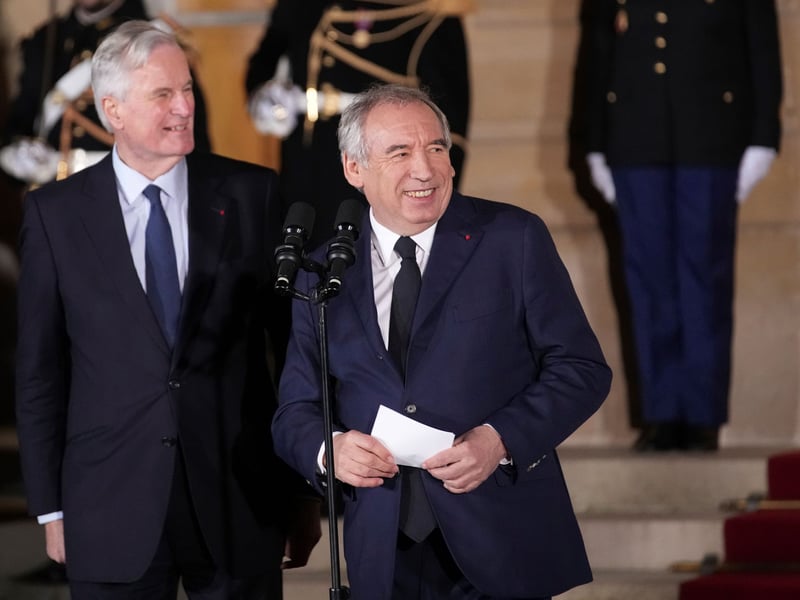
MARSEILLE, France (CN) — François Bayrou, France’s fourth prime minister this year, looks eager to move away from the trend of political extremes calling the shots as his nation grapples with debt, foreign wars and political instability.
On Thursday, the centrist Bayrou united a host of political parties in the Hôtel de Matignon, the prime minister’s official residence in Paris, for talks to form a government.
Notably absent were the National Rally and France Unbowed, the controversial far-left party with Jean-Luc Mélenchon at its head. The centrist Bayrou didn’t leave the far ends of the spectrum completely out of the discussion, though.
Earlier this week, Bayrou hosted extreme-right National Rally leader Marine Le Pen and Jordan Bardella — her 29-year-old protégée — for independent talks. Le Pen said the discussions were “more positive” than previous exchanges with Michel Barnier, the former prime minister whose tenure lasted just three months.
A survey released Thursday found about 64% of people in France are dissatisfied with Bayrou’s appointment. The poll, conducted for Sud Radio by Ifop-Fiducial, asked over 1,000 people; 67% thought Bayrou’s government would soon face no-confidence motions.
French President Emmanuel Macron likely appointed Bayrou partly because he looks set to expand cooperation among a wider group of representatives than his predecessors.
When the government collapsed in early December after Le Pen and a leftist coalition joined forces to push a no confidence vote, Macron’s big task was finding a candidate who could bring France out of a series of political crises that paralyzed the country for months.
“Nobody knows the difficulty of the situation better than I do,” Bayrou said Friday. “I am not unaware of the Himalaya that stands before us. I believe that this issue, the deficit and debt, is an issue that poses a moral problem, not just a financial one.”
He faces a steep climb, with the same parliament that ousted Barnier. He must push through a stopgap budget bill before the end of the year, and move on to talks for a fixed budget in 2025.
With the deficit rising toward 6% of GDP at the end of the year, France faces economic malaise and pressure from the European Union. Neighboring Germany’s political and financial woes have left Europe with a power vacuum as Donald Trump is set to enter the White House, bringing with him questions about the wars in Ukraine and the Middle East.
Barnier ultimately seemed to be too left for the right — which officially balked at what they called a heavy handed budget bill — and too right for the left, which simmered in resentment that despite winning a majority in the summer’s snap elections, they didn’t get a prime minister from their own ranks.
“Bayrou is someone who really represents centrism in France,” Luc Rouban, a senior research fellow at Sciences Po Paris, told Courthouse News. “He has always tried to stabilize centrism in France, which has been very difficult, because deep down, in France centrism has always been a form of the moderate right, in a way.”
Although Bayrou has been an active figure in France’s political sphere since the 1980s, a longtime mayor of the southwestern town of Pau, a three-time presidential candidate, and an ally of Macron, he remained relatively under the radar.
He grew up in the Pyrenees, the mountain range between France and Spain, and doesn’t come from privilege. Politicians in France are often criticized as being out of touch; they tend to graduate from the same handful of universities and have affluent upbringings.
“He is someone who comes from a modest background, who is not a child of French high society,” Rouban said.
Although Bayrou has met mixed reactions generally better than Barnier, months of political chaos have crushed many people’s enthusiasm for this next stage.
On Wednesday afternoon, Joel — who preferred to withhold his last name — was sitting next to a convenience shop in the Gare Saint Charles train station in Marseille. He was wearing Windsor sunglasses and a bomber jacket, and had tousled gray hair.
“I think Bayrou is the right person, but it’s too late,” he told Courthouse News. “For the moment, I don’t think anything special about him.”
Joel lived in Switzerland for 45 years, and appreciates that country’s concordance system, which seeks to involve as many political groups as possible and is therefore rooted in compromise.
“It’s not possible here because it’s not the same culture. We’ll always be in a space of monarchy,” he said, shrugging. “I think it’s the end of a system.”
One woman smoking a cigarette while waiting for the bus said she hasn’t followed the political crisis and doesn’t know who Bayrou is. Another woman in the waiting area of the train station said that she “doesn’t follow the news anymore,” crossing her hands and laughing. One man sipping an espresso said simply: “I think nothing” about the new prime minister.
Bayrou’s greatest achievement could be to avoid another government collapse before summer, when France could theoretically hold new legislative elections. Rouban argues that Bayrou will likely coast until then.
“He’ll make a consensual budget, do a little bit of safeguarding,” Rouban said. “But effectively, he will not be able to make absolutely decisive decisions — I mean really new and original decisions.”
 Follow @lilyradz
Subscribe to our free newsletters
Our weekly newsletter Closing Arguments offers the latest about ongoing trials, major litigation and rulings in courthouses around the U.S. and the world, while the monthly Under the Lights dishes the legal dirt from Hollywood, sports, Big Tech and the arts.