
 Search Articles


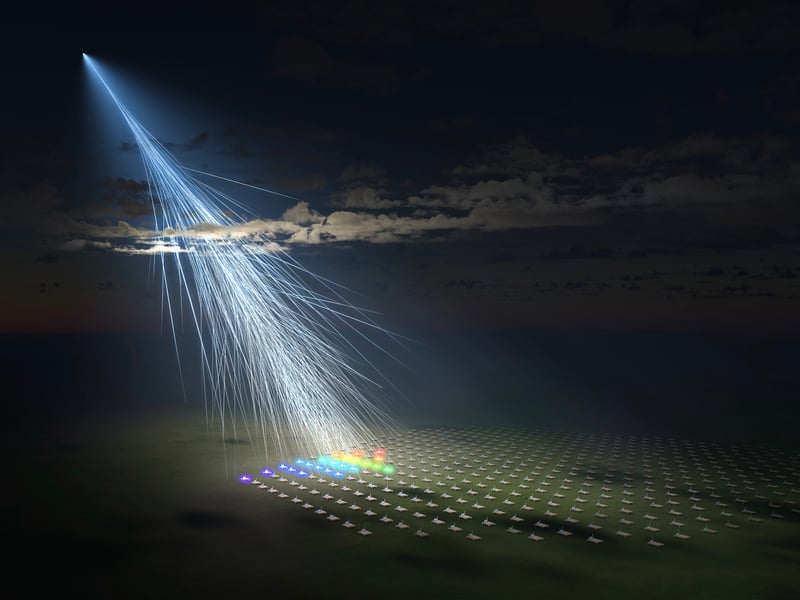
(CN) — Researchers out of Osaka, Japan, have discovered a new high-energy particle falling from space to earth’s surface — another example of mysterious cosmic rays.
We know very little about cosmic rays — where they come from, what they’re made of, indeed, what they even are. We do know that they contain enormous amounts of energy. And the newly discovered particle is one of the highest energy particles ever observed.
“When I first discovered this ultra-high-energy cosmic ray, I thought there must have been a mistake, as it showed an energy level unprecedented in the last three decades,” said Toshihiro Fujii, an associate professor at Osaka Metropolitan University, in a written statement.
Fujii is the lead author of a paper about new particle, being published Friday in the journal Science. He and an international team of scientists have been looking into cosmic rays — a form of high-energy radiation that comes from outside our solar system — since 2008 using the Telescope Array, composed of 507 scintillator surface stations spread out over 430 square miles in Utah.
On May 27, 2021, the researchers detected a particle with an energy level of 244 exa-electron volts, an almost unimaginably high level of energy. One exa-electron volt is roughly a million times more energy than has ever been achieved by the most powerful particle accelerators in the world.
The most energetic cosmic ray ever observed was dubbed the “Oh-My-God” particle. Discovered in 1991, its energy level was measured at 320 exa-electron volts.
Fujii and his colleagues have named their newly discovered particle Amaterasu, a Shinto deity from Japanese mythology that means “the great divinity that illuminates heaven.''
“No promising astronomical object matching the direction from which the cosmic ray arrived has been identified, suggesting possibilities of unknown astronomical phenomena and novel physical origins beyond the Standard Model,” said Fujii in his statement, referring to the Standard Model of particle physics, a general framework that describes both he substance and behavior of the fundamental building blocks of the universe.
“In the future,” Fujii added, “we commit to continue operating the Telescope Array experiment, as we embark… on a more detailed investigation into the source of this extremely energetic particle.”
 Follow @hillelaron
Subscribe to our free newsletters
Our weekly newsletter Closing Arguments offers the latest about ongoing trials, major litigation and rulings in courthouses around the U.S. and the world, while the monthly Under the Lights dishes the legal dirt from Hollywood, sports, Big Tech and the arts.