
 Search Articles


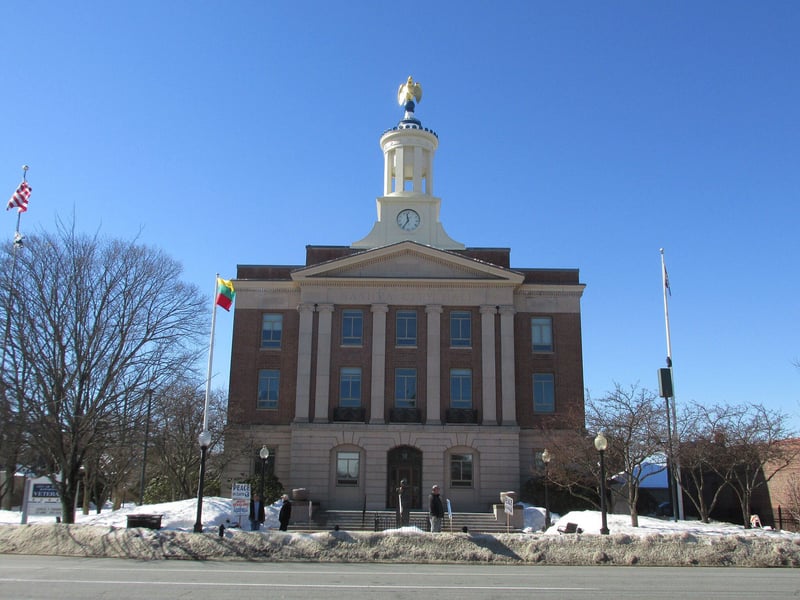
BOSTON (CN) — A New Hampshire city that allowed citizens to fly flags with political and other messages on a “citizen flagpole” outside City Hall could censor any flags it didn’t like, the city told the First Circuit Tuesday — but the court sounded skeptical that the practice was allowed under the First Amendment.
“Here’s the problem,” U.S. Circuit Judge Sandra Lynch said at oral argument. The city allowed flags “that are brought to it by private seekers who own the flags, design the flags and come up with the messages the flags display. The government is using the force of government to choose among those viewpoints. And that is what a government cannot do.”
Starting in 2017, the city of Nashua allowed anyone to fly flags outside City Hall, hosting flags in support of Pride Month, Lutheranism, the Libertarian Party, Brazilian Independence Day, the Lions Club and organ donation.
But when Bethany Scaer flew a flag in 2020 opposing transgender women in women’s sports, the city took it down the next day. Scaer sued for a violation of the First Amendment, but a lower court sided with the city and denied a preliminary injunction.
A similar case involving Boston’s City Hall flags led the First Circuit to hold in 2021 that the city could censor speech on its own property. But the next year, the Supreme Court unanimously disagreed and said Boston shouldn’t have prohibited a Christian flag.
However, the Supreme Court suggested the result might have been different if Boston hadn’t simply allowed anyone to fly a flag and had made it clear that the flags represented official government speech. A week after that decision, Nashua adopted a new policy saying that it would allow flags only if they were “in harmony with city policies and messages that the city wishes to express and endorse.”
In 2024, after this lawsuit was filed, the city scrapped the citizen flagpole altogether and went back to flying only the official Nashua city flag. Scaer says that’s legal, but she wants nominal damages and for the court to hold that Nashua can’t ever return to the 2022 policy because it’s unconstitutional.
Lynch, a Bill Clinton appointee who in 2021 joined the First Circuit opinion that was reversed in the Boston case, said it was “doubtful” the lower court got it right here. The city “decided which messages it wanted to endorse and which it didn’t, and that is the essence of viewpoint discrimination.”
Nashua’s attorney, Steven Bolton, acknowledged that it was viewpoint discrimination but said the city could legally discriminate because, once the city approved a flag, it was now the city that was speaking and not just a private citizen.
Scaer’s lawyer, Nathan Ristuccia of the Institute for Free Speech in Washington, D.C., disagreed. “A government may not turn private speech into government speech just by having final approval. The city doesn’t own the flags or edit the flags or control them in any way.”
The city “must acquire property rights or alter or edit the speech,” he said. “Nashua did neither.”
Bolton countered that, under the 2022 policy, the city required citizens to submit a photo of the flag and a statement of the message the flag was intended to convey.
But U.S. Circuit Judge Gustavo Gelpí, a Biden appointee, sounded skeptical that was enough. “People can present flags, and some are chosen over others. That is not the government saying, ‘This is what we believe in.’”
Lynch cited a 2017 Supreme Court case called Matal v. Tam holding that the government couldn’t reject a trademark for an Asian-American band called The Slants on the grounds that it was derogatory, because a trademark is private speech even though the government approves it.
“Why isn’t your opponent correct that mere approval of private speech doesn’t make it government speech?” Lynch asked Bolton. “That falls exactly into the trap the Supreme Court warned against in the Tam case.”
Bolton responded that the Boston case was more on point, and Lynch replied, “Yes, I know. I was reversed in that case.”
But Bolton pressed on and argued that, unlike a demonstration outside City Hall, passersby were likely to assume that a flag represented official government policy. If the city can’t censor a Nazi flag, he said, then people might assume that the Nashua city government was in favor of Nazism.
“There’s no need for the city to own the flag or design the flag or amend the flag to say something different,” he insisted. “A government can recognize good ideas and bad ideas without having invented them itself.”
U.S. Circuit Judge Jeffrey Howard, a George W. Bush appointee, rounded out the panel.
Subscribe to our free newsletters
Our weekly newsletter Closing Arguments offers the latest about ongoing trials, major litigation and rulings in courthouses around the U.S. and the world, while the monthly Under the Lights dishes the legal dirt from Hollywood, sports, Big Tech and the arts.