
 Search Articles


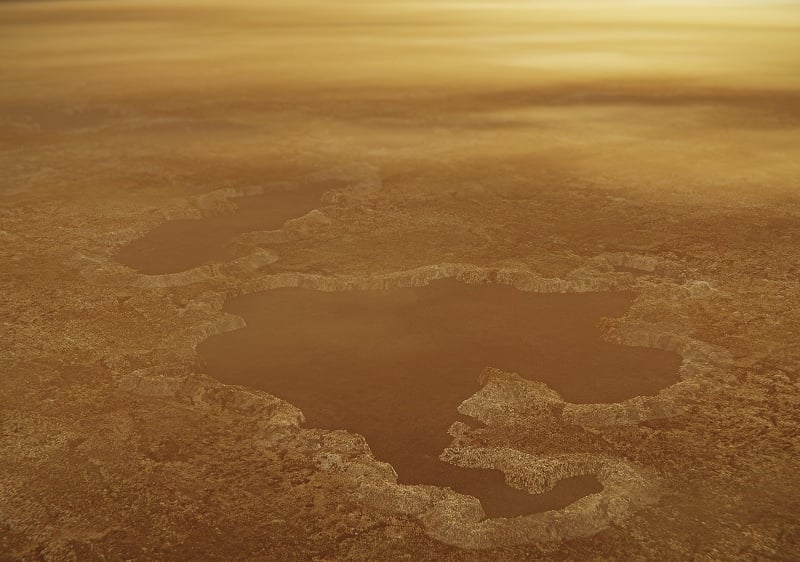
(CN) — A new analysis of data collected by the Cassini–Huygens mission has given astronomers a better understanding of the three hydrocarbon seas on Titan, Saturn’s largest moon.
Titan is shrouded by a thick, opaque atmosphere of hydrogen and methane, almost like smog. We knew little about its surface until the Cassini–Huygens mission. NASA’s Cassini space probe orbited Saturn from 2004 to 2017, analyzing the planet and some of its moons with radar, while the European Space Agency’s Huygens probe landed on Titan in 2005.
The Huygens probe recorded images for the first time of Titan’s surface, revealing a landscape of large, dark sand-like dunes, flat plains and polar regions containing large lakes and seas, which have been named Kraken Mare, Legeia Mare and Punga Mare. The lakes and seas are made up not of water but of liquid methane; the rain, too, is liquid methane.
Valerio Poggiali, an Italian-born research associate at the University of Cornell, and some of his colleagues analyzed bistatic radar data collected by the Cassini probe in an effort to better understand Titan’s seas. They found that the three seas may have significantly different compositions — that is, they may have different methane-ethane mixing-ratios. They also found evidence the seas may have small surface waves, and that there may be active tidal currents.
Results of their analysis were published Tuesday in the journal Nature Communications.
Discovered in 1655 by the Dutch astronomer Christiaan Huygens, for whom the European lander was named, Titan is the second largest moon in our solar system, larger than the planet Mercury and 80% more massive than Earth’s moon. Like the Earth, it has seasons, and a methane cycle similar to our water cycle. It is often compared to Earth, with many Earth-like features, including wind, rain, dunes, rivers, lakes and seas — though its dunes are not made up of sand, and its water is not liquid water, at least not on its surface.
Titan’s temperature is a frigid minus 290 degrees Fahrenheit, and its surface is frozen. Beneath the surface, however, is thought to exist an ocean of liquid water. For some time, astronomers wondered if that underground ocean was capable of sustaining microbial life. But a paper published earlier this year argued that that is unlikely, based on the available data.
The moon remains the most distant body that humans have ever landed a space probe on. NASA plans to send a robotic rotorcraft to Titan’s surface as part of the Dragonfly mission, set for launch in 2028. The aircraft would arrive on Titan in 2034 to study the moon’s prebiotic chemistry and ability to support life.
 Follow @hillelaron
Subscribe to our free newsletters
Our weekly newsletter Closing Arguments offers the latest about ongoing trials, major litigation and rulings in courthouses around the U.S. and the world, while the monthly Under the Lights dishes the legal dirt from Hollywood, sports, Big Tech and the arts.