
 Search Articles


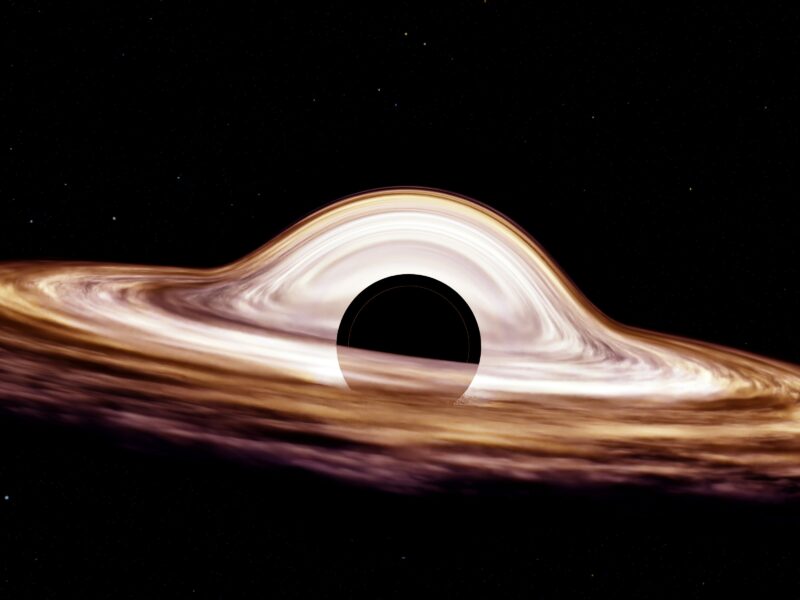
(CN) — A black hole collision may have exposed a part of the universe normally hidden from view.
Researchers analyzing gravitational waves from the event say they detected a signal carrying information from near the black hole’s event horizon, the point beyond which nothing can escape.
The findings, published Wednesday in Nature, stem from observations of GW250114, a black hole merger detected by the National Science Foundation’s Laser Interferometer Gravitational-Wave Observatory in January 2025.
Because nothing can escape an event horizon, researchers have had few ways to study one directly.
While previous research suggested that a type of gravitational-wave signal known as a direct wave could emerge from the violent aftermath of a black hole merger, no such signal had been observed.
Analyzing data from GW250114, researchers identified what appears to be that missing piece.
The signal behaved like a rapidly fading oscillation. According to the researchers, its frequency was linked to the rotation of the newly formed black hole, while the rate at which it faded was tied to the object’s intense gravity.
“The most significant finding is that gravitational waves may be giving us a new way to study the edge of a black hole,” corresponding author Sizheng Ma of the Perimeter Institute for Theoretical Physics in Ontario, said in an email. “The signal appears to carry an imprint from the region very close to the final black hole’s horizon, the famous ‘point of no return.’”
Researchers say the observation could open a new avenue for studying event horizons, which remain among the least accessible features of black holes.
“It is important because the event horizon has always been one of the most defining, but also most difficult-to-probe, features of a black hole,” Ma said.
Because nothing escapes from inside an event horizon, scientists cannot observe it directly with light. Gravitational waves, however, provide a different source of information.
“When two black holes merge, they violently disturb spacetime in the region very close to the final black hole’s horizon,” Ma said. “The direct wave is a way for part of that near-horizon disturbance to travel outward and reach our detectors.”
The signal may also offer clues about the black hole left behind by the merger.
“The signal carries information about how fast the remnant black hole is rotating and how quickly signals from the near-horizon region fade away because of the strong gravity,” Ma said.
Researchers caution that the findings remain preliminary.
The signal was detected in an unusually strong and clean merger event, and confirming the interpretation will require studying additional black hole collisions.
“We are encouraged by the result, but also cautious,” Ma said.
Future work will focus on refining models of the direct wave and searching for similar signatures in other gravitational-wave events.
As detectors become more sensitive, researchers hope the method could become a new way of studying the regions closest to black hole horizons.
“For us, that is the most thrilling part: something that once sounded almost like science fiction, learning about black-hole horizons through observations, is becoming a real scientific program," Ma said.
Subscribe to our free newsletters
Our weekly newsletter Closing Arguments offers the latest about ongoing trials, major litigation and rulings in courthouses around the U.S. and the world, while the monthly Under the Lights dishes the legal dirt from Hollywood, sports, Big Tech and the arts.
Additional Reads

 Whale calls reveal cultural evolution June 23, 2026