
 Search Articles


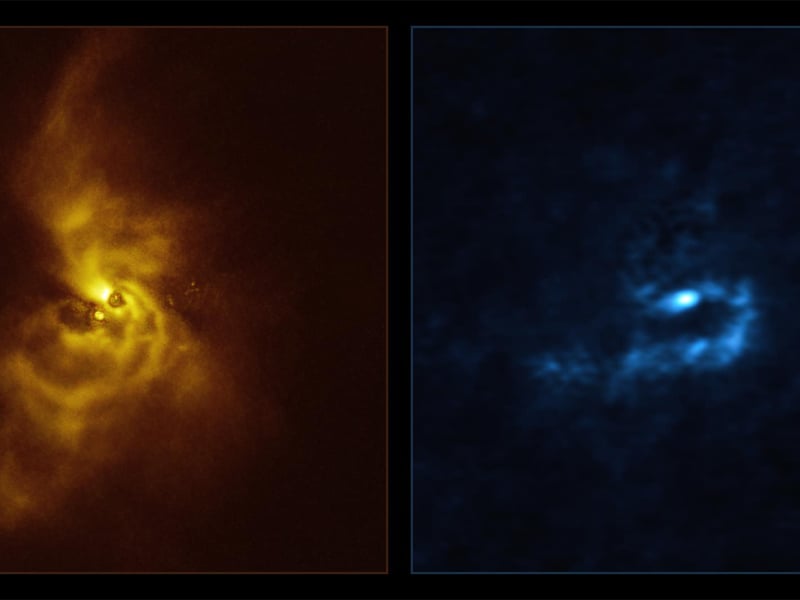
(CN) — A young star 5,000 light years away from Earth, dubbed the not-so-catchy V960 Mon, first caught the eye of astronomers in 2014 when suddenly, without any warning, its brightness increased more than 20-fold.
It was then that researchers began training their telescopes on V960 Mon, and they noticed something startling: material was orbiting around the nascent star, in the vague shape of spiral arms. A solar system was being born.
A new image, published today for the first time as part of a paper in “The Astrophysical Journal Letters,” offers a deeper look at the new solar system, as well as a clue about how giant planets like Jupiter form.
“The image reveals a vast structure of intricately shaped scattered light with several spiral arms,” the paper’s abstract states.
“We still don’t know how planets form,” said Philipp Weber, a researcher at the University of Santiago, Chile, who led the study. “We’re starting, right now, to get observational evidence. This observation is a puzzle piece in this process of planet formation, and can help shine a light on it.”
There are two competing theories of how giant planets are formed: core accretion, where bodies slowly gather more and more material; and gravitational instability, which has been long believed to be the way stars come into being. In recent years, the latter theory has become somewhat disfavored, as applied to planets, largely due to the scarcity of observational evidence to support it. But that may have just changed.
“No one had ever seen a real observation of gravitational instability happening at planetary scales — until now,” Weber said.
Weber and the other researchers on the study believe that the new image shows the process of gravitational instability forming planets — that is, when large fragments of the material around a star contract and collapse.
Scientists believe the phenomenon of a star suddenly becoming much brighter is somehow connected to its gravitational instability. And so the image captured by Weber and his colleagues is not exactly a surprise, but an important confirmation of something that was already believed to be the case.
An orange-colored image of V960 and its surrounding material was taken with the the Spectro-Polarimetric High-contrast Exoplanet Research (or SPHERE) instrument on European Southern Observatory’s Very Large Telescope. After the observation, researchers then went back and looked at two-year-old image of V960, taken with the Atacama Large Millimeter/submillimeter Array, also known as ALMA. The blue image offers a deeper look inside the nascent star’s activity.
“We interpret the localized emission as fragments formed from a spiral arm under gravitational collapse,” the paper’s abstract states. “Estimating the mass of solids within these clumps to be of several Earth masses, we suggest this observation to be the first evidence of gravitational instability occurring on planetary scales.”
“With ALMA, it became apparent that the spiral arms are undergoing fragmentation, resulting in the formation of clumps with masses akin to those of planets,” Alice Zurlo, a researcher at the Universidad Diego Portales, Chile, who also worked on the project, said in a written statement.
The images, said Weber, “do not tell us that gravitational instability forms giant planets,” only that gravitational instability is “a necessary step” for their birth.
 Follow @hillelaron
Subscribe to our free newsletters
Our weekly newsletter Closing Arguments offers the latest about ongoing trials, major litigation and rulings in courthouses around the U.S. and the world, while the monthly Under the Lights dishes the legal dirt from Hollywood, sports, Big Tech and the arts.