
 Search Articles


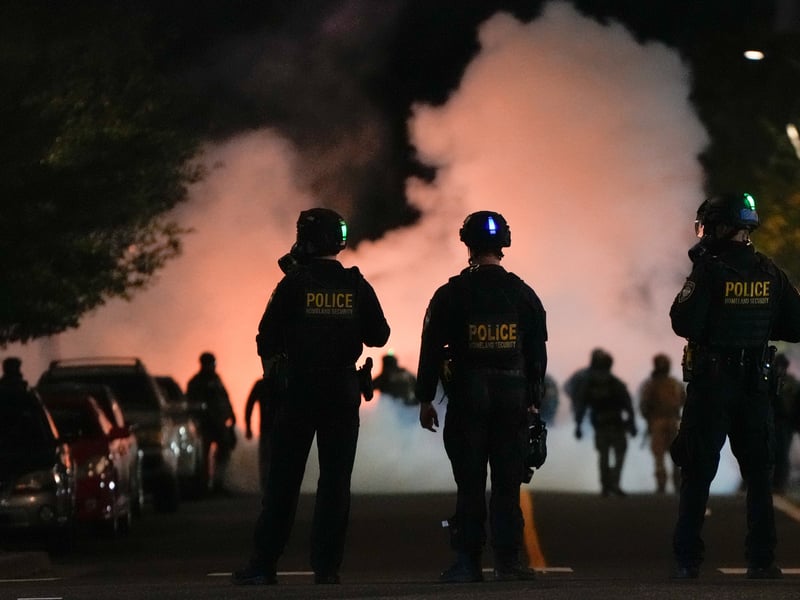
PORTLAND, Ore. (CN) — Residents of an affordable housing complex neighboring the U.S. Immigration and Customs Enforcement facility in Portland testified Friday about tear gas drifting into their homes during protests in their bid to have a federal judge block the agents from using chemical munitions on the crowds.
Some have worn gas masks to bed, others slept in the closet or bathroom to avoid the chemicals and several have said they made repeated visits to the doctor to deal with new or worsening medical conditions.
“Our federal government is knowingly putting them through hell, for no good reason at all,” said Daniel Jacobson, attorney representing the neighbors. “They are not going to stop on their own; only the courts can stop them.”
Nine residents at Gray’s Landing, a low-income apartment building that sits diagonally across the street from the ICE facility in southwest Portland, joined forces with the apartment’s management companies and sued the federal government over the chemical deployment in December.
The residents accuse the defendants, which include ICE and the Department of Homeland Security, of deploying chemical munitions at crowds of protesters without any consideration of the impact on the nearby apartment complex. They say the emissions waft into the residents’ homes, affecting their health for days or weeks following the sprays.
However, the federal government argued that the officers are entitled to use the measures to keep the protest controlled.
“There is no substantive due process right to be free from the effects of lawfully deployed crowd control measures,” argued Samuel Holt with the Justice Department.
The residents also accused the government of artificially stoking tensions at the ICE facility and deploying chemical agents to support President Donald Trump’s thwarted attempt to send in the National Guard. The federal government argued that the crowd control tactic “does not even come close to shocking the conscience.”
The residents are asking U.S. District Judge Amy Baggio, a Joe Biden appointee, to block the Department of Homeland Security from deploying tear gas and other chemical munitions in the area unless there is a genuine threat.
Testimony from the residents of Gray’s Landing described the physical impacts the gas had: difficulty breathing, dizziness, coughing and rashes.
Diana Moreno, a plaintiff resident of Gray’s Landing, told the court that frequent tear gas emissions have exacerbated her medical conditions and raised her stress level.
“When you’re sitting in your own home and there’s no airflow, it’s hard to breathe when there’s tear gas,” Moreno said.
Similarly, Diana Del Nigro told the court that both she and her 12-year-old son have made recurring visits to the doctor since they started being exposed to tear gas. She’s watched as the officers have countered the protesters over the last eight months of ongoing protests.
“Usually they come out in formation and release tear gas no matter what,” Del Nigro said.
A plaintiff using a pseudonym due to her status as a domestic violence survivor said the gas exposure triggered her PTSD, caused heart palpitations and forced her to start sleeping with a gas mask.
“I could feel it, I could see it, I could taste it, I could smell it,” she said about the gas inside her apartment. She started filming the activity from the building’s courtyard to document.
Mindy King, another Gray’s Landing plaintiff and resident of 10 years with her two children, likewise told the court she had been filming the activity across the street.
“There never seemed to be a rhyme or reason, never seemed to be based on crowd size or activity from protesters,” King said.
The federal government’s defense largely focused on demonstrating that none of the residents are law enforcement officers trained in chemical munition deployment, and that none of them are aware of what is happening on the front lines of the protest. Nor had any of them submitted their medical records to the court, Justice Department attorneys noted.
The residents also called a toxicologist, who testified that the impact of tear gas should not be underestimated.
“Based on what I reviewed, ostensibly the harms that have befallen the plaintiffs were the result of tear gas exposure and are likely to continue if tear gas continues to be released in the area around Gray’s Landing,” said Rama B. Rao, chief of medical toxicology at Weill Cornell. “The more exposure the more problems.”
Baggio peppered the federal defendants with questions about their evidence at the end of the long hearing, questioning which officers exactly are on the scene at the ICE facility and what use-of-force policies each follows. Questions that the Justice Department attorneys did not have many answers to offer.
Oral argument on the preliminary injunction motion will be held on Wednesday.
The evidentiary hearing comes on the heels of a temporary restraining order issued in a separate lawsuit earlier this month blocking federal agents from using chemical or projectile munitions outside the ICE facility unless there was a threat of physical harm.
Subscribe to our free newsletters
Our weekly newsletter Closing Arguments offers the latest about ongoing trials, major litigation and rulings in courthouses around the U.S. and the world, while the monthly Under the Lights dishes the legal dirt from Hollywood, sports, Big Tech and the arts.