
 Search Articles


(CN) — The Nebraska Supreme Court on Wednesday upheld as constitutional a law that restores convicted felons’ voting rights as soon as they complete their sentences and ordered state officials to implement it immediately.
In a split decision the state’s top court rejected the Nebraska attorney general’s position that under the state’s constitution only the Board of Pardons, not the Legislature, has the authority to restore a felon’s voting rights.
“The respondents have failed to clearly show that either the constitutional text, or the history of voter reenfranchisement laws in Nebraska, supports their assertion that the phrase ‘unless restored to civil rights’ was intended by the framers to refer only to reenfranchisement by executive pardon,” Justice Stephanie Stacy wrote in a concurring opinion.
“And without such a showing,” she continued, “they cannot clearly establish that ’the constitution makes executive clemency the exclusive vehicle to re-enfranchise felons,’ or that the reenfranchisement provisions in L.B. 20 have the effect of ’exercising a power assigned by the constitution to the Board of Pardons.'”
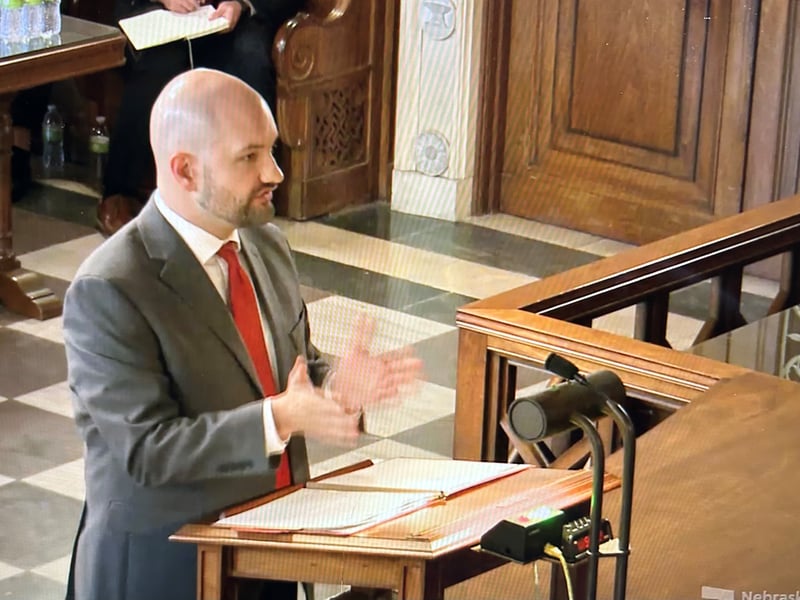
Nebraska Solicitor General Eric Hamilton, at an Aug. 28 hearing before the court, defended Nebraska Secretary of State Robert Evnen’s July 17 instruction to local election officials to stop registering voters with past felony convictions.
Evnen’s directive was prompted by an opinion issued by Nebraska Attorney General Mike Hilgers, also on July 17, two days before Legislative Bill 20 was set to take effect.
The bill eliminated the waiting period previously required for people with felony convictions under the terms of LB 53, which was enacted in 2005 and allowed Nebraskans to vote two years after completing a criminal sentence.
In his 18-page opinion, Hilgers deemed the new voting rights law — passed by the Cornhusker State’s unicameral Legislature in April and which allowed people convicted of felonies to regain their voting rights immediately after completing the terms of their sentence, including probation and parole — unconstitutional.
The state attorney general said only the Nebraska Board of Pardons had sole authority to restore voting rights to people convicted of felonies and said restoration of that right is “an act of grace that undoes a legal consequence of a crime.”
The Board of Pardons is made up of three members: Hilgers, Evnen and Nebraska Governor Jim Pillen.
“We appreciate the Supreme Court’s consideration of this important issue and are grateful that the court provided clarity before the election,” Hilgers said in a statement Wednesday.
Attorneys with the American Civil Liberties Union, ACLU of Nebraska and Faegre Drinker litigated the case on behalf of Nebraskans seeking access to the ballot and Civic Nebraska, a nonpartisan, nonprofit organization.
“This is justice," said Jane Seu, legal and policy counsel at the ACLU of Nebraska. “Given the sheer scale of disenfranchisement that this decision corrects, there is no question that it will be remembered as one of our state’s most consequential voting rights decisions.”
Of the seven-judge panel, four concurred; one concurred in part and dissented in part; and two dissented.
One of the dissenters, Justice John Freudenberg, wrote: “The majority positions dangerously allow the Legislature to amend the Nebraska Constitution by legislative act without requiring it to follow the constitutional amendment process. This abuse should not be condoned, let alone sanctioned, by this court.”
Eligible Nebraskans with past felony convictions who have not yet registered must do so ahead of quickly approaching deadlines, the ACLU of Nebraska said Wednesday. Online registration is available through Oct. 18. The last day to register in person is Oct. 25.
 Follow @edpettersson
Subscribe to our free newsletters
Our weekly newsletter Closing Arguments offers the latest about ongoing trials, major litigation and rulings in courthouses around the U.S. and the world, while the monthly Under the Lights dishes the legal dirt from Hollywood, sports, Big Tech and the arts.