
 Search Articles


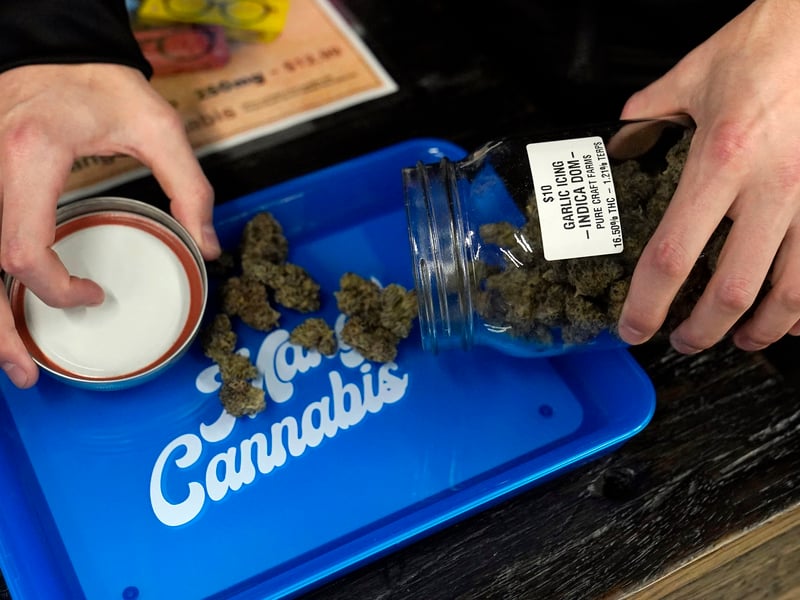
LINCOLN, Neb. (CN) — A judge in Nebraska sided with medical marijuana supporters in a case in which opponents tried to get supporters’ ballot initiatives overturned due to claims of signature fraud by petition circulators.
Lancaster County District Court Judge Susan I. Strong said in an opinion Tuesday that medical marijuana opponents lacked evidence that the number of problematic petition signatures would have affected the outcome of the successful petition drive. Nebraska voters approved medical marijuana on Nov. 5.
One of the initiatives, Initiative Measure 437, was approved by 71% of voters. The other, Initiative Measure 438, was approved by 67%.
“If there was a pervasive practice of notarizing petitions outside of the circulators’ presence, then the court would expect the evidence to be more pervasive,” Strong wrote in her 57-page opinion.
The ruling has long been expected to be appealed, no matter what Strong decided. If it stands, it clears the way for legal medical marijuana sales in the Cornhusker State.
Former Nebraska State Senator John Kuehn filed the lawsuit Sept. 12, naming Nebraska Secretary of State Robert B. Evnen and three key figures in the Nebraska medical marijuana effort.
Kuehn wished to review the petitions, citing the arrest of one medical marijuana petition circulator in Hall County, in east-central Nebraska. Kuehn said Evnen did not produce signature pages of the petitions for two medical cannabis ballot measures that had qualified for the November ballot.
Although Evnen was named as a defendant on the open records claims involved in the suit, his office also later filed a cross-claim against the other defendants seeking a declaratory judgment declaring the number of valid signatures in support of the petition, an injunction to remove any signatures found to be legally insufficient, and an order declaring the initiatives void after the election if an insufficient number of signatures are declared valid.
Strong dismissed both Kuehn’s complaint and the secretary of state’s cross-claim.
“We appreciate the Court’s time and thoughtful consideration in deciding this matter. We are reviewing the decision and considering next steps,” said Suzanne Gage, a spokesperson for the Nebraska Attorney General’s Office, in a text message Tuesday night.
Strong’s decision followed a trial on the matter earlier this month, where medical marijuana opponents targeted text messages by defendant Crista Eggers, the campaign manager for Nebraskans for Medical Marijuana, which they claimed showed Eggers was willing to push the limits of the law to get ballot signatures, They also highlighted the arrested petition circulator, who had admitted to using a phone book to add signatures to petitions.
In her ruling, Strong allowed that plaintiffs had shown some signatures were indeed signed outside the presence of petition circulators.
“But this evidence should be put in context. For example, Crista Eggers and Garrett Connely — the campaign’s number one and number two — exchanged thousands and thousands of text messages. Just their messages between March 14 and July 3, 2024, fill more than 800 pages,” the judge wrote. “Yet out of these thousands of messages, only one refers to notarizing petitions outside of the circulator’s presence.”
And the number of signatures deemed invalid was insufficient to throw off the results of the medical marijuana measure petitions, Strong wrote, finding fewer than 711 signatures for one of the measures and 826 of the other lost their presumption of validity. When Evnen certified the results he said they exceeded the minimum signature requirements by more than 3,000 signatures.
“The plaintiff and the secretary are well short,” Strong wrote.
“In a record of this size, it is likely, perhaps inevitable, that the Court has made some mathematical errors. It is also possible that the Court missed a few petitions that should lose their presumption of validity under the court’s reasoning,” she added. “So it is important to state that this Court’s judgment does not turn on the inclusion or exclusion of a few petitions. In fact, even if the signatures on all the petitions identified in Exhibits 168 and 170 lost their presumption of validity, the plaintiff and the secretary would still fall short.”
 Follow @nelson_aj
Subscribe to our free newsletters
Our weekly newsletter Closing Arguments offers the latest about ongoing trials, major litigation and rulings in courthouses around the U.S. and the world, while the monthly Under the Lights dishes the legal dirt from Hollywood, sports, Big Tech and the arts.