
 Search Articles


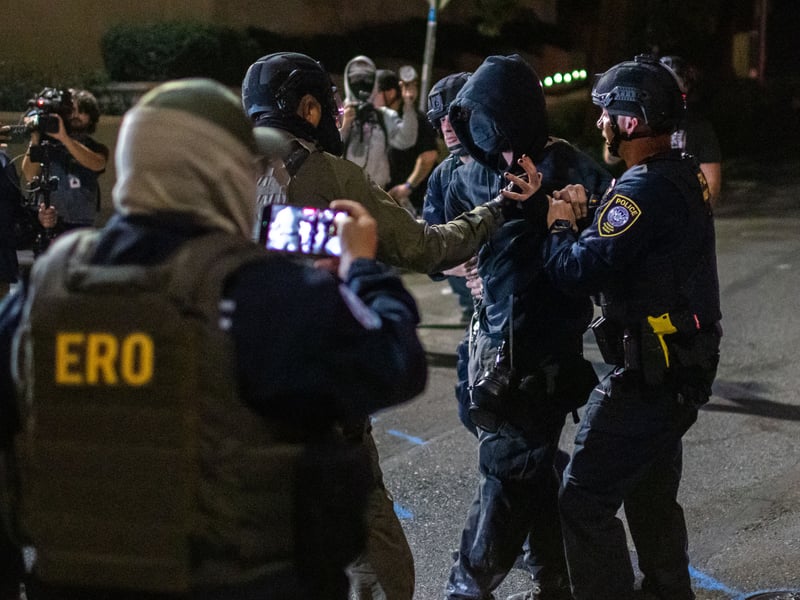
PORTLAND, Ore. (CN) — Federalized National Guard troops may not deploy to protect “war ravaged” Portland and its Immigration and Customs Enforcement facility, U.S. District Judge Karin Immergut ruled on Sunday.
In a 16-page order, the Donald Trump-appointed judge issued a preliminary injunction barring the federal government from deploying any troops until 5 p.m. on Friday, the deadline she set for issuing her final opinion on the merits.
The decision comes just two days after the conclusion of a combined trial and preliminary injunction hearing.
Oregon Attorney General Dan Rayfield celebrated Immergut’s ruling, calling it a step toward truth and accountability.
“From the beginning, this case has been about making sure the facts — not the president’s political whims — guide how the law is applied,” Rayfield said in a statement. “We’re grateful the court is taking the time to get it right, and we’ll keep doing everything we can to protect Oregon’s ability to govern itself and keep our communities safe.”
In late September, Trump called for the deployment of the National Guard to the ICE facility, which has been the site of ongoing protests since June. Portland and Oregon immediately sued Trump and his administration to block the deployment.
Throughout the three-day trial, which concluded on Friday, the federal government painted a sharply opposing picture of the situation at the ICE facility than Portland and Oregon did.
The city and state have characterized the protests at the ICE facility, which are often attended by protesters in inflatable costumes, as largely mild. However, the Trump administration described anarchy and rebellion against federal officers.
“Are protests in Portland so violent it justifies the National Guard?” Portland City Attorney Caroline Turco asked during opening statements on Wednesday. “Plaintiffs submit the answer is no.”
But the government argued that the National Guard would calm the protests and relieve the strain on law enforcement.
Title 10, Section 12406 of the U.S. Code allows federal use of state National Guard troops when the president is unable to execute the laws of the United States with regular forces or during a “danger of rebellion.”
“The court and the president don’t have to find there’s actually a rebellion, there just has to be a danger of a rebellion,” Justice Department Attorney Eric Hamilton said during closing arguments on Friday.
On Oct. 4, Immergut issued a temporary restraining order blocking the federalization and deployment of the Oregon National Guard.
In disclosures before Immergut on Wednesday and Thursday, Justice Department attorneys admitted that Oregon National Guard troops had been deployed to the ICE facility the morning of Oct. 4 and had remained on site for an unknown number of hours after Immergut issued that order.
After Immergut issued that temporary restraining order, the Trump administration announced it would send federalized National Guard troops from both Texas and California. On Oct. 5, Immergut issued a second temporary restraining order blocking the deployment of any National Guard troops to Oregon.
The federal government appealed the first of Immergut’s two orders to the Ninth Circuit Court of Appeals, and a split three-member panel ruled in favor of Trump on Oct. 20. The majority of the panel, two judges appointed by Trump during his first term, found that the president likely “lawfully exercised his statutory authority” by authorizing federal military intervention.
The third judge on the panel, a Bill Clinton appointee, issued a strong dissent to the majority opinion and urged the appeals court to “act swiftly to vacate the majority’s order before the illegal deployment of troops under false pretenses can occur.”
The order effectively cleared the way for the deployment of the National Guard, but a Ninth Circuit judge quickly called for a vote on whether to rehear the case en banc. Deployment stalled as Immergut’s second restraining order remained in effect — though the Ninth Circuit panel majority noted the two orders “rise or fall together.”
On Oct. 24, the Ninth Circuit paused the order clearing the way for deployment until a vote could be taken to rehear the appeal en banc. On Tuesday evening, the day before the trial began in the lower court, the appeals court announced it would rehear the case en banc.
Subscribe to our free newsletters
Our weekly newsletter Closing Arguments offers the latest about ongoing trials, major litigation and rulings in courthouses around the U.S. and the world, while the monthly Under the Lights dishes the legal dirt from Hollywood, sports, Big Tech and the arts.