
 Search Articles


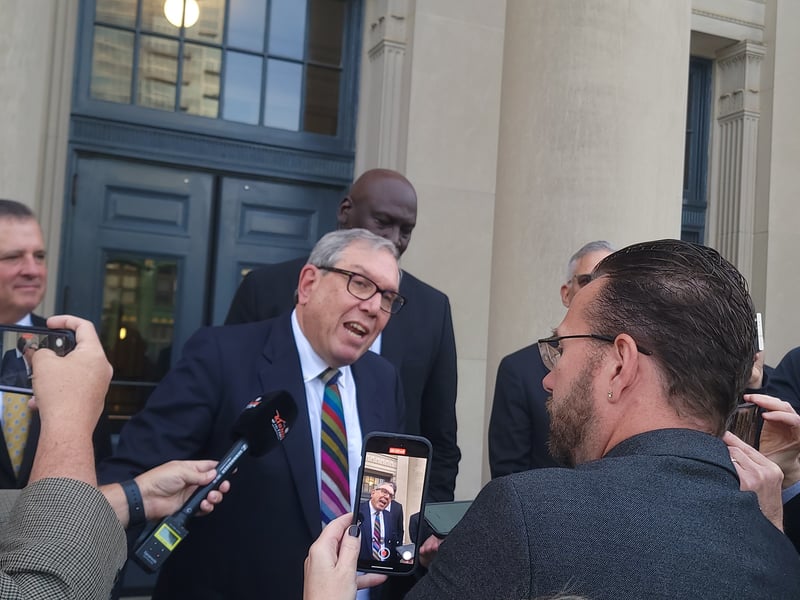
CHARLOTTE, N.C. (CN) — NASCAR’s countersuit against teams targeting the racing organization for antitrust violations will go on, a federal judge ordered Monday.
Front Row Motorsports and 23XI Racing — partially owned by basketball legend Michael Jordan — were countersued by NASCAR in March after they sued over anticompetitive and monopolist practices. They appeared before U.S. District Judge Kenneth Bell last Tuesday, arguing to dismiss the new suit and saying that the move is retaliatory and an attempt to intimidate them and other teams.
In his order, Bell said that the teams’ challenges to the counterclaim are best addressed once there is a more developed factual record, bringing up the potential for summary judgment in the case.
NASCAR satisfied the “(relatively) low bar” of making a plausible claim, Bell said, and sufficiently showed a relevant market and market power to allow its claims to proceed.
In its counterclaims, NASCAR said that the two teams, including 23XI owner and sports agent Curtis Polk, colluded to drive contract negotiations in favor of all of the racing teams, which it says are horizontal competitors that cannot work together for better terms. The teams pressured the sports league for more favorable terms and to boycott, NASCAR said.
The teams stuck to a collectively agreed-upon plan, it said, even when they had individual negotiations with NASCAR and acted as a unified body to seek permanent charters and more fixed revenue. This behavior violates the Sherman Act, NASCAR said, the same antitrust legislation that the teams sued the racing company over.
In court last Tuesday, attorney Lawrence Buterman for NASCAR argued that group negotiations harmed performance-based competition and the incentive for open cars — cars that have to qualify for each Cup Series race — to race. NASCAR was forced into agreements more favorable to the teams because of the group organizing, Buterman said.
NASCAR only sued Polk, Front Row Motorsports and 23XI Racing in its countersuit, not the other teams who participated in collective negotiations. NASCAR has the ability to choose who it files suit against, and doesn’t have a dispute with the teams who signed a contract with it, Buterman said. Attorneys for non-party teams in the Race Team Alliance were present.
Jeffrey Kessler, counsel for Front Row Motorsports and 23XI Racing, argued that participating in group negotiation is not a violation of the Sherman Act. NASCAR failed to claim any anticompetitive effects to the industry or other parties stemming from the teams’ behavior, barring a less profitable contract for itself, the teams said.
Because the “rules need to be the same for all participants,” teams all race under the same terms in the charter agreements, contracts that include guaranteed race entry and a cut of broadcasting profits. 23XI and Front Row have argued that participating without these agreements, as “open” teams, is not sustainable or profitable.
While dismissing their request, Bell echoed several of the teams’ claims, noting that while NASCAR’s counterclaims met the threshold to survive this initial challenge, a decision will still need to be reached over the merits of NASCAR’s case.
“NASCAR and each Charter holder needed to reach the same agreement in all the Charters on many issues, whether or not NASCAR negotiated the Charters individually or collectively,” said Bell, a Donald Trump appointee. “Therefore, it would (or at least could) be more efficient and procompetitive for the teams and NASCAR to engage in joint negotiations when they all would be affected by the resulting single ‘standard’ agreement.”
The joint negotiations were not “inherently ‘pernicious,’ lacking ‘any redeeming virtue,’ or ‘always or almost always tend[ing] to restrict competition,’” Bell said.
NASCAR’s claim that Front Row and 23XI’s behavior be perceived as a “per se” — or self-evident — antitrust violation is “not appropriate,” Bell said, especially seeing as NASCAR maintains sole control over Cup Series racing.
“Judge Bell’s decision today is encouraging even though we are disappointed that he did not dismiss NASCAR’s meritless, retaliatory counterclaim,” Kessler said in a statement to Courthouse News. “The judge’s recognition of many of our arguments, including the efficiency and necessity of joint negotiations and lack of credible evidence, reinforces our confidence that we will prevail in summary judgment. This counterclaim is a tactic by NASCAR to divide and distract.”
Bell also dismissed the teams’ request to strike NASCAR’s petition to eliminate a section from the 2025 Charter Agreement concerning guaranteed entry of chartered teams in all Cup Series races. NASCAR represented at the hearing that it no longer sought this result, following the Fourth Circuit’s order denouncing the court’s decision to force NASCAR’s hand contractually, so Bell dismissed the request as moot.
The case, which is scheduled for trial in December, also has a pending appeal before the Fourth Circuit.
On Friday, the teams appealed a Fourth Circuit order finding a lower court did not act appropriately in requiring NASCAR to sign a racing contract that granted the teams more favorable terms. 23XI Racing and Front Row asked that the entire circuit reconsider the case, claiming that the precedent would allow any monopolist to maintain its power by barring participants from a market unless they agree to sign an anti-litigation agreement first.
The teams first sued NASCAR and CEO James France in October 2024, claiming that the car racing company holds a monopoly on the stock car industry, has purchased its closest competitor and owns the bulk of the high-quality racing tracks. The company’s control over the industry prevents the teams from signing more competitive contracts, they claim, and NASCAR presented them with a racing contract that would force them to forfeit any legal claims against the company if they wanted to race as chartered teams in the 2025 season. The teams ultimately raced as chartered teams in 2025, with guaranteed race entry and a cut of broadcasting profits, after the court required NASCAR to offer the contract without the litigation release clause.
Representatives for NASCAR did not reply to a request for comment.
 Follow @SKHaulenbeek
 Follow @shaulenbeek.bsky.social
Subscribe to our free newsletters
Our weekly newsletter Closing Arguments offers the latest about ongoing trials, major litigation and rulings in courthouses around the U.S. and the world, while the monthly Under the Lights dishes the legal dirt from Hollywood, sports, Big Tech and the arts.