
 Search Articles


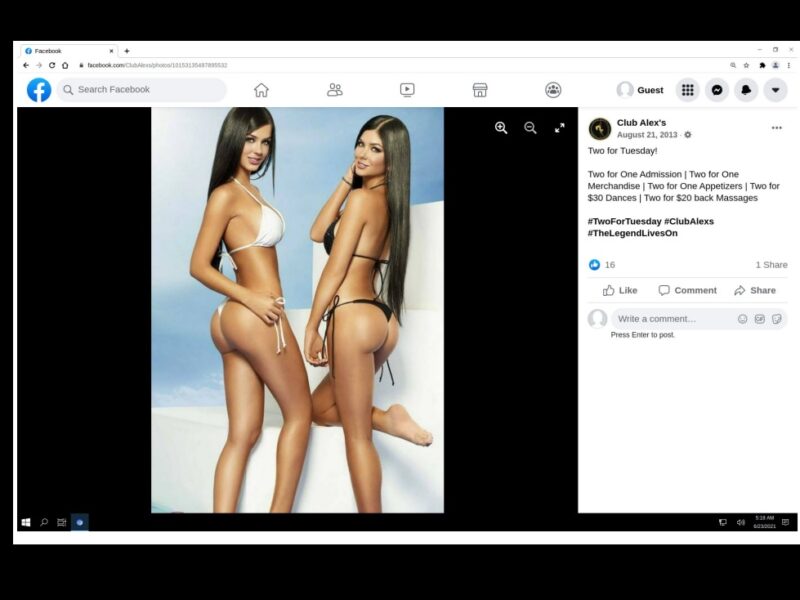
BOSTON (CN) — In a case with far-reaching implications for how people can protect their online identities, the First Circuit appeared divided Thursday about whether a strip club that professional models claim copied their photos and used them without permission in its Facebook ads should get off the hook because the models didn’t realize what was happening fast enough.
The plaintiffs — six professional models, actresses and social media influencers — claimed Club Alex’s Adult Entertainment in the Boston suburb of Stoughton manipulated their images on social media to imply that they were dancers there.
The images started appearing in 2013, but the models say they didn’t discover the misuse until 2021, well past the three-year statute of limitations. A lower court threw the case out, but the models say that’s unfair because they shouldn’t be legally required to constantly search thousands of websites to make sure their rights aren’t being violated.
The difficulty of uncovering misappropriated images is staggering: Even back in 2013, Facebook had more than a billion users and averaged more than 350 million image uploads every day. And while Facebook had a “facial recognition” program, the models say, it was designed to search one’s own image uploads and suggest tagging friends, not to search for random offending advertisements across the entirety of Facebook.
Some of the models had gone so far as to hire a law firm that assigned a paralegal to actively search for misuse, resulting in their bringing hundreds of similar lawsuits. But the paralegal stated there are roughly 74,000 adult clubs in the U.S., and the only way to determine if they’re misusing images is to painstakingly go through all of their posts individually.
This argument appealed to U.S. Circuit Judge Julie Rikelman. “Why shouldn’t they prevail?” she asked at oral argument. “If you don’t know that Club Alex is one of the 74,000, you have a needle-in-a-haystack problem. How would they have known to look at Club Alex site? You can’t go through 74,000 sites.”
“The question isn’t whether it was hard; the question is whether something prevented them from finding it,” answered Club Alex’s lawyer, Jessica Savino of Morrison Mahoney in Boston.
“But if not searchable, that prevents them from finding it,” Rikelman, a Joe Biden appointee, responded.
Savino said the lower court relied on the fact that the Club Alex page was publicly available, widely accessed and never concealed.
U.S. Circuit Judge Kermit Lipez said there was “evidence of a very small number of ‘likes,’” suggesting that there wasn’t broad awareness of the ads.
“But doesn’t show how many people saw them,” Savino replied.
“Isn’t it significant that plaintiffs had no connection at all with club that posted these?” Lipez, a Bill Clinton appointee, continued. “There was no nexus. Doesn’t that go to whether they should have known?”
Savino answered that “if a newspaper is published in New York and I’m in Massachusetts, that doesn’t make it unknowable.”
But while Rikelman and Lipez appeared sympathetic to the models on how difficult it is to identify misuse, Chief U.S. Circuit Judge David Barron fixated on the fact that there was nothing in the record showing when the models in fact learned about it, which he thought was necessary to establish that they acted within three years. The models said they received so many notifications from their lawyers about offending uses that they couldn’t remember exactly when they were told about Club Alex.
“You’re saying your clients knew, but you’re not going to tell us when,” Barron, a Barack Obama appointee, told the plaintiffs’ lawyer, John Golaszewski of the Casas Law Firm in San Diego. “Why isn’t that a red flag?”
This led to a number of sharp exchanges between the lawyers and the judges over who had the burden of proof under Massachusetts law.
Lipez said the trial judge spent a lot of time analyzing when the models should have known about the misuse, which wouldn’t have made sense if the case could have been thrown out on a much simpler basis.
But the trial judge might not have understood “the import of this point,” Barron replied.
Barron seemed to favor rejecting the case simply because of the faulty record, but since neither of the other two judges on the panel appeared receptive to this idea, he floated the possibility of sending the case back to the trial judge with instructions to specifically address the issue.
Subscribe to our free newsletters
Our weekly newsletter Closing Arguments offers the latest about ongoing trials, major litigation and rulings in courthouses around the U.S. and the world, while the monthly Under the Lights dishes the legal dirt from Hollywood, sports, Big Tech and the arts.