
 Search Articles


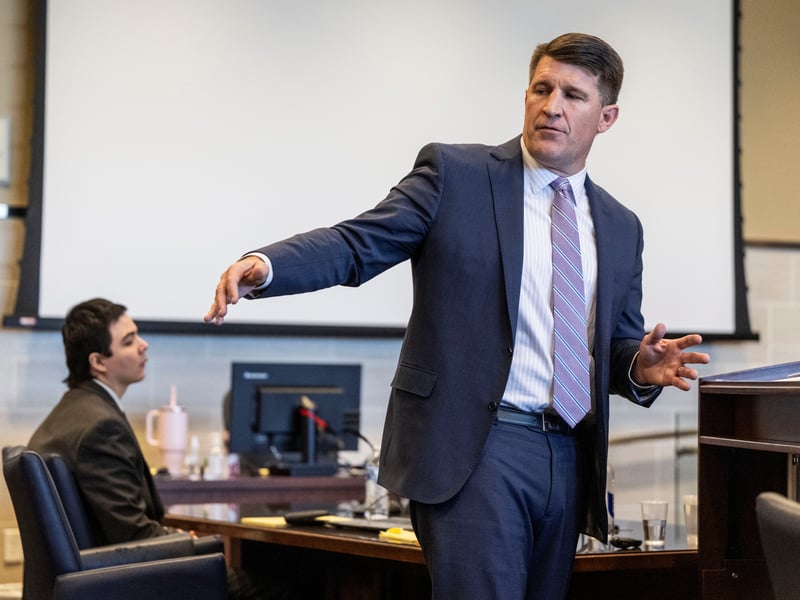
WOODLAND, Calif. (CN) — A prosecutor on Monday re-created the movements he said a former California university student took when fatally stabbing two people and injuring a third in spring 2023.
Cellphone data, surveillance video and eyewitnesses provided a roadmap for the path taken by Carlos Dominguez, who faces two counts of murder and an attempted murder count. Standing before jurors on the first day of trial, Deputy District Attorney Frits Van Der Hoek walked through key points in his case — the online purchase of a 9-inch knife, the evidence found at the stabbing scenes and finally Dominguez’s arrest in early May 2023.
Authorities accuse Dominguez of fatally stabbing David Henry Breaux, 50, and Karim Abou Najm, 20. He’s also accused of stabbing an unhoused woman, who survived the attack.
“Everyone was borderline panicking,” Van Der Hoek said of Davis, California, a college town some 15 miles west of Sacramento. “People were scared to go out at night. People were scared to go to parks.”
Dominguez’s attorney, Supervising Deputy Public Defender Dan Hutchinson, told jurors there’s no dispute over the person who committed the stabbings. What they must determine is his mental state.
Medical experts have diagnosed Dominguez with schizophrenia. Given court-ordered anti-psychotic medication, Dominguez spent some time in a state hospital to get his competency restored.
Dominguez has pleaded not guilty by reason of insanity. His trial is expected to take over two months. If jurors convict him, they will then start a second trial to determine whether he was legally insane at the time.
Van Der Hoek in his opening statement listed a series of events to show that Dominguez’s actions were willful, deliberate and premeditated.
In December 2022, Dominguez bought a knife online as he struggled with school, had recently lost his girlfriend and had no job while facing rent payments. Four months later, police would find the sheath to that knife at the scene of the first slaying, the prosecutor said.
“This is not just a quick event,” Van Der Hoek added. “This is 31 quick stabs.
“As far as crime scenes go, there is very little evidence,” he said moments later, pointing to the knife sheath as the lone example. “And it was left behind by Mr. Dominguez.”
Dominguez’s phone kept geolocation information, which police used to determine his movements in late April and early May 2023. That data shows Dominguez was in the area of two parks around the time Breaux and Njam died in them.
At times, Dominguez would turn off his phone, stopping any record of geolocation. At other times, its battery would die, leading to the same result.
Surveillance video and eyewitnesses helped fill in the gaps. A doctor heard someone screaming for help a few nights after Breaux’s death, finding the man stabbed many times in a nearby park. The doctor saw a man Van Der Hoek identified as Dominguez. Authorities later found a bicycle taken by the assailant and linked DNA on a water bottle to Dominguez, the prosecutor said.
“It shows that Carlos Reales Dominguez is the person who kills Karim,” Van Der Hoek said.
Two nights later, Dominguez stabbed the unhoused woman as she sat inside her tent, he added. Dominguez didn’t have his cell phone this night, but surveillance footage shows him moving toward the homeless encampment and away from it.
By early May, police were responding to many suspect sightings. One of them led to Dominguez, who was found with the knife. He gave a false name, date of birth and address, but officers arrested him anyway as he matched the suspect description and had cuts on his hands. Authorities later found DNA on the knife linked to Najm and the unhoused woman, Van Der Hoek said.
Hutchinson, Dominguez’s attorney, focused on his client’s mental state at the time of the slayings. An athletic, scholarly and habitually hygienic young man devolved into someone who dropped to barely 100 pounds, failed out of college and stopped showering.
“Slowing of movements, maintaining rigid postures for long period of time,” Hutchinson said of some symptoms of schizophrenia.
His client also had grown paranoid and delusional. He feared and believed supernatural shadow figures stalked him. His former girlfriend, friends and housemates, as well as his family, could see the deterioration, but Dominguez couldn’t see it in himself — also a symptom of schizophrenia, Hutchinson said.
“He did not believe in his mind that he had stabbed or killed anyone,” he added.
Hutchinson also pushed back on some statements made by Van Der Hoek. Dominguez had an old cellphone that didn’t hold a charge well. Its pattern of turning off and on lasted for months.
Additionally, after his arrest and while jailed, Dominguez asked for a laptop to continue his schoolwork. He said he needed to register for classes.
“This trial is not just about the physical acts that Mr. Reales Dominguez did, but also what was happening in his mind when he did them,” Hutchinson said.
Subscribe to our free newsletters
Our weekly newsletter Closing Arguments offers the latest about ongoing trials, major litigation and rulings in courthouses around the U.S. and the world, while the monthly Under the Lights dishes the legal dirt from Hollywood, sports, Big Tech and the arts.