Search Articles


(CN) — Heavier downpours and longer dry stretches, attributed to climate change, are likely leaving less water available for ecosystems, groundwater and public supplies even in places on the planet that are experiencing more annual rainfall.
That’s the key finding from a study published Wednesday in the journal Nature.
Since soil can only absorb so much water at once, intense bursts of rain are more likely to pool at the surface and evaporate, rather than soak into the ground, researchers say in the study.
“It doesn’t matter where you are, more consolidated rainfall means less water is available for the land. We show that this phenomenon is consistent worldwide, what physically accounts for it, and what we should expect going forward,” said Justin Mankin, the study’s senior author and an associate professor of geography at Dartmouth College.
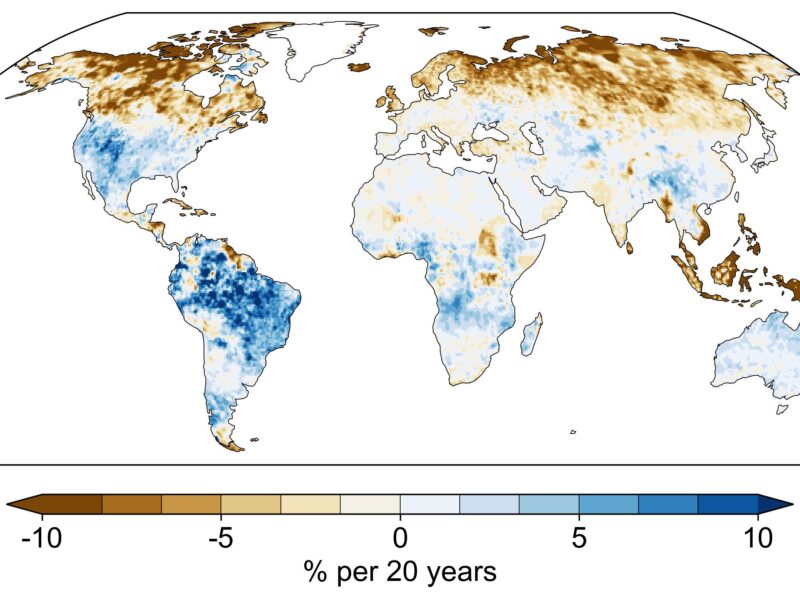
Researchers analyzed global precipitation records from 1980 to 2022 and found rainfall patterns shifting toward fewer, heavier storms in many regions, regardless of whether those areas were historically wet or dry.
In order to measure the trend, the researchers borrowed a concept more commonly used in economics, the Gini coefficient, which measures inequality.
Scientists used the tool to gauge how evenly rainfall was distributed across the year. A score closer to zero reflected precipitation spread relatively evenly over time, while a score closer to one meant most of a region’s annual rainfall fell in a very short window.
The findings suggest timing matters nearly as much as total rainfall.
“Rainfall concentration is almost as important to land wetness as how much rainfall you get in a year,” said Corey Lesk, the study’s first author all with Dartmouth, in a press release.
The trend was particularly pronounced in some regions. The western U.S. saw some of the highest levels of rainfall consolidation, with yearly precipitation in the Rocky Mountains becoming 20% more concentrated into heavier storms.
In South America’s Amazon basin, rainfall became 30% more concentrated, the largest increase researchers identified.
Not every region followed the same pattern. Northern Europe, Canada and the Arctic saw precipitation become more evenly distributed over the study period, though researchers said that likely reflects warming-driven increases in year-round rain and snow. Southeast Asia also experienced less concentrated rainfall, though the reason remains unclear.
Still, researchers say those exceptions may not last.
Climate modeling in the study suggests rainfall concentration will worsen as global temperatures rise. If warming reaches 35.6 degrees Fahrenheit above baseline levels, the researchers project abnormally dry land conditions could affect 27% of the world’s population, even if total precipitation increases.
“This is not a good effect we’ve uncovered,” Lesk said. “It really exposes the mechanics of how climate change will affect water resources for everyone.”
The findings complicate the long-standing assumption that more rainfall in a warming world automatically means more water availability.
“From a hydrology perspective, we’ve long believed that what matters is how much precipitation a place gets, less its demand by ecosystems and the atmosphere,” Mankin said.
According to researchers, how rain falls matters as much as how much falls.
“We discovered that it’s not just supply that counts, but also how it’s delivered. Rainfall concentration is essentially asking the land to drink from a firehose,” he said.
This could create difficult choices for water managers, particularly in places already grappling with drought and flood risk.
California has already faced that tension during recent drought years punctuated by atmospheric rivers, when officials had to weigh whether to release stored reservoir water to make room for incoming storms without knowing when the next rainfall might come.
Researchers say the same challenge could spread to regions that historically relied on steadier precipitation patterns.
“The acceleration of rainfall consolidation raises the imperative to conceive of ways to deal with the simultaneous flood and long-term drought risks,” Mankin said. “Places we don’t typically think of as needing reservoir storage may need it in the future.”
Subscribe to our free newsletters
Our weekly newsletter Closing Arguments offers the latest about ongoing trials, major litigation and rulings in courthouses around the U.S. and the world, while the monthly Under the Lights dishes the legal dirt from Hollywood, sports, Big Tech and the arts.