
 Search Articles


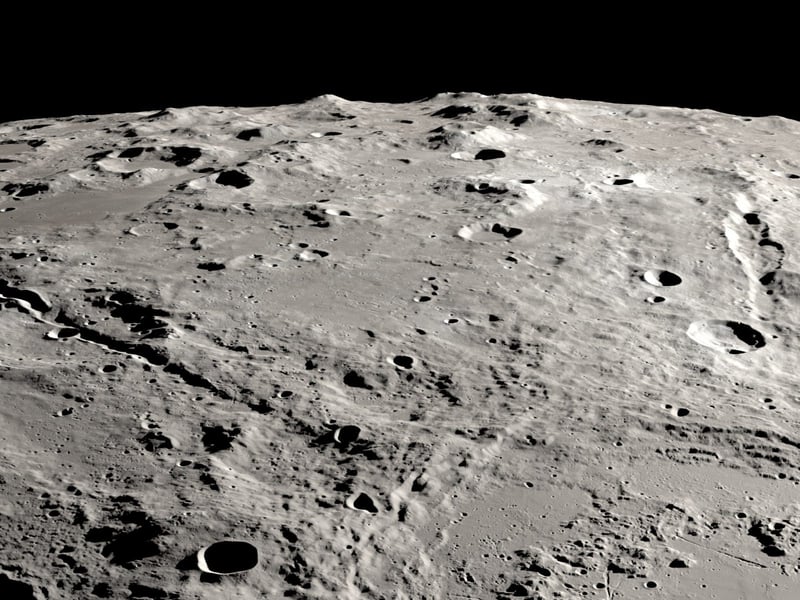
(CN) — During the moon’s impact event, streaks of rocky debris known as ejecta rays carved their way across the moon’s surface and perhaps carved a path for future lunar missions.
The result of closely spaced and radially aligned secondary impact craters, the ejecta rays excavated deep canyons that surround the Schrödinger impact basin, according to a study published Tuesday in Nature Communications.
“Early Solar System bombardment resurfaced the Earth, moon and other rocky planets,” said study author David Kring, planetary geologist with the Lunar and Planetary Institute of the Universities Space Research Association. “Thus, understanding the cadence of impact events during that period of bombardment and the magnitude and duration of that bombardment is needed to understand the earliest epoch of the Earth-moon system.”
Kring and fellow authors Danielle Kallenborn and Gareth Collins compared the size of the moon’s grand canyons to North America’s Grand Canyon. One of these canyons, Vallis Schrödinger, is about 167 miles long while the deepest portion of another called Vallis Planck is about 173 miles long.
Meanwhile, the Grand Canyon boasts a length of 277 river miles between Lees Ferry and Grand Walsh Cliffs, which includes the length of Marble Canyon. Another comparison is depth, as a transect of Vallis Planck is similar to the Grand Canyon along the Bright Angel Trail.
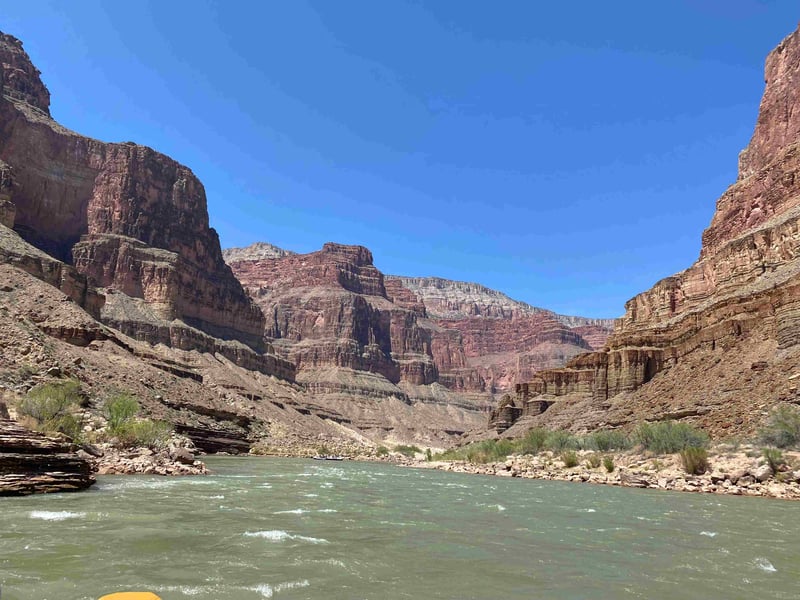
Although the exact formation of the moon’s grand canyons is unknown, the team came up with some answers.
First, the team used photographs of the moon’s surface to create maps before calculating the flow direction and speed of the debris ejected during the impact event. From there, the team hypothesized that it took less than 10 minutes for streams of impacting rocks to carve Vallis Schrödinger and Vallis Planck, whereas water took over five to six million years to carve the Grand Canyon.
The team said that the energy needed to produce the moon’s grand canyons is 1,200 to 2,000 times larger than the nuclear explosion intended to excavate a second Panama Canal, over 700 times larger than the total yield of the U.S., USSR and China’s nuclear explosion tests and about 130 times larger than energy in the global nuclear weapons inventory.
But beyond the questions surrounding the formation of the moon’s grand canyons, how the impact event distributed the debris could be useful to future lunar missions, including a robotic one scheduled for 2026.
The team’s calculations revealed the existence of a shallow trajectory impact away from the south pole. They believe this implies that the ejecta distributed in such an asymmetrical way that it coincides with a thinner and potentially absent distal ejecta blanket — or rocky debris excavated by the impactor and strewn over the surrounding landscape, per Kring via email — over the Artemis exploration zone, the first destination of Artemis astronauts.
According to the team, such a setting could allow astronauts and robotic assets to sample the South Pole-Aitken and underlying primordial crust samples without dealing with a great amount of Schrödinger impact ejecta covering landing sites.
Another potentially collectible sample is impact melt from the Schrödinger impact basin. That type of sample can help scientists test the lunar impact cataclysm hypothesis, which posits the theory of an enhanced period of impact bombardment when the Schrödinger impact basin formed, a high priority for the National Research Council according to Kring via email.
 Follow @kndrleon
Subscribe to our free newsletters
Our weekly newsletter Closing Arguments offers the latest about ongoing trials, major litigation and rulings in courthouses around the U.S. and the world, while the monthly Under the Lights dishes the legal dirt from Hollywood, sports, Big Tech and the arts.