
 Search Articles


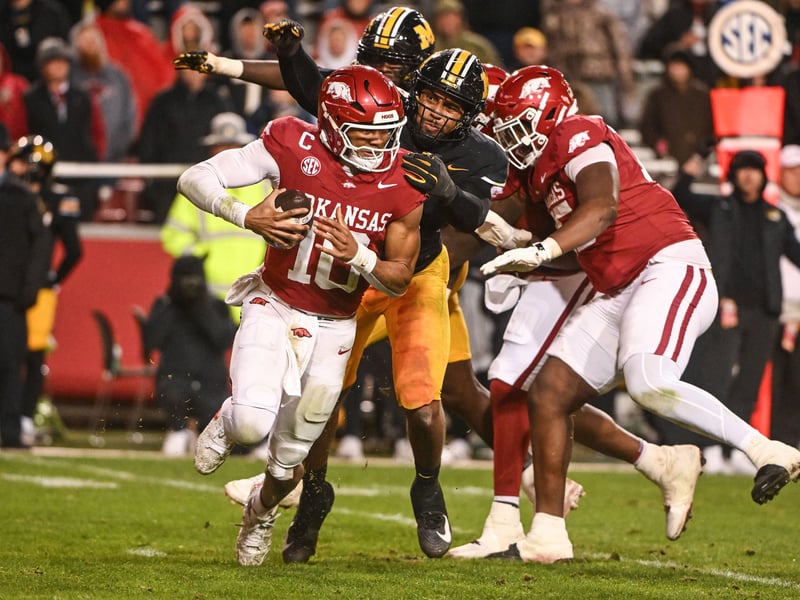
(CN) — University of Missouri pass rusher Damon Wilson II filed a countersuit against the University of Georgia Athletic Association on Tuesday, claiming Georgia engaged in a “coordinated campaign” of harassment to punish him for transferring.
“UGAA’s actions signal that it is stuck in its old ways,” Wilson says in the complaint. “The era of universities exerting total control over the career trajectories and rights of their student-athletes has been dead for nearly half a decade.”
Earlier this month, the association filed an application to compel arbitration against Wilson to receive $390,000 in damages, claiming Wilson breached a name, image and likeness agreement signed just weeks before his January 2025 transfer.
In his countersuit filed in state court Tuesday in Boone County, Missouri, Wilson details Georgia’s “strong-arm” recruitment tactic where he claims he was pressured into signing a non-binding term sheet without legal counsel present amidst preparation for the College Football Playoff.On Jan 6, 2025, just a few weeks after signing the agreement with Georgia’s Classic City Collective — which is also named as a defendant — the primary NIL arm for Georgia athletics, Wilson entered the transfer portal.
While the collective paid Wilson an initial $30,000 in December 2024, he claims he was told the agreement was a preliminary list of terms intended to lead to a full agreement that was never signed between him and the Georgia association.
The term sheet itself makes clear that it is not an enforceable contract. The term sheet states that it ‘preced[es]’ a ‘full License and Option Agreement,’" Wilson claims. “No ‘full License and Option Agreement’ was ever offered to Wilson, much less accepted by him.”
Wilson also pushed back on the school’s damages claim: “The term sheet’s ’liquidated damages’ term is a penalty provision. It makes no effort to reasonably quantify damages that are difficult to ascertain, and it serves only to penalize Wilson for his decision to enter the transfer portal,” he writes.
Wilson claims in the countersuit Georgia directly interfered with his ability to transfer, and tarnished his reputation throughout the offseason and into his 2025 football season at Missouri.
According to the Wilson, Georgia broke the confidentiality agreement outlined in the term sheet, choosing to disclose provisions of the agreement to news outlets and affiliate institutions with the intent that it would harm Wilson’s negotiations with other teams.
He says Georgia falsely told multiple college programs whom Wilson was in talks with that he would owe Georgia a $1.2 million buyout if signed, making teams believe Wilson would bring financial consequences to any program who brought him in.
Wilson is asking the court to declare that the term sheet, and its arbitration and liquidated damages terms, are not enforceable. He also brings tortious interference with contract, civil conspiracy and defamation claims against the defendants, including Matt Hibbs and Tanner Potts, both former CEOs of Classic City Collective.
The suit is the first known instance of a school seeking legal action against a player over an NIL buyout since new rules and state laws in July 2021 opened the door for collegiate athletes to earn money through endorsements, social media and business ventures.
It’s also likely the first time a player has sued a school regarding an NIL deal.
In the years since NIL was established, “collectives” — groups of alumni and boosters — have pooled funds to pay athletes for NIL activities to entice them to join their school’s athletic programs, quickly changing the way teams recruit and retain players.
With many claiming that NIL has transformed college football into the wild west, this case may shape how NIL contracts will be enforced in the future, especially after June’s $2.8 billion NCAA settlement paved the way for schools to pay athletes directly through revenue sharing.
Bogdan Susan, one of Wilson’s attorneys in the case, said recent court decisions have changed the landscape of college football and paved the way for NIL payments, but what hasn’t changed is that players still only have four years of competition to realize their potential and achieve their dreams.
“Decisions to transfer are not always about money,” Susan said. “Stopping a young man from pursuing is dreams by forcing him to pay money that he has not received is just wrong.
Wilson led Missouri’s defense with nine sacks this season, earning Second Team All-SEC honors, and is projected to go high in the 2026 NFL Draft, should he choose to declare.
Georgia is set to play Ole Miss in the College Football Quarterfinal on Jan. 1, with hopes to advance to the semi-finals, and then the National Championship in Miami.
The University of Georgia did not immediately respond to a request for comment.
Subscribe to our free newsletters
Our weekly newsletter Closing Arguments offers the latest about ongoing trials, major litigation and rulings in courthouses around the U.S. and the world, while the monthly Under the Lights dishes the legal dirt from Hollywood, sports, Big Tech and the arts.