
 Search Articles


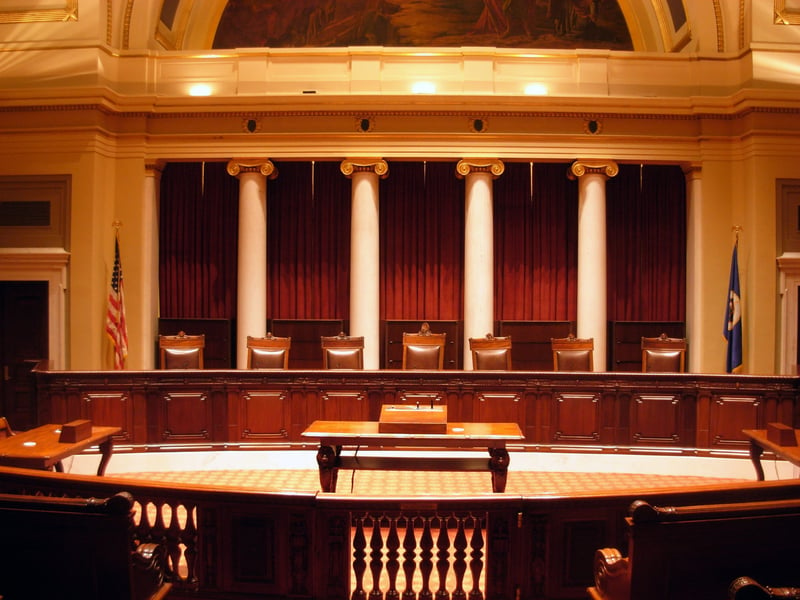
VIRGINIA, Minn. (CN) — A man convicted of the beating death of a homeless man in 2021 argued before the Minnesota Supreme Court Thursday his privacy rights were violated the rural Minnesota murder investigation because of a geofence warrant, or a search warrant that lets law enforcement find active devices in a certain geographic area.
The justices appeared reluctant both to bar law enforcement from using the technique and to allow police to cast such a wide net that it would capture private information from ordinary people.
Bringing the challenge is Ivan Contreras-Sanchez, a Minneapolis man convicted of second-degree intentional murder following a jury trial in a Minnesota state court for the murder of 39-year-old Manuel Mandujano.
Prosecutors accused him and others of kidnapping Mandujano from a Minneapolis homeless encampment and beating him to death before dumping his body in Dakota County.
Law enforcement used a geofence warrant to track cell phone location data in the area where the body of Mandujano was found, a drainage culvert in Castle Rock Township in Dakota County, in the spring of 2021.
Contresras-Sanchez appealed to the state Supreme Court after the Minnesota Court of Appeals upheld the trial judge’s decision to deny his motion to suppress evidence from that warrant and other information, including his identification, as fruit of the poisonous tree.
“Cell phone users have a reasonable expectation of privacy in their location data,” assistant public defender Jennifer Workman, who represents Contreras-Sanchez, told the court Thursday.
Law enforcement’s gathering of that data amounted to a search, Workman said.
“We are asking this court to find that geofence warrants are prohibited general warrants because they permit sweeping intrusions into private protected data without a check on law enforcement’s power,” she told the court.
Police used the warrant to get the location history of Google devices within a 65-foot-wide, 290-foot-long rectangle where Mandujano’s body was found. Google provided anonymous device data for 11 devices to law enforcement. Police then asked Google for subscriber data for one device under a new warrant. Officers determined that the device belonged to Contreras-Sanchez.
Justices at the state’s high court appeared hesitant toward Workman’s argument, suggesting people don’t have an expectation of privacy for data they are willingly giving to another party — in this case, Google.
“Why wouldn’t we want law enforcement to use this incremental process, where I think they thought about the things that you’re talking about?” Associate Justice Anne McKeig asked.
Workman pointed to the U.S. Supreme Court’s decision in Carpenter v. United States , in which the court held that there is a reasonable expectation of privacy when it comes to cell site location data. In that case, law enforcement obtained 127 days’ worth of someone’s cell phone location data, something the court ruled was unconstitutional.
“It is a logical extension to also hold that there is a reasonable expectation of privacy in your cell phone location history, as well,” Workman said, adding that they are similar technologies. She also cited the vast amount of personal information stored on cell phones as a reason to bar the practice.
However, in the warrants used to identify her client, police didn’t request data beyond location and, later, identifiable information like a name and email address associated with the specific account later found to be Contreras-Sanchez.
Workman argued that law enforcement simply found a way to get around doing old-fashioned police work, like asking a neighbor or a store employee what they saw before requesting personal data.
Assistant Hennepin County Attorney Adam Petras argued for the state, pointing out that law enforcement’s first request elicited anonymized data — so even if other people were swept up in the technological dragnet, there needed to be other factors present, like frequency and time at a location, for police to request more personal data.
He argued that, had police been more broad in their request in this case, the warrants should not have been approved or would have been thrown out at trial. “An independent magistrate would have been asked, and would have had to weigh in, about whether probable cause existed,” Petras said Thursday.
Workman called the anonymity argument by Petras a “red herring.”
“It does not provide the protection that the state would like you to think it does because the police have the ultimate power to overrun that anonymity and find out whoever is attached to that data,” she said.
The Minnesota Supreme Court will review whether geofence warrants are categorically prohibited as general warrants under the United States and/or Minnesota Constitution; if geofence warrants are not categorically prohibited, whether this one came with probable cause; and whether this warrant was properly tailored.
Subscribe to our free newsletters
Our weekly newsletter Closing Arguments offers the latest about ongoing trials, major litigation and rulings in courthouses around the U.S. and the world, while the monthly Under the Lights dishes the legal dirt from Hollywood, sports, Big Tech and the arts.